Method of improving
the technology of filigree production
A.Gudelaytis¹, L.Zhukova¹, E.Sisfontes²*
¹University of Technology and Design, Bolshaya Morskaya str. 18,
191186, Saint Petersburg, Russia
²Atelier AgAu owned by Sisfontes Design, Torsen Alms gatan 27,
12761, Hägersten, Sweden
Keywords: filigree, jewelry, additive manufacturing
In this article we
would like to show the results of the experimental work made in order to
reproduce main filigree ornaments using additive technologies. A method is
proposed for the mechanization of manufacturing technology for production of
filigree articles by developing support tools for bending of metal wire of
various types.
The
traditional method for bending the wire in filigree articles is to make them
manually in the accordance with the thumbnail form drawn on paper. Each entry
arches into the desired shape using tweezers, a pair of pliers or pliers (Fig.
1, a). When multiple repetitions of forms of decorative elements are needed it
is common to produce quite simple tools. Winding simple shapes is performed on
a mandrel, complex shape elements bent on Lazy (Fig. 1, b) [1].
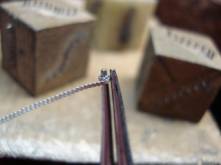
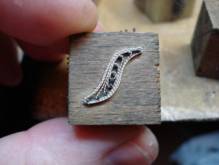
a b
Fig. 1. - The process of
bending filigree elements: a - using pliers, b - with a sloth
The disadvantage of this
method is that the elements bent manually, may not match the sketch, as well as
elements of the same shape may be different from each other. Making filigree
ornament, as a rule, is time-consuming and demands special professional skills
to produce quality results with the accuracy of bending operations while
formatting the ornament, which increases the cost of production of filigree.
It is known that for the
replication of delicate products technology of molding, electroplating and
stamping are used in the industrial production. [2] These methods allow us to
reproduce filigree products in full compliance with the sketch and
significantly reduce the time spent. However, such products have a low
aesthetic properties of filigree weave (Fig. 2, a) compared with filigree made
by hand (Fig. 2, b).
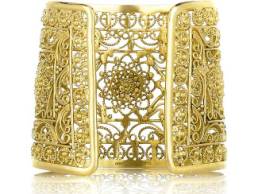
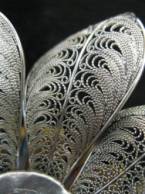
а b
Fig. 2. - Samples
of filigree items: a - produced by injection molding technology;
b - done manually
by a conventional method
Current technology trends in
filigree production are to develop new and improve existing methods of making
filigree products with high aesthetic characteristics, as well as in reducing
the time spent in the manufacture of filigree objects by partial mechanization
of the process and its subsequent automation.
To achieve this, the
experimental work on the application of additive technologies for reproduction
filigree products [3]. In carrying out the experimental work technology of
selective laser melting technology and three-dimensional color printing were
used. Filigree elements have been designed by computer simulation using a
graphics program 3d Max, which solved the main problems associated with exact
match filigree ornament sketch.
The results obtained as the
result allowed exploring the possibility of additive technologies and
identifying the key characteristics that affect the quality of reproduction
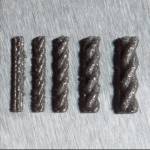
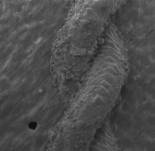
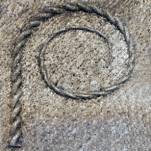
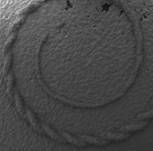
filigree products. Analysis of the results showed that the production of
jewelry with these processes is used to display the filigree products on a new
level. However, for this purpose is necessary to improve these techniques:
·
manufacture of jewelry with
the selective laser melting technology requires improved technological
capabilities of the sintering process products and reducing the roughness of
finished products (Fig. 3);

а b
Fig. 3. Fragments of
filigree-after manufacturing by selective laser melting technology: a - pattern
of weaving, b - sample cell
· production of
filigree products by color three-dimensional printing technology requires an
increase in the strength characteristics of the products obtained for use in
the jewelry industry (Fig. 4).

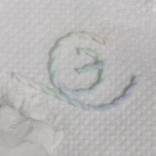

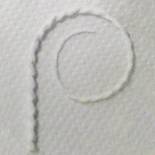
Fig. 4. - Example
of damaged and ready to sample filigree element after production on a
three-dimensional printer
The study of the limitations in the traditional method of forming a
filigree ornament and others used in the jewelry industry, ways of reproducing
of filigree as well as experimental work with additive processes have allowed
to develop recommendations for improving the process of manufacture of filigree
items. In particular, was developed special equipment, with the ability to
control the parameters of each element in the bending process to improve the
quality and reduce the bending of time spent in the manufacture of filigree
patterns (Fig. 5) [4].

Fig. 5. - Bending device
template for the formation of filigree elements and ornamental compositions
Method
for forming elements and ornamental filigree compositions using the equipment
is designed to feed the wire into the removable bending template, securing it
in the bending sequence and the template between the locking surfaces of the
template in the desired shape. The method is characterized by decrease in time
spent in the formation of filigree ornament, decorative qualities of the
expansion of filigree items and obtaining results of bending operations without
a special skill.
Bibliography:
1.
Flyorov A.V. Art processing of metals [Text] / A. Fleury. - M.,
Graduate School, 1976. - 122.;
2.
Malahovskiy, I. Scans of patterns [Text] / I. Malahovskiy / / Journal
"Science and Life" / M: 1982. - 2.;
3.
Gudelaytis, A.K. Evaluation of the possibility of application of selective
laser melting technology and three-dimensional printing in the reproduction
filigree products [Text] / A.K. Gudelaytis, L.T. Zhukova / / Journal
"Design. Materials. Technology ", / SPX: SPGUTD, 2013. - Issue. 2
(27.) - P. 54-56;
4. The
device for bending of long objects [Text] stalemate. Ros number 2013113151.
Federation: IPC B 21 F / A 44 00 C 27/00 / Gudelaytis A.K., Zhukova L.T.,
Sisfontes E. applicant and patentee of St. Petersburg State University of
Technology and Design (SPGUTD).