Shimdt V.A., Ospanov K.K., Duisen M.A
Kostanaygovernment
university named A.Baytursinov
Kostanay, Kazakhstan
DEVELOPMENT
OF NATIONAL CURRENCY OF KAZAKHSTAN
The aim
of our study - to show the development, history, change of course, as well as
the latest devaluation of the Kazakhstan tenge.
Kazakhstan Tenge - the national currency of Kazakhstan. Kazakhstan
tenge - original and important historical source . They brought us the whole
portrait gallery of historical figures, pictures of various monuments, reflected
in its drawings of mythological scenes, genre scenes. No exception and Kazakh
state money - Tenge.... The name "tenge" comes from the medieval
Turkic small silver coins "dengue" or "tanga", from which
the name of Russian coins money (polkopeyki ) and the word money. Reflection of
a range of ideas and concepts in images and inscriptions, names and dates found
on coins, material and equipment manufacturing, as an element of weight
metrology - all this makes the coin very noble material for a comprehensive
study of the economic and political history of the people, their material and
spiritual culture.
Coins are
currently used by States to perpetuate the historical events, cultural
monuments, prominent figures, to commemorate anniversaries, achievements in the
field of culture and sport. They are a kind of "representatives",
"business card" of the country and the historical era.On November 12,
1993 a decree of the President of the Republic of Kazakhstan was issued "On
the introduction of the national currency of the Republic of Kazakhstan."The
national currency was introduced on November 15, 1993. In our country, in the
national currency "T" was introduced, including in the form of metal
coins. Originally the territory of the Republic of Kazakhstan had circulation
of small coins alloy A -80 rated at 2, 5, 10, 20, 50 tiyn were subsequently
withdrawn from circulation. In addition, the coins were introduced monetary
alloy "nickel silver" in denominations of 1,3, 5, 10, 20 tenge, and
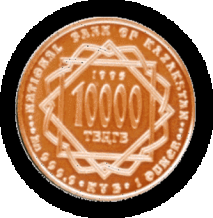
commemorative coins. In addition, in 1996, put into circulation gold bullion
coins of Kazakhstan were put into circulation "Silk Road" dignity 10000,
5000, 2500 and 1000 tenge.
Commemorative coins have solvency in accordance with the
designated denomination on them, but their main purpose is cultural and
educational development. Typically, they are manufactured strictly limited
edition and are for sale on the territory of the Republic of Kazakhstan and
abroad collectible value.The first commemorative coins in the Republic of
Kazakhstan became 5 silver coins 100 tenge, issued in honor of the 150th
anniversary of Abay - an outstanding personality in the social and cultural
life of Kazakhstan last century.During the period 1995-1998, was released six
commemorative and jubilee coins alloy "nickel silver": 20 tenge coin
in honor of the 50th anniversary of the UN commemorative coin to mark the 150th
anniversary of Zhambyl Zhabayev, coin dedicated to the 5th anniversary of
Kazakhstan's independence anniversary coin dedicated to the 100th anniversary
of Auezov coin dedicated to the Year of national consensus and the victims of
political repression, the coin is 20 tenge in honor of the presentation of
Astana as the capital of Kazakhstan.
Investment coin of Kazakhstan
"Silk Road" dignity 10000 tenge 
Among
the most significant moments of exchange and inflation level include the
following: before joining the National Bank of Kazakhstan changed Kelimbetov 6
chairmen, and Grigory Marchenko headed Office 2 times.
From January 1992 to December 1993 under the leadership of
the National Bank was Galym Baynazarova. The national currency was introduced
on November 15, 1993. At the end of its administration of the central bank rate
of tenge to the dollar was 6.31 tenge per 1 U.S. dollar. During the formation
of the first financial institutions and the transition to its own currency
sovereign Kazakhstan and the general instability of the economic situation in
the country, of course, could not affect the "fortress" tenge - from
the beginning of the introduction and the at end of 1993 tenge weakened against
the dollar on the 3973% per annum. Inflation also changed quite dramatically -
its value for the year 1993 amounted to 2165.0%. The level of Kazakhstan's GDP
at the end of 1993 amounted to $11.4 billion.
Since the end of December 1993 and January 1996, the head of
the Central Bank of the Republic was Daulet Sembaev. The process of formation
of financial and regulatory landscape of Kazakhstan kept going. During the
years of its management by the National Bank continued weakening tenge(at 447.5%
APR) and in January 10, 1996 Rates KZT/USD was 64.34 tenge per $1. Inflationary
pressures gradually weakened - in 1995 (the last full year when D.Sembaev
headed the National Bank) rate of inflation was 60.3%. By the end of 1995
Kazakhstan's GDP was $16.6 billion. In this period, Uraz Jandossov at the helm
of the central bank of the Republic (from January 1996 to February 1998)
Kazakhstan Tenge weakened against the dollar by 8.8% per annum. At the end of
February 1998 Course KZT / USD was 76.35 tenge per 1 U.S. dollar. The inflation
rate for the last year by the National Bank Management W. Dzhandosova was 11.2%.
Kazakhstan's GDP by the end of 1997 reached the level of $22.2 billion.Kadyrzhan
Damitov headed the National Bank in late February 1998 to early October 1999.
During this time tenge weakened against the U.S. dollar by 52.0% per annum and
at the beginning of October 1999 its market rate was 141.63 tenge per 1 U.S.
dollar. Inflation in 1999 was accelerated and was 17.8%. The country's GDP at
the end of the year amounted to $16.9 billion.
First coming to the National Bank of Grigory Marchenko
happened at the beginning of October 1999 - and lasted more than three years,
until the end of January 2004. During his management agency tenge first showed
a small, but strengthening - for the period tenge has appreciated against the
dollar by 0.4% per annum. Rates KZT / USD at the end of January 2004 was at the
level of KZT 139.50 per U.S. $1. Inflation also slowed down and by the end of
2003 was 6.8%. The country's GDP for 2003 was $30.8 billion. Since
the end of January 2004 to the end of January 2009 the head of the National
Bank was Anuar Saydenov . The country's economy was booming - Kazakhstan's GDP
in 2008 was $133.4 billion in construction and credit boom in the country to
bear fruit - the market prices grew fast and brewing "bubbles", the inflation
rate for 2008 was 9.5%. Nevertheless, in 2004-2008 tenge appreciated against
the dollar by 2.6% per annum, and its rate at the end of January 2009, before
the memorable simultaneous devaluation was 121.31 tenge per 1 U.S. dollar.And
then there was the devaluation of the tenge by 25%.
And with her back to the National Bank Grigory Marchenko, who
was at the head of the regulator to 1 October 2013. This period was the
financial crisis, post-crisis economic recovery, the association with the
National Bank FSA "freezing" of the project and the beginning of RFCA
pension reform in Kazakhstan. Over the years tenge weakened against the dollar
by 5.7% and its rate on October 1, 2013 was 153.86 tenge per 1 U.S. dollar.
Inflation in January - September 2013 was 6.2%. GDP in January-June 2013
amounted to $92.4 billion.
Sufficiently
controversial and important factor in the development of the national currency
is the tenge devaluation in February 2014 . Failure to maintain the exchange
rate as at the same level in Kazakhstan due to the financial situation in other
countries, as well as the internal state of the balance of payments and a plan
to restore the competitiveness of the national currency. Such explanations were
given to the National Bank of the Republic of Kazakhstan. Its decision in the
bank explained primarily the situation in the leading developing countries,
particularly in the BRICS countries. "There is a flow of capital from
developing countries to developed countries, leading to increased pressure on
the currencies of these countries. Amid the uncertainty of further development
of the world economy has increased volatility in global financial and commodity
markets".
Secondly, noted in the National Bank of Kazakhstan,
uncertainty remains regarding to the exchange rate of the Russian ruble. "As
a result of the transition of the Central Bank of the Russian Federation to the
freer exchange rate formation of the Russian ruble in 2013 weakened by 7.1%
against the U.S. dollar".The third reason - the balance of payments of Kazakhstan.
"Despite the fact that the current account is positive, an increase in
imports, mainly due to imports of consumer goods," - says the
bank.Moreover, the decision of the National Bank due to the high devaluation
expectations in the economy of Kazakhstan and gain in connection with this
speculation. "To counteract speculative frenzies and avoid excessive
exchange rate volatility forced the National Bank regularly participate in the
foreign exchange market", - said the bank.Fifth, to create basic
preconditions for reducing inflation to 3-4% in the medium term, the National
Bank of Kazakhstan plans to "move to inflation targeting, which implies a
departure from the strict regulation of the exchange rate". "The need
to restore external competitiveness of the tenge exchange rate, trade balance
of Kazakhstan's economy and remain competitive "domestic producers
requires a change in the monetary policy of the National Bank".
Thus, the National Bank of Kazakhstan has decided to abandon
from February 11 to maintain the exchange rate as at the same level. The
result, as expected , the national currency exchange rate changed from 155.5
per dollar to 185 tenge. Meanwhile, Kazakh banks are already selling the dollar
more expensive than 200 tenge. And so, out of all the above we can safely
conclude that national currency of Kazakhstan is the Kazakh tenge. Tenge is a
young currency. Kazakhstan introduced
its own money later than other countries of the former USSR. It happened on
November 12, 1993, when the President issued a decree "On the introduction
of the national currency of the Republic of Kazakhstan".
Kazakhstan sees itself as a country with a developed economy
and independent. Kazakhstan's economic development, according to some sources,
it was determined in comparison with the price of fuel and the total gross
transfers of money to offshore accounts that Kazakhstan is certainly is one of
the leading places in the world.
One Kazakhstani tenge is equivalent of 100 Kazakh tiyn that
have long gone out of cash flow and are used for banking operations. Kazakhstans
tenge is also called "wrappers", as this kind of money beckons almost everybody who sees them. This
allows the currency of Kazakhstan look stylish, bright and change shape every
year. This allows the currency of Kazakhstan look stylish,
bright change shape every year. Denomination banknotes on all registered is not
only in the Kazakh language, but also in Russian, because Russian is
transnational language of Kazakhstan.
Yet none of the
devaluation of national currency of Kazakhstan did not cause such a negative
reaction from the population of the country, such as the one that occurred in
February 11, 2014. At one point the rate of tenge against the dollar and euro
has fallen nearly 20 percent. The reason for another sharp reduction appears
tenge served morning February 11 statement of the National Bank of Kazakhstan,
the final refusal to support the exchange rate at the same level, reducing
foreign exchange interventions and interference in the formation of the exchange
rate of tenge. Kazakh government in these difficult conditions must prove the
consistency of the reforms, the decisions are taken in order to preserve the
stability of the national currency and strengthen the economic security of
Kazakhstan.
Literature
1. http://imf.org
2. ru.wikipedia.org
3. History of Kazakhstan - Authors: Abdugulova Baghlan, Kaparkyza
Kapayeva, Ayzhan Tokankyza, Kenzhebayev Gabit капезулы, 2012. p. 192-194
4. http://news.mail.ru