Sukhorukova Irina V., Doctor of Economics, Professor
of the Mathematics Department of the Russian Plekhanov University of Economics,
117997, Russian Federation, Moscow, Stremyanniy per., 36;
Mushrub
Vladimir A., Ph.D , associate
professor of the Academic Department of Mathematical Methods in Economics of
the Russian Plekhanov University of Economics, 117997, Russian Federation,
Moscow, Stremyanniy per., 36.
The Jacobson Radical and ring Endomorphisms.
Throughout this paper all
rings are associative but not necessarily contain a unity and R denotes such a ring unless indicated otherwise. Let f be an endomorphism of R. We
say that an ideal I of R
is an f-ideal if  . An ideal I of R is called invariant with
respect to f (or briefly f-invariant) if f(I)
. An ideal I of R is called invariant with
respect to f (or briefly f-invariant) if f(I)  I.
I.
In this paper we are
concerned about the question of determining the behavior of the Jacobson
radical when it is mapped by ring endomorphisms. We will find conditions that
ensure that the Jacobson radical of R is an f-ideal.
It is well known that
the abstract definition of a radical property ρ in the category of rings includes the
following axiom:
if φ:R  S is a surjective homomorphism of rings then φ(ρ(R))
  ρ(S).
ρ(S).
On the other hand, any
radical τ in the category
of right R-modules satisfies
in particular the following axiom:
if φ:M  N is a homomorphism of R-modules then φ(τ(M))
  τ(N).
τ(N).
Therefore, it seems
interesting to know under which circumstances the inclusion f(ρ(R))  ρ(R) holds true,
where f : R
ρ(R) holds true,
where f : R  R is an endomorphims of R.
This
problem cannot be solved rashly and simultaneously for various radicals by
abstract radical theory methods. For each specific radical, this problem should
be considered individually.
We can formulate only
one obvious assertion of common type:
Lemma
1. Let R be a ring and f be an
endomorphism of R with Ker f
 ρ(R) and ρ be a radical property in the category
of all associative rings.
ρ(R) and ρ be a radical property in the category
of all associative rings.
(1). If ρ is a strongly hereditary
radical (i.e. every subring of any ρ-radical ring is ρ-radical), then  (ρ(R))
  ρ(R).
ρ(R).
(2). If ρ is a strict radical (i.e. it’s
semisimple class is closed under taking subrings, see [16]), then f (ρ(R))  ρ(R).
ρ(R).
Proof.
(1). Since S = f( (ρ(R))) is
a subring of ρ(R), S is ρ-radical. But
(ρ(R))) is
a subring of ρ(R), S is ρ-radical. But  (ρ(R)) / (Ker f
  (ρ(R))) is ρ-radical, because of the isomorphism
S
(ρ(R))) is ρ-radical, because of the isomorphism
S  (ρ(R)) / (Ker f
  (ρ(R))). Then
since ρ(R) / (Ker f
(ρ(R))). Then
since ρ(R) / (Ker f  (ρ(R))) and
Ker f
(ρ(R))) and
Ker f  (ρ(R)) are
both ρ-radical,
the ideal
(ρ(R)) are
both ρ-radical,
the ideal  (ρ(R)) is ρ-radical too.
Let P = ρ(R). Then f(P) / P f(P) is ρ-semisimple as a subring of R / P
and f(P) / P
f(P) is ρ-semisimple as a subring of R / P
and f(P) / P f(P) is ρ-radical as a homomorphic images of P. Hence f(P) / P
 f(P) = 0 and f(P)
  P.
P.
Throughout the sequel,
except for Proposition 1, let R be an associative
ring and let us denote by J=Rad(R)
its Jacobson radical.
What interests us in
this work is invariance of the Jacobson radical. The question that naturally
arises is:
Question
1. On what conditions R and f does one of the
relations  ,
,  ,
,  hold true?
This problem was first
considered by A.V. Jategaoncar, who proved that the Jacobson radical of a right
Artinian ring R is invariant with respect to any
injective endmorphism of the ring R.
We call the problem
described above as the problem on invariance of classical radicals of rings
with respect to their endomorphisms. Under certain additional hypotheses on R and f, such as R is a right Kasch ring and f is an injective endomorphism,
we also give the affirmative answer to Question 1, see Theorem 1.
The authors of the
present paper have received different results concerning this problem. Some of
them are presented in Propositions 2 and Theorems 1. Proposition 1 deals with
universal algebra by the reason that it can be used not only in the associative
rings, but also for other algebraic structures such as groups, semigroups,
division rings, alternative rings.
In particular, the
following problem looks natural to state:
Question
2. Is the
Jacobson radical of SBI-ring R invariant with
respect to injective endomorphisms of R?
With certain additional
assumptions, the answer is yes. However there are many obvious counterexamples of
SBI-rings having an
injective endomorphism f such that . Some
partial affirmative answers to this question will be given in [3].
. Some
partial affirmative answers to this question will be given in [3].
Invariance of the nil
radical with respect to endomorphisms was used to determine radicals of skew
polynomial rings, their ring of fractions (see [1]), and Goldie dimension (see
[2]). The result of the research could be an effective technique for investigating
structure of skew polynomial rings, Cohn-Jordan extensions of rings, skew group
rings and skew semigroup rings.
Research carried out at
Plehanov Russian University of Economics.
Here is a piece of
notations: a set of non-negative integers is denoted by  , the right
and left annihilators of M in R are denoted by r(M) and
, the right
and left annihilators of M in R are denoted by r(M) and  , in the commutative
case the annihilator of M is denoted by ann(M).
, in the commutative
case the annihilator of M is denoted by ann(M).
First we give the
following proposition.
Proposition 1. Let R be
a universal algebra, f be an
endomorphism of R and S be
a nonempty set of subalgebras of R. Set 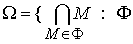 is a subset of S}, i.e.
  is the set of all kinds of
intersections of some subalgebras
is the set of all kinds of
intersections of some subalgebras  . Set I =
  . Suppose
that one of the following conditions (1.1) and (1.2) holds true:
. Suppose
that one of the following conditions (1.1) and (1.2) holds true:
(1.1) each nonempty
subset  оf Ω
contains an inclusion-wise maximal element;
оf Ω
contains an inclusion-wise maximal element;
(1.2) I =  for every infinite
subset
for every infinite
subset  of Ω.
of Ω.
Suppose in addition that
R satisfies also the following condition:
(1.3) given any
subalgebra  , there exists
subalgebra
, there exists
subalgebra  such that
 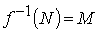 .
.
Then  .
.
Proof.
Inductively, we
can construct the sequence { 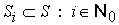 } as follows:
  = S and
  . Set
. Set 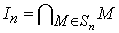 for all n ∈
  . Then
  , since S =
  . Since
any subalgebra M
. Since
any subalgebra M  S can be represented as M =
  for some
  , we have
  . It implies
that
. It implies
that 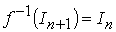 .
.
Note that  . Therefore,
it can be proved by induction on n that
. Therefore,
it can be proved by induction on n that
 for all nonnegative integers
n. It follows from
for all nonnegative integers
n. It follows from  that
that  .
.
First suppose that
condition (1.1) holds true. Since all algebras  belong to Ω, the ascending chain
  by condition (1) must stabilize,
so, for some m,
by condition (1) must stabilize,
so, for some m,  . It implies that
  . Hence
 and
and 
 .
.
Let us suppose now that
condition (1.2) holds true. If the set S is finite,
then the condition (1.1) holds true. So, without loss of generality, we may
assume that S is an infinite set. It is easy to see
that the set  in this case is infinite
too. Condition (1.2) yields
in this case is infinite
too. Condition (1.2) yields 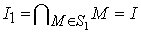 . Thus
 .
.
First let us recall the
notion of quasiregularity. An element a  is said to
be right quasiregular if a + x – ax = 0 for some element x of R. An element a
is said to
be right quasiregular if a + x – ax = 0 for some element x of R. An element a  is
quasiregular if it is both left and right quasiregular. If every element of a
right ideal P of R is
quasiregular (right quasiregular), then P is called
quasiregular (resp. right quasiregular).
is
quasiregular if it is both left and right quasiregular. If every element of a
right ideal P of R is
quasiregular (right quasiregular), then P is called
quasiregular (resp. right quasiregular).
Recall that a right
ideal M of R is called regular (or modular) if there
exists an element e in R
such that er − r ∈ I for all r ∈ R. This element e is
called a left unity modulo I. Any right regular
ideal contains in maximal regular right ideal with the same left unity. If R contains the unity 1 then any right ideal of R is regular, since we may set e = 1.
Recall that the Jacobson radical J=Rad(R) of R can be defined as the
intersection of all maximal regular (modular) right ideal of R. The Jacobson radical J=Rad(R) of R is also called
quasi-regular radical, because Rad(R) is just the
largest right quasiregular right ideal of R.
We use Sp(Rad(R)) to denote the set of all maximal regular right ideals
of R.
Definition
1. Let f be an endomorphism of R. Following D. Jordan we say
that a right ideal I ring R is
weakly f-closed if I = 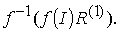 The
right ideal I is said to be f-closed
if I is weakly
The
right ideal I is said to be f-closed
if I is weakly  -closed for
all natural numbers n. Analogously an ideal I ring R is said to be weakly f-closed in I =
-closed for
all natural numbers n. Analogously an ideal I ring R is said to be weakly f-closed in I = 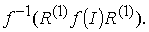 An
ideal I is called f-closed
if, for all natural numbers n, I is weakly
An
ideal I is called f-closed
if, for all natural numbers n, I is weakly  -closed.
Let us denote by  the ring
  obtained from R by adjoining a unity.
Proposition 2. Let f be
an endomorphism of R such that 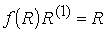 . Let J be the Jacobson radical of R.
Let S = Sp(Rad(R))
be the set of all maximal regular right ideals of R. Set
. Let J be the Jacobson radical of R.
Let S = Sp(Rad(R))
be the set of all maximal regular right ideals of R. Set
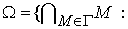
 Sp(Rad(R))}.
Suppose that one of the following conditions (2.1)and (2.2) holds true:
Sp(Rad(R))}.
Suppose that one of the following conditions (2.1)and (2.2) holds true:
(2.1) every subset  оf
оf  contains a maximal element;
(2.2) J =  , for every infinite
subset
, for every infinite
subset  of Ω.
of Ω.
In additoin let us
suppose that the following condition (2.3) holds true:
(2.3) all maximal
regular right ideals of R are weakly f-closed.
Then 
Proof.
Let us use Proposition
1 with I = J and
S = Sp(Rad(R)). If I = J then condition (1.1) implies (2.1) and condition (1.2)
coincides with condition (1.1) of Proposition 1 for the case considered. Thus
Proposition 2 follows from Proposition 1 provided that the condition (1.3)
holds true in the case under consideration. So to prove the present
proposition, it is sufficient to prove that for each  Sp(Rad(R)) there exists a subalgebra
  Sp(Rad(R)) such that
 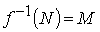 .
.
Let M
 and e be
a left unity modulo M. Let us denote by P the smallest right ideal of R containing
f(M), i.e. P =
and e be
a left unity modulo M. Let us denote by P the smallest right ideal of R containing
f(M), i.e. P =  . If
. If  and
and  then f(e)f(t)c −f(t)c = (f(e)f(t) −f(t))c
 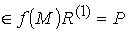 . Since
 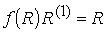 every element s of R can be represented as
 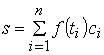 where
where  and
and  . Therefore f(e)s −s
  for all
  . Moreover, since
  is weakly f-closed,
  . It follows that P is
a proper regular right ideal of R, f(e) is a left unity modulo P and consequently f(e)
. It follows that P is
a proper regular right ideal of R, f(e) is a left unity modulo P and consequently f(e)  P. So there exists a maximal regular right ideal N of R such that P
  N, f(e)
  N and f(e)
is a left unity modulo N.
N and f(e)
is a left unity modulo N.
To finish the proof we
observe that  and e
and e  , since f(e)
  N. Moreover, er – r ∈
 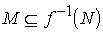 for
all r ∈ R, i.e. e is
a left unity modulo
for
all r ∈ R, i.e. e is
a left unity modulo  and
and  is regular. However,
  is a maximal regular right
ideal of R, so, indeed,
is a maximal regular right
ideal of R, so, indeed, 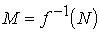 . Hence the
condition (1.3) of Proposition 1 is satisfied. The present proposition
immediately follows.
. Hence the
condition (1.3) of Proposition 1 is satisfied. The present proposition
immediately follows.
Definition
2. A ring R is called a right
Kasch ring if every maximal regular right ideal of R
coincides with the right annihilator of some nonempty subset S of R.
Lemma
2. Let f be an injective endomorphism of R and L be a subset of R Then  = {r
= {r  Lr = 0} is an f-closed
ideal of R.
Lr = 0} is an f-closed
ideal of R.
Proof.
Let  . To prove
the inclusion
. To prove
the inclusion 
 let a
let a 
 , b
, b  and c
and c  . Since
 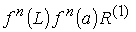 =
= 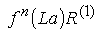 =
=  = 0,
we obtain that
= 0,
we obtain that  =
=
=
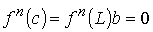 and
consequently Lc = 0. The reverse inclusion
and
consequently Lc = 0. The reverse inclusion

 is
obvious.
is
obvious.
We state a major result.
Theorem
1. Let R be a right Kasch ring
and f be an injective endomorphism
of R such that 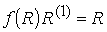 . Suppose that one of the following
conditions (i), (ii) holds true:
. Suppose that one of the following
conditions (i), (ii) holds true:
(i) R
satisfies the ascending chain condition for right annihilators containing
J;
(ii) J =  , for every infinite
subset
, for every infinite
subset  of Sp(Rad(R)).
Then 
Proof.
It is clear that
(ii) implies (2.2). In order to prove the implication "(i) (2.1)"
we need to make sure that the intersection
(2.1)"
we need to make sure that the intersection 
 is a right annihilator in R if
 Sp(Rad(R)). Finally, by using Lemma 2 we can see that every maximal regular
right ideal of the ring R is f-closed.
Hence, for every maximal regular right ideals of R,
the condition (2.3) of Proposition 2 is also satisfied and theorem 1 follows
from Proposition 2.
Sp(Rad(R)). Finally, by using Lemma 2 we can see that every maximal regular
right ideal of the ring R is f-closed.
Hence, for every maximal regular right ideals of R,
the condition (2.3) of Proposition 2 is also satisfied and theorem 1 follows
from Proposition 2.
Example 1. There exists a commutative Kasch
ring satisfying both conditions (i) and (ii) of theorem 1 the Jacobson radical
of which is neither zero nor nil.
Proof.
Let K be a commutative principal ideal domain with unity. As
well-known every prime ideal of K is a maximal ideal
of K. Let S be the set of
all maximal ideals of K. Consider the power series
ring T = K[[x]]
in one variable x over K. If
P∈S then M(P) denotes the simple T-module T/(P+xT) that is isomorphic to K/P as a K-module. We set R=T  where
M =
where
M =  M(P) and define multiplication
on R by setting
M(P) and define multiplication
on R by setting
(t+m)(s+n)=ts+(tn+sm) (  t, s ∈R
  m, n ∈M).
Then R becomes a commutative ring with the same unity (1 + 0) = 1
as in K. It is transparent that J(R)=J(T)  J(K)
J(K)  xT
xT  M, here we consider K and T as subrings of R. Note that R/J(R)
  K/J(K) is a commutative
Noetherian ring. Hence R satisfies condition (i) of
Theorem 1.
K/J(K) is a commutative
Noetherian ring. Hence R satisfies condition (i) of
Theorem 1.
Since K is a principal ideal domain, given any infinite subset Γ of S, we
have J(K) =  . But every
maximal ideal of R has the form of P+J(R)=P
. But every
maximal ideal of R has the form of P+J(R)=P  xT
xT  M=ann(M). It
is straightforward to check that R satisfies
condition (ii) of Theorem 1. Note in addition that
M=ann(M). It
is straightforward to check that R satisfies
condition (ii) of Theorem 1. Note in addition that  for every unitary
endomorphism of R.
for every unitary
endomorphism of R.
We finish this paper by
formulating the following conjecture.
Conjecture. Let
R be a semilocal SBI-algebra over a field k and 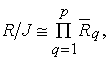 where
where  Matrix(
  ) are
the matrix rings over some division rings Dq.
If Ker f
) are
the matrix rings over some division rings Dq.
If Ker f J and the Gelfand-Kirillov transcendence degree of all Dq over the base field k are finite, then
  .
.
Bibliography
1. Grishin A.V., Mushrub V.A., Schigolev
V.V., Tsybulya L.M., Platonov S.V., “Varieties of Algebras, T-Spaces and Application
of algebraic Groups to them”, research report № 07-01-00625 (Russian Foundation
for Basic Research), 2009.
(Grishin A.V., Mushrub V.A, Schigolev V.V., Tsibulya L.M., Platonova S.V., “MNOGOOBRAZIYA
ALGEBR, T-PROSTRANSTVA I PRIMENENIE K NIM ALGEBRAIChESKIH GRUPP”, otchet o NIR
# 07-01-00625 (Rossiyskiy fond fundamentalnyih issledovaniy), 2009.
2. V. A. Mushrub, On the uniform
dimension of skew polynomial rings in many variables, Fundam. Prikl. Mat., 2001,
Volume 7, Issue 4, 1107–1121, pp. 1107-1121. (Mushrub V.A. O razmernosti Goldi
rasshireniy Ore so mnogimi peremennyimi //Fundamentalnaya i prikladnaya
matematika., 2001. T. 7, vyip. 4, C.1107-1121.)
3. I.
V. Suhorukova, V.A. Mushrub, Invariance of the Jacobson Radical of SBI-rings
with respect to endomorphisms. To appear.