technical
/ metallurgy
Candidate of Physical and Mathematical Sciences
Mukhtarova M.N., Nurseytova
A.K., Ermaganbetova S. D.
Al-Farabi Kazakh National University
Almaty, Kazakhstan
The concept and ways of its realization
Currently, the following areas are defined
creating waste-free (and low-waste) production:
-
development of new technological schemes and methods of industrial production,
excluding the release of waste into the environment;
-
Creation of closed technological schemes of water reuse and process gases;
-
The creation of waste management system of production, which are considered as
secondary material resources, the organization of large regional
territorial-industrial complexes of the closed structure of the feed streams to
deep processing.
Work
on the latest trend began in the 80s and took thirty years.As a result, not
only the new concept of deep processing of non-waste technological fields were
managed, but also developing methods and technical means for its
implementation. Proposed currently processing complex today includes the
proven, unique, having no analogues in the world equipment.
We
are convinced that it is time to centralized implementation and replication
technologies for deep waste-free development of natural and man-made deposits
autonomous mobile complexes with extraction of useful components and dumping
(conservation) of harmful components (-toxicants elements), followed by
reclamation and return into the economy liberated from their territories.
Methods
of designing systems to adapt the technology of deep-waste recycling in terms
of virtually any known technogeneticdeposits, including deep processing of
sludge storage tanks coal preparation plants to produce finely
dispersedcoal-water and briquetted fuel, building material and fertilizer, as
well as their use in the cement industry in the production of chalky-clay
sludge and many other products.
In
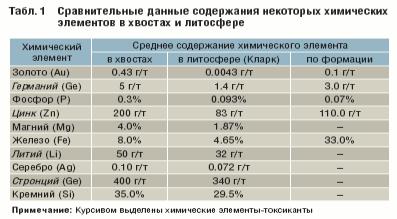
assessing the ecological status of the ore district chemical composition of the
tailings ferruginous quartzite field has been studied. Ecological and
geochemical characteristics of tailings ferruginous quartzite are presented in
Table 1. The data obtained are compared with an average content of chemical elements
in the lithosphere and the list above the Clarke us elements (in descending
order of concentration ratios).
With
regard to natural radionuclides, the comparative analysis of their distribution
in the tailings and source ferruginous quartzites showed that tails depleted
thorium (Th) of 3.5 times, uranium (U) to 1.3 times, i.e., these radionuclides
"enrich" iron ore concentrate and follow further along the process
chain up to the metallurgical processing. The chemical composition of coal
sludge storage tanks present similar elements with their different content,
depending on the genesis of deposits.
As
a result of investigations to solve the most acute problems of cleaning
territories from man-made pollution and the associated extraction of mineral
and toxic components of the technology of working out of man-made and natural
and man-made deposits via mobile technological complexes on the basis of
original technical solutions (Fig. 1).
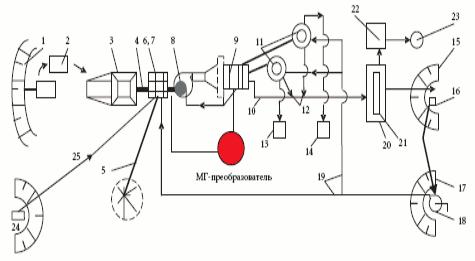
Fig.
1 Autonomous Driving Mobile technological complex circuit devices for recycling
and disposal man-made and natural technogenic deposits
Technological
complex for deep processing of technogenic raw materials with the extraction of
valuable components (gold, platinum, palladium, silver, non-magnetic
iron-hematite and others.) and the removal of harmful impurities (containing
mercury and heavy metals, radionuclides) from the tails of enrichment plants of
non-ferrous and ferrous metallurgy. All of these components and waste without
metal (tailings) are quite valuable products for the
metallurgical, construction, part of
jewelry and other industries and the economy as a whole .
Thus,
the proposed technology for processing technogenic waste (tailings, Ephel,
sludge storage tanks) allows removal and disposal of harmful impurities,
including in underground spaces developed after their preliminary condensation,
which is also ensured by technical means that are part of the complex. The
proposed technology provides a cost-effective and environmentally friendly and
virtually waste-free production with significantly lower cost of operating the
main products of mining and processing of non-ferrous and ferrous metallurgy in
Kazakhstan.
Literature:
1. Vinogradov NF, "Nature." - M., 1994.
2. Kikava O.Sh. etc. "Construction materials from production waste."
- "Ecology and Industry of Russia», 12, 1997.
3.
Protasov VF, Molchanov AV "Environment, health
and environmental management in Russia" - Moscow, "Finance and
Statistics", 1995.
4. "Ecology". Textbook, Ed. S.A.Bogolyubova - M.,
"Knowledge", 1997.