Экономические науки/15.Государственное
регулирование экономики
Stozharova K.A., Bogdanova A.A.
The
THE ANALYSIS
OF SOCIAL INFRASTRUCTURE DEVELOPMENT
Social
infrastructure is a group of serving industries and activities designed:
- to meet the needs of people;
- to guarantee the necessary level and quality of life; - ensure the
reproduction of human resources and professionally trained personnel for all
spheres of the national economy.
Each
country is interested in the development of social infrastructure, because the
activities of this area ensure the normal functioning of the remaining
components of the market infrastructure.
This
confirmation of the message of the President of the
To
solve the problem of emergency schools and three-shift training, 70 billion
tenge has been additionally allocated, as the funds do not allow to solve this
problem until 2017. Akims are instructed to do their best to involve the
private sector to reduce the deficit of places in pre-school organizations. In
addition, KZT 20 billion will be additionally allocated for this purpose within
3 years.
The
President instructed to form the material and technical base of 10
universities, on the basis of which the science will be connected with the
economic and personnel sectors, having directed up to 10 billion tenge for
these purposes until 2017.
Transformations
are already yielding results. The unemployment rate fell to 4.9% for the July
2015 estimate (Figure 1).
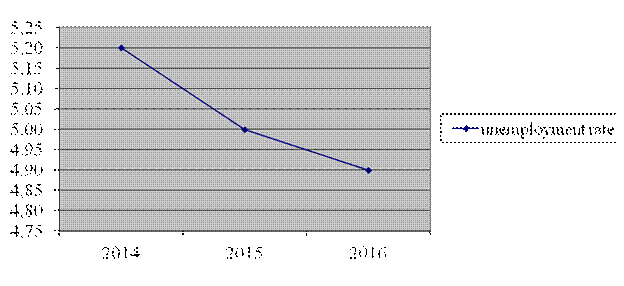 Figure 1. The
unemployment rate in the period from 2013 to 2015.
Figure 1. The
unemployment rate in the period from 2013 to 2015.
The
average monthly wage increased to 126,714 tenge, compared to 2015 by 0.6%
(Figure 2).
 Figure 2.
Average month salary in the period 2015-2016.
Figure 2.
Average month salary in the period 2015-2016.
So,
the analysis made it possible to identify the following problems:
1.
High number of self-employed people (in 2013, more than 2.5 million people,
that is, one-third of the total working population).
2.
52% of the self-employed had only a general 11-year education, but did not
study professional skills.
3.
Almost every tenth self-employed worker of working age did not graduate from
high school at all.
4.
Almost a quarter of all wage earners in the country work without proper
professional qualification, having only a diploma of graduation.
5.
There are 180 emergency schools, 104 three-shift schools.
6.
The total number of children in pre-school organizations in the country is
540,000 places (for 2013).
This
year, the financing of social protection and healthcare programs in the
republican budget is estimated at KZT 2.4 trillion. Due to this, since January
1, 2015, pension payments have been increased by 9%, basic pensions and social
benefits have been increased by 7%.
Short-term
training courses in services will be organized for youth in the
In
2015, the number of emergency schools was reduced to 66. The number of
three-shift schools was reduced by 20%. It is planned to completely solve the
problem of emergency and three-shift schools until
Positive
trends in the development of social infrastructure were noted in comparison
with