экология/6. Экологический мониторинг
Zaytseva A.S., Yudina N.Yu., Arlyapov V.A.
Tula State University
BOD-biosensor based on yeast strain Debaryomyces hansenii immobilized on
polyvinyl alcohol matrix modified by N-vinylpyrrolidone
Water-quality monitoring is an important aspect of
water management because it assists in identifying the areas in need of
restoration, the extent of pollution control required, and the efficacy of
pollution control efforts. Biochemical oxygen demand (BOD) is one of the common
indices of pollution in wastewater. In the conventional method the BOD value in
water samples takes 5 days and requires complicated procedures and skilled
analysts. Therefore, the method is unsuitable for short-term water-quality
control.
A rapid method of BOD estimation bases on employing
microbial sensors. The sensor consists of a combination of an oxygen electrode
as a transducer and a bio-film. When organic compounds present in the samples
are degraded by the microorganisms immobilized in the bio-film, dissolved
oxygen is consumed and determined and this is designated as a BOD5
value.
In this project a biochemical oxygen demand
(BOD) sensor has been designed using immobilized yeast strain Debaryomyces hansenii. The
immobilization was carried out by dropping a cell suspension onto the polyvinyl
alcohol matrix modified by N-vinylpyrrolidone and then the bio-film was fixed
to the oxygen electrode. It has improved characteristics of biosensor such, as
reproducibility of the sensor responses, long-term stability and linear rage of
calibration curve.
In these experiments, the glucose-glutamic
solution (GGS) was employed as a standard solution for the calibration curve.
Fig. 1 shows a calibration curve obtained using this sensor and the GGS.
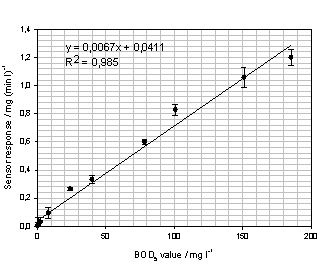
Fig. 1. Calibration curve observed using the
GGS. Error bar show the standard deviation of seven measurements.
A linear relationship (r2 = 0,985)
was observed between the sensor responses and the BOD5 values from
0.2 to 180 mg l-1. The reproducibility of the sensor responses was
4.2 % (average of relative standard deviations (RSDs)) in the calibration curve
obtained by using the GGS. A slope of calibration curve of 0.0067±0.0003 min-1
was obtained.
The receptor element metabolized various organic substances, which is advantageous for BOD measurements.
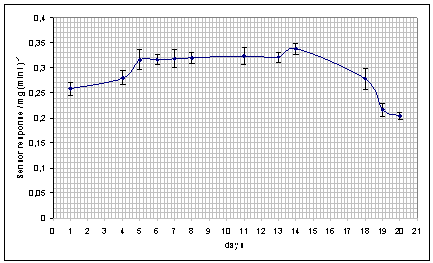
Fig. 2. Long-term stability of the BOD sensor.
Error bar show the standard deviation of three measurements.
Fig. 2 shows the responses obtained be the BOD
sensor after storage for 20 days. The sensor tip was stored at 25°C and 6.8 pH.
The responses after 20 days decreased approximately half their original values.
Thus biosensor works for 20 days well.
Table 1
shows the examination of real samples using the sensor and the conventional
5-day BOD method. Wastewater samples were taken from “Industry Service” ltd.,
untreated wastewater from supermarket “Stroydepo” and treated wastewater from
“Vodokanal” ltd. In these measurements, the sensor response of
different batches was calibrated using the GGS.
Table 1. Examination of real samples.
|
wastewater |
The BOD value measured using
designed biosensor / mg l-1 |
The BOD value measured using 5-day
BOD method / mg l-1 |
|
“Industry Service” ltd. |
11,1 ±
0,1 |
11 ±
2 |
|
Supermarket “Stroydepo” |
61,6 ±
0,4 |
60 ±
10 |
|
“Vodokanal” ltd. |
4,0 ±
0,2 |
3,5 ±
0,5 |
BOD values measured using the conventional 5-day
method and the biosensor, were the same taking into account confidential
interval.
Time of
the analysis using mentioned equipment does not exceed 10 minutes. There is no need
to attract skilled analysts
for measurement. The designed BOD-sensor can be used for short-term
water-quality control.
Finally, we have designed the BOD-biosensor,
which can used at sanitary and epidemiological service, Department for
Emergency Preparedness and Response, different ecological structures.
The work was supported
by the Federal Goal-oriented Program “Scientific and Scientific-Pedagogical
Cadres of Innovative Russia” for 2009–2013, State Contract No 16.740.11.0766 and a grant of the President of the Russian Federation for state support
of young Russian PhD scientists, Agreement No 16.120.11.4341-MK.