Medicine / 7.Clinical medicine
Chugunov V.V.,
Kurilo V.A., Danilevska N.V.
Zaporizhzhya State Medical University Ministry of
Healthcare of Ukraine
postictally
suggestion as Way of preventing the recurrence of depression in
patients treated with electroconvulsive therapy
Research
actuality. Biological methods for the treatment of depression, which include
electroconvulsive therapy, have long established themselves as etiopathogenetic
– affecting influential components of the disease and is able to achieve
prolonged remissions even in cases of pharmacoresistant [1, 3].
The
modern technique of electroconvulsive therapy with anesthesia and muscle
relaxation allows in short time to achieve the significant improvements in mood
without the classic electroconvulsive therapy side effects [3].
Electroconvulsive therapy has a proven antidepressant
effect. It helps to improve the mood of patients even after the first sessions.
But in some cases, relapse of the disease. It is associated with the
pathogenesis of depression. Іn the genesis endoreactive
depression in addition to the endogenous depressed mood, plays significant role
in the cognitive component, the
unpleasant thoughts and feelings of psychotrauma genesis, which arose in response
to the transferred patients psychological trauma. This forced us to find ways of preventing the recurrence of depression
in patients treated with electroconvulsive therapy.
The aim of research was to determine the postictally suggestion as Way
of preventing the recurrence of depression in patients treated with
electroconvulsive therapy
Materials research. We formed two groups of
patients. Patients of the first group (n=4) were treated by
electroconvulsive therapy without combination with other therapies. Patients of
the second group (n=6)
were treated in compliance with the combined method we have developed a
combination of electroconvulsive therapy and postictally suggestion.
Method of research: psychopathological,
psychodiagnostic, anamnestic. For quantification of the results used: Hamilton
Rating Scale for Depression (HDRS-HAM-D, M.Hamilton, 1960); Association test
(F.E.Rybakov, 1910) [2, 4].
Used
equipment: Apparatus for electroconvulsive therapy "NIVIQURE"
(Niviqure Meditech Private Limited. India. Code UCGFEA: 9018 90 75 00. Certificate
on registration № 8222/2008, 15.10.2008).
In the
purpose of preventing the recurrence of
depression, we have developed a combined technique, combined
electroconvulsive therapy and postictally suggestion.
Manipulation
aimed at mitigating painful traumatic experiences in patients with depression
who were treated by electroconvulsive therapy method consisted of two stages
observed. The first stage is one minute before application of anesthesia,
patients were asked to focus on painful experiences.
The
second stage – in the first minutes after the release of patients from
anesthesia, patients were susceptible to hypnotic suggestion designed with
therapeutic formulas aimed at correction of traumatic experiences.
As a
result of the developed technique, we have achieved two therapeutic effects:
1. due
to electroconvulsive therapy the mood of patients noticeably improved from the
first session according to the test, Hamilton Rating Scale for Depression total
score was reduced from 23,4±0,75 to 5,0±0,52 points (pic. 1).
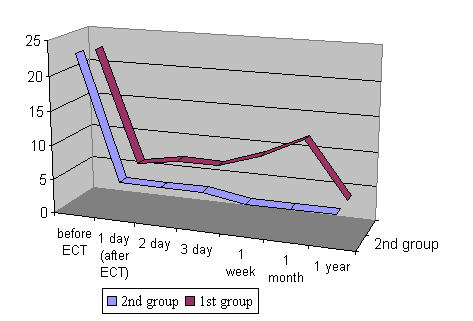
Pic. 1.
The results of the study on a Hamilton Rating Scale for Depression.
2. due
to additions of electroconvulsive therapy sessions of postictally hypnotherapy,
effectively neutralised by traumatic experiences, which allowed to avoid the
relapse of the disease – thus, according to the associative test was noted the
elimination of the previously dominant in the cognitive sphere of patients
negative experiences (pic.2).
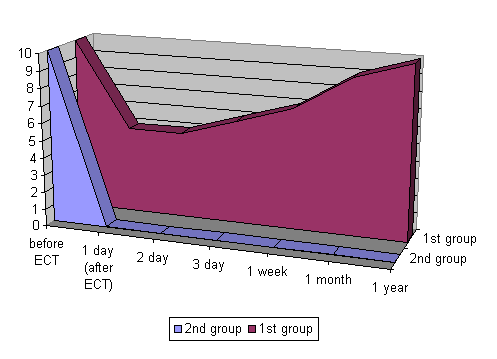
Pic. 2.
The results of the study on a Association test.
All patients who followed a course of
therapy developed by our method indicated a full recovery; during one year of
follow-up after therapy, disease recurrence was not.
References.
1. Roman A.,
Kreiner G., Nalepa I. Macrophages and depression – a misalliance or well-arranged
marriage? Pharmacol. Rep., 2013,
no.65(6), pp.1663 – 1672.
2. Hamilton M. A
rating scale for depression. Journal
of Neurology, Neurosurgery and Psychiatry, 1960, no.23, рр.56 – 62.
3. Nelson A. I. Electroconvulsive therapy in psychiatry,
narcology and neurology. Moscow: BINOM. Knowledge laboratory, 2005, 368
p. (Rus.).
4. Rybakov F. E. Atlas for the experimental-psychological
research of personality with a detailed description and explanation of the
tables. Saint Petersburg: KARO, 2008, 120 p. (Rus.).