Aitbembetova A.B.
Doctor of economic sciences, Associate professor,
faculty of Economics
al-Farabi Kazakh National University, Kazakhstan,
Almaty
Kenzhetay A.K.
1st grade master’s degree student of
Economics
al-Farabi Kazakh National University, Kazakhstan,
Almaty
Statistical
data on the standard of living of the population in Kazakhstan
Studies of the standard of living of the population have been carried
out comprehensively since the late 1950s. Since 1970, these studies have become
permanent and multifaceted. There is no unambiguous definition of the category
"standard of living of the population", but one should distinguish
between the concept of the standard of living of the population in the narrow and
broad sense of the word:
• in the narrow - is the satisfaction of personal needs for material and
spiritual goods;
• in broad - the whole complex of socioeconomic conditions of the
people's life. [1]
In the absence of a single generalizing indicator characterizing the
standard of living of the population, a number of statistical indicators are
calculated for its analysis reflecting various aspects of this category and
grouped into the following main blocks:
- indicators
of incomes of the population;
- indicators
of expenditures and consumption by the population of material goods and
services;
- saving;
-
indicators of differentiation of incomes of the population, level and borders
of poverty;
-
socio-demographic characteristics;
-
generalizing estimates of the standard of living of the population.
It should be noted that the above subsystem of indicators reflects a
more quantitative aspect of the category being studied. To qualitatively
characterize the living conditions of the population, it is necessary to use
indicators of social statistics that give an idea of the quality of life. These
include the main indicators of demographic statistics, health status and
protection, quality and structure of consumed food, literacy and the state of
education and culture, the comfort of housing, etc. [2]
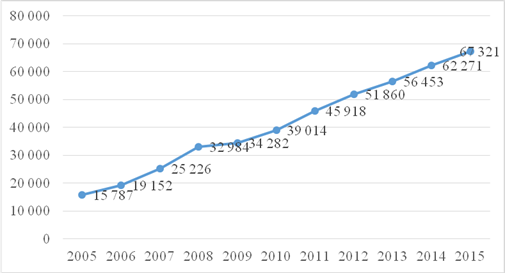
One of the indicators used
in the statistics of the Republic of Kazakhstan is the money income of the
population. The average per capita nominal monetary incomes of the population
for the period from 2005 to 2015 is depicted in Picture 1.
Picture 1. The average per capita nominal income of
the population, tenge.
Note-compiled by
data from the Agency for Statistics of the Republic of Kazakhstan[3]
Money
incomes of the population on average per capita for 11 years increased from
15787 tenge to 67321 tenge. Considering these data, it is also necessary to
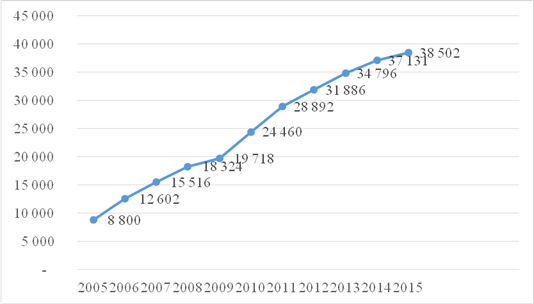
take into account the monetary expenses of the population.
Picture 2. Monetary expenditures of the population on
average per capita, tenge
Note-compiled by
data from the Agency for Statistics of the Republic of Kazakhstan[3]
As noted
from the graph above, the population's money expenditures on average per capita
also show a trend of increase.
The main source of income
for the majority of the population is income received in the form of payment
for labor, i.e., wages. Table 1 shows the average monthly salary of workers in
the Republic of Kazakhstan in the context of the regions for 2011-2016.
Table 1. Average monthly nominal wages of workers by
region.
|
Region |
2011 |
2012 |
2013 |
2014 |
2015 |
2016 4 quarter |
|
The Republic of Kazakhstan |
90 028 |
101 263 |
109 141 |
121 021 |
126
021 |
154
632 |
|
Akmola |
64 495 |
74
685 |
79
127 |
85
412 |
89
176 |
114 462 |
|
Aktobe |
79 878 |
90
241 |
96
575 |
106
265 |
106
778 |
127 114 |
|
Almaty |
67 638 |
77
320 |
81
596 |
89
283 |
90
445 |
110 809 |
|
Atyrau |
165 975 |
180
406 |
192
356 |
221
664 |
225
121 |
266 024 |
|
West Kazakhstan |
87 503 |
90 728 |
98 360 |
108 223 |
116
798 |
141
921 |
|
Zhambyl |
61 825 |
72
296 |
76
742 |
81
874 |
85
298 |
102 722 |
|
Karaganda |
77 940 |
92
382 |
99
339 |
107
821 |
113
905 |
136 262 |
|
Kostanay |
67 252 |
76
647 |
83
451 |
90
602 |
93
560 |
118 880 |
|
Kyzylorda |
81 518 |
93
361 |
98
813 |
104
485 |
106
332 |
123 362 |
|
Mangistau |
151 041 |
157
358 |
183
914 |
222
294 |
234
007 |
273 762 |
|
South Kazakhstan |
67 721 |
75 467 |
78 705 |
84 550 |
85
693 |
107
740 |
|
Pavlodar |
75 338 |
85
844 |
93
639 |
102
310 |
108
630 |
134 035 |
|
North-Kazakhstan |
61 712 |
68 921 |
74 853 |
81 062 |
84
324 |
104
385 |
|
East Kazakhstan |
73 677 |
84 872 |
90 263 |
99 130 |
103
028 |
133
648 |
Note-compiled by
data from the Agency for Statistics of the Republic of Kazakhstan[3]
As can be
seen from the data in Table 1, every year there is a tendency to increase the
average nominal wage. The highest level of average nominal wages is observed in
Atyrau and Mangistau regions, this fact is directly influenced by the
development of the oil industry in Western Kazakhstan and the corresponding
high salaries.
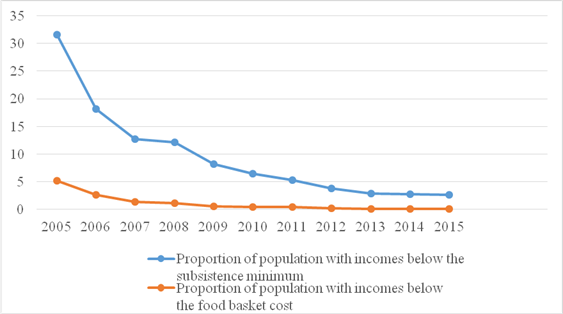
Speaking about the standard of living of the population, it is necessary
to take into account the share of the population with incomes below the
subsistence minimum and below the food basket cost.
Picture 3. Proportion of population with incomes below
the subsistence minimum and below the food basket cost
Note-compiled by
data from the Agency for Statistics of the Republic of Kazakhstan[3]
From 2005
to 2015, there is a decrease in the proportion of the population with incomes
below the subsistence level and below the cost of the food basket. This means
that the financial condition of the population has improved comparatively.
Analyzing through incomes in the standard of living of the population,
annual growth is observed. The highest level of average nominal wages is
observed among workers of Atyrau and Mangistau regions. The decline in the
share of the population with incomes below the subsistence minimum and below
the cost of the food basket is associated with some improvement in the
financial condition of the population.
Used literature
1.
Spiridonov I. World economy - M., 2010. - 272 p.
2. Quality
of life of the population and improvement of the demographic situation. -
Article. [Electronic resource]: https://articlekz.com/article/11996
3. The
official website of the Agency for Statistics of the Republic of Kazakhstan.