Филологические науки /7.
Язык, речь, речевая коммуникация.
Verba Y. A., Gaurieva G. M
Eurasian National University, Kazakhstan
Strategies of speaking teaching for beginners
Abstract
The
present study aims at investigating teacher strategies in improving speaking
ability for EFL learners in primary schools of Kazakhstan. The object of this research is the 3rd grade
pupils of school-gymnasium № 31 in Astana. The implied methods of the research are
bibliographical, comparative analysis. The significance of the present work is
that the investigation in this sphere was not fully completed by the
researchers of the field, it considers strategies of teaching speaking at the
primary level, that demands the careful and correct choice of techniques and
strategies of speaking teaching. Having considered the classifications of
speaking teaching strategies, we have chosen the role play strategy and
investigated its implementation during a lesson course as the most effective strategy
to develop speaking fluency in pupils.
Key words: strategies of speaking teaching, primary
school, role play strategy, speaking fluency
The use of English as
a second language (ESL) or foreign language (EFL) in oral communication is,
without a doubt, one of the most common but highly complex activities necessary
to be considered when teaching the English language, since we live at the time
when the ability to speak English fluently has become a must.
The goal of teaching speaking skills is communicative
efficiency. Learners should be able to make themselves understood, using their
current proficiency to the fullest. They should try to avoid confusion in the
message due to faulty pronunciation, grammar, or vocabulary, and to observe the
social and cultural rules that apply in each communication situation.
Topicality of the present work is that at
primary school the spoken language foundation in a foreign language is spent
for formation of skills: the pronunciation, graphic, spelling, lexical and
grammatical skills. Thus, success of using appropriate types of strategies
develops interest, motivation and therefore, knowledge of English as a second
language.
Research on language learning
strategies started at the 1970s. Since that time many researchers have
suggested their own classifications of teacher-learner speaking strategies. (Oxford,
1990; Bialystok, 1981; O'Malley, 1985; Willing, 1988; Stern, 1992; Ellis,
1994). But, studying them possibly will help both language teachers and
language learners to understand language learning strategies and different
methods which are engaged in strategy use. In what follows, taxonomies of
language learning strategies will be demonstrated:
O'Malley's Classifications of
Language Learning Strategies[1, 21-46]
O'Malley (1985), separated
language learning strategies into three main categories:
A. Meta cognitive Strategies,
B. Cognitive Strategies,
C. Socio affective Strategies.
A. Meta cognitive Strategies
Rubin's (1987)
Classification of Language Learning Strategies[2]
Rubin, who assigned a great
deal of effort in the field of language learning strategies, made a distinction
between strategies contributing directly to learning and those contributing
indirectly to learning.
Oxford's (1990)
classification of Language Learning Strategies[3]
By referring to the
literature, it seems that the most inclusive taxonomy of language learning
strategies is provided by Oxford's (1990). Oxford divided language learning
strategies into two main categories, direct
and indirect strategies which are also subdivided into six classes.
Direct strategies, which
involve the new language directly, are divided into Memory, cognitive and compensation strategies. As Oxford's says,
"all direct strategies require mental processing of the language" [3,
37].
Indirect strategies include metacognitive, affective strategies.
Indirect strategies provide indirect support for language learning by employing
different strategies such as focusing, arranging, evaluating, seeking
opportunities, and lowering anxiety Oxford's.
According to Brown, there are four most effective speaking teaching strategies:
cooperative activities, creative tasks, role play and drilling. [4, 96] For the
further research we picked up the role play strategy.
In Cambridge International Dictionary of English, role
defined as the person whom an actor represents in a film or play, while role
play is a method of acting out particular ways of behaving or pretending to be
other people who deal with new situations. It is used in training courses
language learning and psychotherapy [5, 123].
A role play is a highly flexible learning activity
which has a wide scope for variation and imagination. According to Ladousse,
role play uses different communicative techniques and develops fluency in the
language, promotes interaction in the classroom and increases motivation. Here
peer learning is encouraged and sharing of responsibility between teacher and
the learner in the learning process takes place. [6, 24]
Role play can improve learners’ speaking skills in any
situation, and helps learners to interact. As for the shy learners, role play
helps by providing a mask, where learners with difficulty in conversation are
liberated. In addition, it is fun and most learners will agree that enjoyment
leads to better learning.
Role play can be used with students of most ages. The
complexity of the role situations must be minimized in using the method with
children. But if we keep it simple for their limited attention spans, role play
can be used even in teaching preschoolers.
Here are some of the roles that will be
sufficiently interesting and effective in the role-playing game for the
development of educational and cognitive activity of students in the process of
teaching a foreign language:
1. A person who really existed (the king,
prince, chief of the insurrection, military commander, politician, etc.)
2. A fictional character (peasant, feudal,
military, seller, etc.)
Preparation:
1. Planning the game.
2. Work with students:
-
the title of the
topic, the date of the role-playing game,
-
distribution of roles
and tasks,
-
division into groups,
as needed - election of the jury, key players,
-
acquaintance with the
goals of the game,
-
comments on goals and
expected outcomes,
-
the configuration of
the presentation of the material,
-
additional fiction,
-
as needed -
consultations, rehearsals,
-
the production of
important didactic materials,
-
knowledge control
report.
Variants of knowledge control:
1. Evaluation for the work in the lesson, i.e. a
specific role in the game in the work of their own group.
2. Assessment for preparing for a role-playing
game (drawing, diagram, costume, crossword, news, etc.)
3. Work in the notebook during the game
(recording games of other groups, table, time tape, main texts, etc.)
4. At the lesson - test work, analysis,
dictation, etc.
Course of the game:
1. Organizational moment.
2. Role-playing game.
3. Reflection: an oral test at the end of the
lesson, a questionnaire, an article in the school edition, an exhibition of
creative assignments, etc.
A good example is the use of role
play “Little Red Hen” on a lesson on the
topic “Animals” in the 3rd
grade. After the introduction of a new theme and some vocabulary exercises,
pupils role play the tale they prepared in advance.
After a lesson questioning
of pupils and the teacher regarding increase of educational cognitive activity
at a lesson has been carried out.
Questions for pupils
The pupils are suggested to
estimate a lesson of five-point system, answering questions. 1 – very
negatively, 5 – excellent.
1. Do you want to
use Role play at the lesson?
2. Do you feel
comfortable in the class?
3. Do you know well
the names of animals?
4. Is a computer
helpful?
5. Does role play
help you speak?
There were 14 pupils in a
class. We will provide the table of results of the testing held after a lesson
with use of a method of ICT
Table 1 Results of
questioning of pupils at an English lesson with role play before the lesson
|
Pupils/ questions |
1.
|
2.
|
3.
|
4.
|
5.
|
|
1.
|
5 |
4 |
3 |
3 |
4 |
|
2.
|
4 |
4 |
5 |
3 |
4 |
|
3.
|
3 |
4 |
3 |
5 |
2 |
|
4.
|
5 |
3 |
3 |
4 |
4 |
|
5.
|
5 |
3 |
4 |
3 |
|
|
6.
|
3 |
4 |
4 |
5 |
3 |
|
7.
|
4 |
3 |
4 |
5 |
3 |
|
8.
|
3 |
3 |
4 |
5 |
5 |
|
9.
|
3 |
3 |
3 |
4 |
4 |
|
10.
|
4 |
5 |
4 |
4 |
4 |
|
11.
|
3 |
5 |
3 |
5 |
3 |
|
12.
|
4 |
4 |
5 |
5 |
5 |
|
13.
|
3 |
3 |
5 |
4 |
4 |
|
14.
|
4 |
4 |
5 |
5 |
4 |
Diagram 1 Pupils
answers before the lesson
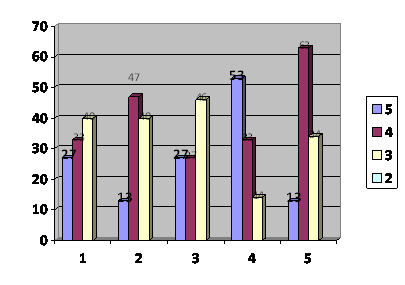
Table 2 Results of questioning of pupils at an
English lesson with a role play after the lesson
|
Pupils/ questions |
1.
|
2.
|
3.
|
4.
|
5.
|
|
1.
|
5 |
4 |
4 |
5 |
4 |
|
2.
|
5 |
5 |
5 |
5 |
5 |
|
3.
|
4 |
5 |
4 |
5 |
4 |
|
4.
|
5 |
5 |
4 |
5 |
5 |
|
5.
|
5 |
4 |
5 |
5 |
4 |
|
6.
|
5 |
4 |
5 |
4 |
4 |
|
7.
|
4 |
4 |
5 |
5 |
4 |
|
8.
|
5 |
3 |
3 |
4 |
5 |
|
9.
|
5 |
3 |
3 |
4 |
4 |
|
10.
|
5 |
4 |
4 |
4 |
5 |
|
11.
|
5 |
5 |
5 |
5 |
5 |
|
12.
|
5 |
4 |
4 |
5 |
5 |
|
13.
|
5 |
5 |
5 |
5 |
5 |
|
14.
|
5 |
5 |
4 |
4 |
4 |
Diagram
2 Pupils answers after the lesson
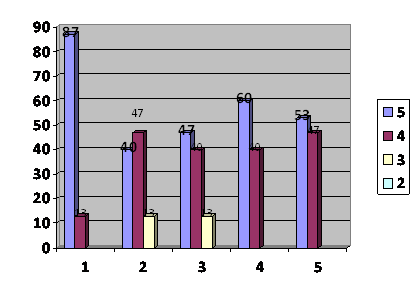
The
answers after the lesson show that pupils liked the lesson and means of
teaching were very useful in acquisition of knowledge.
As we see
from the diagram, most of pupils were
extremely positive to a lesson. Pupils have noted a great interest to
such form of a lesson and all have supported use of role play at English
lessons further. Some pupils haven't seen special development of grammatical
skills more weakly, however they have objectively estimated the knowledge and
have counted an assessment of the teacher fair.
As we see
from an example of a lesson of English with use of role pay strategy for
developing speaking skills, we certainly draw a conclusion that use of speaking
technologies allows to carry out what has been conceived even sometimes more,
the lesson becomes more modern. It leads to growth of educational spoken
activity of pupils, as well as to increase of professional competence of the
teacher. Use of role play at elementary school at English lessons, provides
positive motivation of training, focuses both pupils and the teacher on success
in various skills and abilities when training in English at various levels of
training.
During the lesson, the teacher tried to
develop spoken language of primary school children. There are a great variety
of communicational tasks such as greeting, naming things, talking about food
and likes. According to this approach, even the weakest primary student can
communicate with other children.
Role play teaches
primary students to use speech consciously. Regular application of the
described technology makes it possible to create a comfortable psychological
climate in the classroom. Students who have felt their success in the game,
more confidently learn a foreign language, quickly overcome the language
barrier. In addition to teaching tasks, the game helps to solve a number of
educational and developmental tasks. Students learn speech etiquette, learn to
help each other, react quickly to the situation, learn to practically apply
their knowledge in different conditions.
References:
1. O'Malley, J. M., (1985). Learning strategies used by
beginning and intermediate ESL students. Language Learning, 35(1): 21-46.
2. Rubin, J. (1987). Learner strategies: theoretical
assumptions, research history and typology. In A. Rubin, J. (1975). What the
"good language learner" can teach us. TESOL Quarterly, 9(1): 41 -5.
3. Oxford, R.L., 1990: Language Learning Strategies: What
Every Teacher Should Know.
4. Brown, D. H. (2007). Principles of language learning
& teaching. (5th Eds.) Pearson: Longman.
5. Paul Procter (Ed.), Cambridge International Dictionary
of English, (New York: Cambridge University Press, 1996)
6. Gillian Porter Ladousse, Role Play: Resources Books
for Teacher Series, (New York: Oxford University Press, 1995)