Химия и химические технологии / 1. Пластмассы, полимерные и
синтетические материалы, каучуки, резино-технические изделия, шины и их
производство.
Ph.
D. Chigvintseva O.P., Dub V.A., Kanibolotskiy I.A.
Dniepropetrovsk State Agrarian-economic University,
Dniepropetrovsk
ORGANOPLASTICS BASED ON POLYESTER BINDERS
At present the biggest specific
gravity in total volume of the polymer production occurs on thermoplastical
polymers and composite materials on its base [1-5]. Thermoplasts differ from
thermoreactive polymer binders with less duration of technological cycle by the
second recast, increased viscosity destruction and less sensibility to the
damage and also unlimited expiration date.
Choosing the thermoplasts with different chemical structure and stated
elasticity module and deformability, changing type and filler content can
greatly expand branded range of the composites materials: range of application
– deformational-constructional, high endurance, high module, fireproof,
chemical and waterproof, electrotechnical, frictionproof, etc.; recast –
founding under pressure, extrusion, pultrusion, vacuum- and pneumoforming, covering,
pressure stamping, melting etc. [6-8].
More than 50% of general volume
of thermoplast production belongs to large-capacity polymers of general purpose
(polyethylen, polyvinilchloride, polystirol), the rest one belongs to the construction plastic (polyethylene,
aliphatic polyamides, polyesters, polyurethanes, polymethylacrylates,
polycarbonates) and polymers with peculiar physical and specific properties
[9-11]. Upper temperature of a longstanding
exploitation of large-capacity polymers is situated lower 373K, and we can
slightly increase this temperature by modification. Upper temperature of a
longstanding exploitation about
423K has just some members of constructional plastics, such as polycarbonate,
unsaturated polyesters, cross-linked poly urethanes, polyamides [9, 10].
It is known that modern
machines and aparatus work in rather intensive exploitation regimes (at high
speeds and loads), at that such tendency is indicative for as new areas of
technics, as for the traditional branch of industry such as automobile
manufacturing, agricultural engineering industry, production of household
appliances and medical equipment [12-15]. That’s why for improving main
exploitation characteristics of thermoplastic binders with the purpose of
increasing their term of working capacity in an exploitation hard mode,
approach of reinforcing them by discrete fibrous filler is frequently used.
We should refer aramide fiber
terlon to perspective reinforcing fillers of the polymer matrices. This organic fiber can be operated in a wide
temperature interval (from 23 to 548K), and has high resistance to repeated
deformation, chemical endurance, low thermal shrinkage and a range of other
valuable properties [16].
With the purpose to create new
polymer compositional materials, thermoplastic binders (complex aromatic
polyesters polyarylate and polycarbonate, polyether pentaplast) were reinforced
by terlon fiber in amount of 5-35 mass
% [17-19].
The results of complex research
of main thermophysical, physical and mechanical characteristics of developed
polymer composites show us that they significantly depend on polymer binder nature,
as discontinuous fibers content. In
particular, it is established that organoplastics based on polyarylate (1.64
kJ/kg × K) have the maximum average heat capacity at the
temperatures 298-498K, and organoplastics based on pentaplast (1.40 kJ/kg × K) have minimum one. Temperature curves of
specific heat capacity of researched organoplastics have analogous character:
at the temperatures 298-398K we can see linear enhance of heat capacity; in the
organoplastics transition area from glass into high elastic state (423-473 K)
is shown its intensive growth, after which sharp decreasing is happened. High values of heat conduction coefficient
have organoplastics based on pentaplast (0.43- 0.47
W/m × К) and polycarbonate (0.33-0.39 W/m × К), at
the same time organo-plastics based on polyarylate
is in a range of 0.29-0.33 W/m × К
[20] (fig. 1).
Considering
that the polyarylate refers to heat resistant polymer matrices, rather regular
is the fact that organoplastics on its base also have the highest heat
resistance according to VICat in comparison with other researched polyesters
(table 1).
It also takes
notice the fact that all developed organoplastics have lower temperature coefficient
of linear thermal expansion in comparison with polyesters (in average in 4-6 times). Organoplastics based on pentaplast has high
physical and
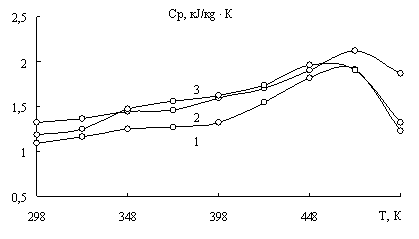
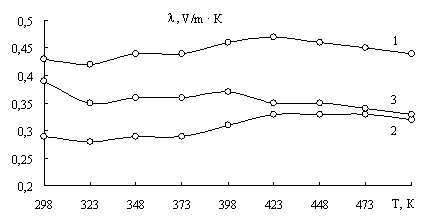
Fig.
1. Temperature dependence of specific heat capacity (Ср)
and
heat conduction coefficient (l) of
organoplastics based on pentaplast (1), polyarylate (2) and polycarbonate (3)
Table
1. Influence of terlon content on heat resistance
according
to polyester VICat
|
Polyester
binders |
Terlon
content, mass % |
|||
|
– |
5 |
15 |
25 |
|
|
Polyaryate |
473 |
475 |
477 |
483 |
|
Polycarbonate |
425 |
427 |
431 |
435 |
|
Pentaplast |
427 |
430 |
437 |
440 |
mechanical indices: tensile strength at compression for them
increase on 26-124 MPa
in comparison with base polymers, while it increases on 5-69 MPa for organoplastics based on polycarbonate.
Significant (on 70 MPa) enhance of
flintiness according to Brinell was established for organoplastics based on pentaplast;
the enhance was just 26 MPa for organoplastics based on polyarylate. As a result of faulty adhesive bonds of
fibrous filler with the polymer matrix, reinforcing of base polyester by
discrete organoplastics don’t let create plastics with high impact
resistance. However, considering the
fact that polycarbonate refers to the amount of the most shockproof thermoplastic
matrices, the samples made from it has the highest shockproof in comparison
with other polyesters (95-20 kJ/m2). Analysis of concentration dependences
of studied characteristics shows that the samples contented less than 25 mass %
of terlon has the most optimal complex of properties.
In whole, the
research results let us to conclude that reinforcing of polyester binders by aramide
terlon fiber let us to create new polymer composites with enhanced properties
complex, and it gives an opportunity of their using in a wide temperature
interval and in more rough exploitation conditions [21-22].
Literature:
1. Perspektiven
technischer Kunststoffe // Konstruktionspraxis. - 1992. - №6. - P. 10-11.
2. Karandikar H.M.,
Mistree F. Tailoring composite materials though optimal selectoin of their constituents
// Trans. ASME J. Mech. Des. - 1992. - 114. - № 3. - Р.
451- 458.
3. Archibald D.A., Schwarz J.W.,
Wanamaher J.L. Reducing the
cost of thermo-plastic composite structures // Proc.
Amer. Soc. Compos.: 4th Techn. Conf., Bracksburg, Oct. 3-5, 1989, Basce. - 1989. -
Р. 593-601.
4. Steady growth for plastics in
electronics // New Mater. Int. - 1990. - № 47. - Р. 7-8.
5. Chang Ike Y.
Thermoplastic matrix composites
development update // 37th International SAMPE Symp. and Exhib.
“Mater. Work. for You 21st Cent.”, Anaheim, Calif., March 9-12, Covina
(Calif.). - 1992. - Р. 1276-1290.
6. Langfaserverstarkte
Thermoplaste fur hochste mechanische Beanspruchungen // Techn. Rept. - 1993. -
20. - № 5. - Р. 28-29.
7. Muhlhaupt Rolf.
Die Zukunft der Polymeren // Plastverarbeiter. - 1994. - 45. - №12. - Р.96-98.
8. Baider E. Ya. Thermoplastics composite
materials // Composite materials in a
construction of demersal technical equipment: Report theses of scientific and technical conference - Nikolaev.
- 1991. - P. 8-9.
9. Buller K.U. Heat- and thermoproof
polymers: Transl. from Germ. -
М.: “Chemistry”, 1984. - 1056 p.
10. Standardkunststoffe, technische Kunststoffe and Spezialitaten // Plasverrarbeiter. - 1992. - 43. - № 11. -
Р. 226-231.
11. Koba M. Introduction to new
materials. Plastics with the
unique properties // Puranto enjinia
= Plast. Eng. - 25. - № 1. - 1993. - Р.
63-68.
12. Sokolov L.B. Thermoproof and high tensile polymers’ materials. - М.: “Knowledge”, 1984. - 64 p.
13.
Esida Haruo Construction plastics / Esida Haruo // JETI : Jap. Energy and
Technol. Intell. - 1991. - 39. - № 1. - Р. 167-170.
14. Koba Michio.
Modern
construction plastics / Michio Koba // Puranto enjinia = Plant. Eng. - 1993. - 25. - № 2. - Р. 69-75.
15. Neue Polyarylate fűr Hochleistungsanwendungen // Kunststoffe. - 1994. - 84. - № 8. - Р. 1015-1019.
16. Gluing-in table. Thermoresistant and
heatproof fibers // Chemical fibers. - 1975. - №3.
17. Askadskiy A.A. Phisico-chimistry of
polyarylates. - М.: “Chemistry”, 1968. - 216 p.
18. Smirnova O.V., Yarofeeva S.B. Polycarbonate. - М.: “Chemistry”, 1975. - 288 p.
19. Mulin U.A., Yartseva I.K. Pentaplast.
- L.: “Chemistry”, 1975. -120 p.
20. Chigvintseva O.P., Kiprich V.V.
Studying the thermo-physical
properties of organoplastics based on thermoplastic
binders // Materials from VI International problem-oriented exhibit-conference
“Composites and glass plastics 2013”. - 24-25.04.2013. - Zaporozhje. - P.
59-60.
21. Chigvintseva O.P., Golovyatinskaya
V.V. Studying of thermophysical proper-ties
of organoplastics based on
pentaplast // Scientific life. - 2013.
- №2. - P. 54-62.
22. Chigvintseva O.P., Dub V.A., Lisnyak
L.A. Studying of exploitation character-ristic
of composites based on polycarbonate // Collected scientific works on materials
of International scientific conference “Theoretical and practical aspects of
scientific researches” - 30. 04. 2014.
- P. 4-7.