R.T. Bulyakov, O.A.
Gulyaeva, O.V. Basharova
Bashkir State Medical
University (Ufa, Russia)
Psychological patients types in
dentists practice
Summary. We have studied the ability of doctors and dentists and future
professionals of the profession to the definition of psychological type of the
patient. We found that almost half of the respondents had difficulty in
communicating with patients, and the hardest is to work with neglect and
denying type of patients.
Keywords: psychological type, patient questionnaires, dentist
The role of psychology in dentistry is widely recognized, and many
leaders of dental clinics, doctors, dentists assistants and administrators
believe that they need knowledge of psychology, because it helps to establish
trust with patients diffrent types, have a relaxing, inspiring and persuasive
influence, helps anticipate and resolve conflicts. Terms of commerce and
competition strongly dictate the need for psychological training of medical
staff [3]. Patients of dental clinics every day becoming more educated and
demanding, they want to get quality treatment and care. Even yesterday,
patients pay attention primarily to the painless and safe treatment for
attractive interior of the clinic. Today, these frontiers achieved by many
dentists. Authority for patients becomes a specialist you can trust 100%. To
make a positive impression on each patient, the dentist must be responsible not
only for their craft, but should to overestimate their behavior, character,
plants. Academician of the International BPA, corr. Peter's Academy of Arts and
Sciences, Professor, head of department of psychology and ethics SpbINSTOM
Boyko V.V. in his scientific work, "Why dentist need psychological
preparation" says: "Our research shows that the mandatory elements of
professional communication cope not all doctors. Some do not give them much
importance, other negligent third act clumsily. The patient must be convinced
of the individual approach, sincere attention and respect. The doctor must be
able to convince to use arguments, think clearly, act quickly and take into
account the emotional and intellectual personality traits of the patient
"[1]. In order to assess the patient's psychological type often used
classification of "subjective types of attitude to the disease,"
according to R. Konechniy and I. Bouhal [2]:
1. Normal (real objective assessment of the state)
2. Disparaging (underestimation of the severity of the disease)
3. Denying (ignoring the fact that the disease)
4. Nozofobny (exaggerating fact illness)
5. Hypochondriac (immersion in the disease)
6. Nozofilny (glad that the disease is exempt from a number of duties)
7. Utilitarian (the desire to cash in on the disease)
The aim of our work was the study of the ability of dentists and
specialists of the future of the profession to determinate the patient's
psychological type.
Materials and methods. Were interviewed 135 dentists developed questionnaire consisting of 12
questions. Held information sessions among dentists on existing psychological
types of patients. The results were statistically processed using standard
techniques.
Results. In 135 interviewed dentists there were 52 therapists (38.51%), 25 orthopedists
- (18.51%), 19 surgeons - (14.07%), 11 periodontists - (8,14%); 8 orthodontists - (5.92%); 20 young
professionals - (14.85%) (Fig. 1).
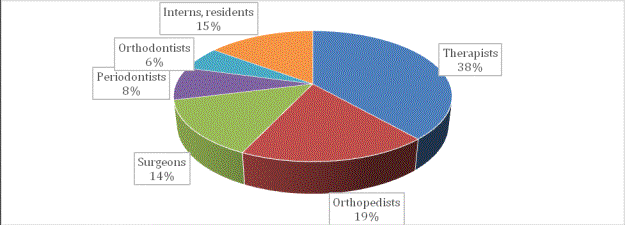
Fig. 1. Distribution of
specialty.
Analyzing sex of interviewed, we found that 87 (64.44%) women responded to our questionnaire, 48 men
- 35.56%. The number of doctors working in the city - 115 (85.18%), in rural
areas - 20 (14.81%). Working in public health institutions, 70.37% of the respondents
(95 persons), in private - 40 doctors (29.62%). Work experience were: less than
5 years - 62 doctors (45.92%), 5-10 years - 48 doctors (35.55%), more than 10
years - 25 doctors (18.51%).
We also found that about psychological types knows 101 doctors (74.81%)
(mostly therapists, orthodontists and periodontists). Do not know much smaller
- 34 doctors (25.18%) (mainly surgeons, orthopedics and residents). The
question: "What type of patients is more common in your work?" -
Doctors answered so: normal type of the selected 75 doctors - 55.55%;
"Disparaging" - 36 doctors (26.66%); "Denies" - 19 doctors
(14.07%); "Nozofobny" -7 doctors (5.18%); "Hypochondriac" -
11 doctors (8.14%); "Nozofilny" - 5 doctors (3.71%); Utilitarian - 3
(2.22%), difficulty in communicating with patients experiencing - 39 doctors
(28.88%); 96 (71.11%) easily
communicate with patients. The hardest to work with the type of denying
patients responded to 65 doctors (48.14%) and patients with dismissive type,
them chose 54 doctors (40.0%), Hypochondriac type chosen 49 doctors (36.29%),
nozofobny - 39 (28.88%); nozofilny 21 (15.55%); utilitarian 12 - 8.88%.
According to a questionnaire, doctors with experience of 5 years are
more common disparaging type (33.87%) and denies type (51.61%), with experience
from 5 to 10 years more common disparaging type (43.75%), with experience more
than 10 years - nozofilny (36.0%), denies (44.0%).
Most often difficulty in communicating with patients experienced doctors
with experience of up to five years (73.68%), as well as interns and residents
(85.54%); in the analysis of the problem among doctors by specialty – it is
mostly surgeons (65.76%), physicians (81.78%), paradontologists (77.45%). It's
hard to find a contact with the patient appeared more often therapists working
in public clinics for at least five years (35.72% of cases), in 13.16% -
surgeons working in public hospitals with experience of 5 years in; 16.92% of
cases - orthopedists working in the public clinic at least 5 years; 5.54% orthodontists working in private
practice from 5 to 10 years; 7.65% -
parodontologists working in the public clinic from 5 to 10 years, interns and
residents - 13,16% of cases. With the conflicts in practice in 23.18% of cases
experienced dental therapists working in public hospitals; 8.54% - surgeons working in public
institutions up to 5 years; 10.98%
-ortopedists working in a public hospital from 5 to 10 years; 4.83% - periodontists and 3.35% -
orthodontists working in a private clinic to 5 years, as well as interns and
residents in 9.01% of cases.
We found that dentists working in the public clinic frequently
encountered type of neglect and denying patients (82.56%); doctors working in a
private clinic - with nozofobny and utilitarian (61.32%). It is also important
to note that surgeons are more common in the practice with denying and
hypochondriac types (46.76%). And therapists, orthopedists, periodontists -
disparaging (53.33%), nozofobny (25.67%) and utilitarian (11.21%), and
orthodontists - nozofilny (40.74%), denies (22.11%). It is difficult to find
contact with patients for 94 doctors - it is 69.62%; but
41 doctors - 30.37% - do it easier. Faced with the conflicts in practice 61
doctors - 45.18%; deny conflict - 74 doctors- 54.81%.
New learned through our questioning 56 doctors - 41.48% (mainly
surgeons, internists, orthopedic surgeons working in public hospitals, with up
to 5 years experience), on the question of whether there were useful
recommendations for working with each type of patients, answered positive - 94
doctors (69.62%).
Conclusions: Thus, by analyzing the collected material, we found that almost half of
the respondents had difficulty in communicating with patients, the majority of
which young professionals. Revealed the difference in the frequency of
different types of patients in public and private clinics, and in doctors of
different specialties. It turned out that the most difficult work for dentists
is with disparaging and denies types of patients. The bulk of the doctors surveyed
considers it useful to obtain information on this issue and recommendations for
working with each type of patients in order to prevent conflict and enhance the
quality of work that must be considered in the preparation of programs of
additional vocational training.
References
1. Boyko V.V. The mentality of the doctor-patient: aspects of psychology
and ethics // Institute of Dentistry. St. Petersburg, 2001. - №2. - S. 46-53.
2. Burno M.E. Clinical psychotherapy. - M .: Academic Project, OPP,
2000. -719 p.
3. Leontiev V.K. Ethical principles and the codex of professional
conduct of dentist // Dentistry for all. 1998. - № 1. - S.52-54.