Технические
науки/6.
Электротехника
и
радиоэлектроника
Коляска
А.Г.
Національний
технічний
університет
України
„Київський
політехнічний
інститут“
Influence
of operating factors on the reliability
of induction motors
Induction motors - the most
common electrical machines. Increasing their reliability and durability
provides a large technical and economic effect in various industries.
Despite
the continuous improvement of production technology and safety regulations in
the steel and coking plants in the area of the working environment there are
high temperature and dustiness. To combat these harmful factors of environment
use ventilation to the inflow into the room air and water or aerosol droplets
showering, increases the humidity in the production rooms.
The study of information on
the operation of induction motors in various industries showed that 85-95% of
failures occur due to damage to the stator windings; 2-5% failure rate -
because of damage to the bearings. Cause of failure is low quality engine production
(30-35%), the shortcomings of operation (35-50%) and mismatch Motor Design
operating conditions (15-35%) [2].
During
operation, the performance reliability of electrical machinery operates a set
of operational factors, which can be divided into three groups:
electro-mechanical, climatic factors of the working environment and casual. By
electromechanical load factors include the induction motor (IM), switching
frequency, vibration, electrical voltage. By climatic environment factors
include temperature, humidity, dust air. Under the random factors understand
mistakes or incompetence of staff, leading to breakdown of electrical machines.
Thus,
the failure rate of an induction motor in the conditions of metallurgical plant consists of three
components

where ,– failure rate of an induction motor, caused by electromechanical,
climatic and random factors respectively.
,– failure rate of an induction motor, caused by electromechanical,
climatic and random factors respectively.
During the year the mean values of
electromechanical factors have seasonal variations. However, the intensity of
the plant will affect the intensity of induction motor work. The failure rate
or the load can be attributed to both the constant and the variables
influencing factors.
Climatic factors: average temperature, relative
humidity, air dustiness of the working environment depend on the climate and
have a strong seasonal dependence. Consequently, the failure rate of the
induction motor due to climatic factors of production will be variable.
Random factors can not be accurately predicted.
They are more dependent on the professionalism and competence of personnel.
fight with them in every enterprise has individual character. In the
production environment metallurgical plant on asynchronous motors will affect
both electromechanical and climatic factors. An analysis of the operating
experience of induction motors found that the failure rate at nominal
electromechanical and constant climatic factors of production is 1,3 10-5 or
below. Analysis of the failure rate of induction motors demonstrates that they
are mainly caused by climatic factors, while the effects of electromechanical
factors insignificant.
10-5 or
below. Analysis of the failure rate of induction motors demonstrates that they
are mainly caused by climatic factors, while the effects of electromechanical
factors insignificant.
In turn, in the conditions of metallurgical plant impact
on induction motors with climatic factors depends on the mode of operation.
Operating time of electric motors can be considered for the following periods:
heat, steady state, cooling and simple.
The motor can be represented as a homogeneous body
heat sources (as well as its losses), evenly distributed within its volume. If
we assume that the heat losses are constant over time, the process of heating
the surface of the motor is described by the equation of heat balance [2]

where  – the sum of losses in the amount of motor, W;
С – heat capacity of the machine;
– the sum of losses in the amount of motor, W;
С – heat capacity of the machine;  – excess surface temperature of the
motor on the ambient temperature. The heat
capacity of the machine may in turn be determined by expression
– excess surface temperature of the
motor on the ambient temperature. The heat
capacity of the machine may in turn be determined by expression
 где
где  – specific heat of the material of the motor, J
/ kg × º C; m machine
weight, kg.
– specific heat of the material of the motor, J
/ kg × º C; m machine
weight, kg.
 During operation, the temperature
of the motor winding insulation is much higher than the ambient temperature, so
the surface insulation evaporates humidity, i.e. insulation dries.
During operation, the temperature
of the motor winding insulation is much higher than the ambient temperature, so
the surface insulation evaporates humidity, i.e. insulation dries.
a c
b d
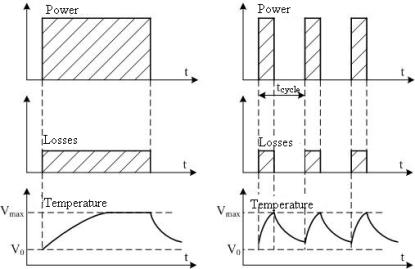
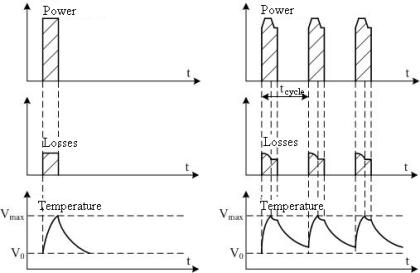
Figure 1– Variation of load, losses and temperature
of the induction motor in different operating modes: а – S1; b – S2; c –
S3; d – S4
Analysis
of the influence of operational factors on induction motors leads to the
conclusion that the high dependence of the motor failure on climate conditions
observed at 20-22 or more stops per day (modes S2-S8). At motors with
continuous operating mode (S1) depending on climatic factors is almost
negligible.
It can be
concluded that the development of mathematical models electric motors
reliability indices along with electromechanical factors need to consider the
impact of climatic factors and mode of operation of the induction motor.
References:
1. Radin V.I. Induction machines: Textbook for
electromech.. spec. univ. / Radin V.I., Bruskin D.E., Zorohovich A.E.; Edited
by I.P. Kopilov– M.: High sch.,
1988. – 328 p.
2. Handbook
of electrical machines / Under the total. Ed. I.P. Kopilov, B.K. Klokov. V. 1.
M.: Energoatomizdat, 1988. 456 p.