REVISITED THEORIES ABOUT
"LIBERTIES"
AND STATEHOOD OF COSSACKS
Yerokhin I.Yu.
Croydon College, London, Great Britain
Abstract: Cossacks originated as a free ethnic group in
Rus. The concept of "Cossack ethnicity" was introduced into practice.
The situation changes drastically in the course of historical development when
the Cossack community is drawn to the military and government service. A new
Cossacks state ideology was formed, transforming ethnicity into a military
class. Up to the present time there continues to exist an ideology of a free
nation and a worldview of state noblemen. They may come into conflict with each
other. The study of Cossack history and their state ideological orientation is
an important factor in a number of sciences – history, economics, pedagogy,
philosophy, and sociology.
Key words and phrases: Cossacks, Cossack liberties, Cossack
privileges, Cossack ethnic group, Cossack class, state and power, Cossack states,
independence.
From
their very appearance Cossacks were formed solely as a freedom-loving, proud-hearted
and rebellious ethnic group. In historical science, we find a lot of
confirmations and evidences to this. It is difficult to name another cultural
and social ethnographic community of ancient Rus which in such a way cherished
their "freedom" and struggled for it, and held on to their age-old
traditional way of life, as the Cossacks.
S.M.
Solovyov wrote on this occasion: "These were free people, with no
obligations, ready to work for hire and to move freely from place to place,
regardless of their language, religion and origin who were called Cossacks in
Rus since ancient times, at least 14-15 cc. These people belonged to the basic
number of recruits during land reclamation. Many of them have not changed their
way of life – they did not want to live in settled foreign lands, depending on
the circumstances, they preferred belligerent, dangerous, but more freestyle
wildlife in the steppes at the boundaries or farther, beyond the borders of the
state.» [4]
The
thesis of Cossack "liberties" is rather widespread in historiography.
First of all, this is an aristocratic historiography, about which a Soviet
historian A.L. Stanislavskiy says: «For historians of noble "outrageous
Cossacks" were seekers of "wild liberties and capture",
"scum of homeless people," exclusively engaged in robberies, looting,
and looking for prey. The carriers of a destructive and anti-state ominous
beginning, people who strove to live at the expense of society.» [5,p.7] Revolutionary
clerisy of different classes of later times strongly supports and cultivates
the thesis of the rebellious nature of the Cossacks. Their heroes and leaders
are S.Razin, Ye.Pugachev, K.Bulavin.
Indeed,
all the way through its historical development, the Cossacks not once nor twice
took arms in their hands to combat the unwanted power. [1-3] Here is a far from
complete list of the riots, wars and rebellions, where Cossacks participated:
1591 Krzysztof Kosiński Uprising.
1595 Nalyvaiko, Szuła and Loboda Uprising.
1625 Marek Zhmaylo Uprising.
1630 Taras Fedorovych (Triasylo) Uprising.
1635 Ivan Sulyma Uprising.
1637-38 Pavlo But (Pavluk), Dmytro Hunia, Karl Skydan,
Yakiv Ostrianyn (Ostrianytsia) Cossack Uprising.
1638 Yakiv Ostrianyn and Dmytro Hunia Uprising.
1657 Martyn Pushkar and Yakiv Barabash Uprising.
1659 Ivan Bohun Uprising.
1670 Stepan Razin Uprising.
1702 Semen Paliy Uprising.
1707 Kondraty Bulavin Uprising.
1772 Yaik Cossacks Uprising.
1773 Yemelyan Pugachiov Uprising.
Already
in the ancient Cossack history the state was trying to "tame" the
proud and freedom-loving Cossacks. However, this relationship has been
possessing the character of "contractual partnership" for a long
time. This situation would exist until the time of Peter I.
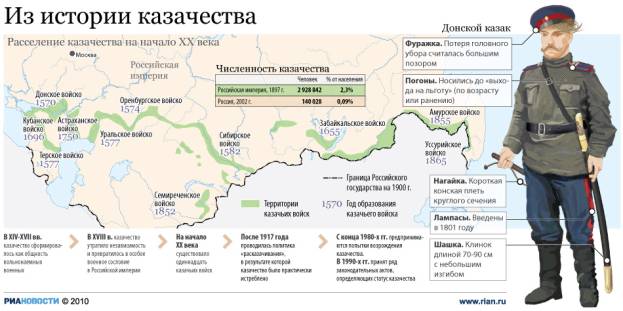
The title
of the largest and most successful Cossack communities which pursued state and
foreign policy can be given to Zaporizhian Sich and the territories of Don
Cossacks. Both communities have a long history, which was studied pretty good
and in detail, and is reflected in a variety of sources.
Unlike
them many other areas settled by Cossacks (Cossack armies) were formed at once as
structural elements of the Russian statehood and fulfilled well defined
functions in the state (such as border protection and expansion of the state).
Since
the beginning of reformist era of Peter I he starts to implement a system of similar measures towards Cossacks
as a part of the overall reformist policy of the state. This was a truly
systematic and focused approach, not occasional relationships with the ethnic
group, as it was before. Peter for the first time acts not as a partner for
Cossacks, though as a head of state. It is quite clear that Cossacks themselves
lose the right of statehood as a consequence of those measures.
When
studying history of Cossacks, their philosophy and development psychology, we
can make an important conclusion about duality of the Cossack community. On the
one hand, there is a desire to serve the state, on the other hand, trying to
preserve a very special lifestyle and a way of life based on the system of
Cossack liberties. This was written and said by many historians, prominent public
and political figures. For example, P.B. Struve, P.I. Miliukov etc. [6, p.4-5]
References
1.Dubrovin N. Pugachiov
and his accomplices. Episode in the history of the reign of the Empress Catherine
II. Saint-Petersburg, 1884.
2. Materials for the history of indignation of Stenka
Razin. Мoscow,
1857.
3.Pushkin A.S. History of
Pugachiov, Applications, The Complete Works in 10 vols, ed. IV, T.VIII. Leningrad: Nauka, 1979.
4.Solovyov S.M. History
of Russia from the earliest times: in 29 vols. – Saint-Petersburg, Publisher: Association "Obshchestvennaya
polza", 1851-1879.
5.Stanislavskiy A.L. Civil
war in Russia in the 17 cent.: Cossacks at a turning point of history. Мoscow, 1990.
6. Contemporaries’ thoughts about the past, present and the
future of the Cossacks. Publisher: Kazachiy Soyuz. Paris, 1928.
http://kvzn.zp.ua/?go=news&nomid=133&news_id=1440
[Electronic
network resource] Recurrence date:
30.05.2013.