Lexico-semantic Field of the Concept
“Sense” in the Works of Sherwood Anderson and Iris Murdoch
A
system of knowledge about the world is constantly developing due to receiving
the significant amount of information emerging in the general concepts. Concepts are certain ideas that exist in the
brain. It is important to pay attention to the “metaphor of iceberg” in order to understand concepts. According to
this theory the language is only the "tip of the iceberg" (small
visible part) and "under water" there are the cognitive processes
involved in the formation of a language.
The
topicality of study is stipulated by the necessity to analyze the
verbalization of the concept “sense”
in the form of lexico-semantic field in the sphere of cognitive linguistics. It
allows us to define the semantics and the implication of the lexemes. According
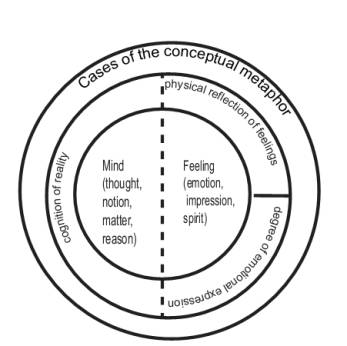
to Z.D. Popova, the lexico-semantic field has the special structure. It consists of the nucleus and the periphery (the
closest, the farthest)
Modern
linguists have identified two types of concepts: the cognitive concept and the concept of a literary text. Concept
of a literary text is understood as the verbalized in fiction
significant mental unit of the individual view of the author, which represents
the common knowledge and reflects the subjective perception of the author's
understanding of the reality.
The
great significance in cognitive linguistics stems from the theory of conceptual
metaphor by George Lakoff and Mark Johnson. The conceptual metaphors in fiction
can be considered as a basic mental operation based on the figurative
expression of concepts.Conceptual metaphors can also be used as a stylistic
device which is filled with the new content of the text.
Our
research involves the study of the concept “sense” in the works of fiction.
Short stories by Sherwood Anderson and novels by Iris Murdoch served as the material
for our research.
Perception
of the reality is very similar in the works of both writers. Considering the
inner world of man, they both describe it as a fragmented, there being a
constant struggle between reason and feeling. This struggle really emphasizes
the tragedy of the reality of the 20th century. This tragedy, I am afraid, has
gone over to the 21 century.
Having
conducted this research, we determined that the nucleus of the concept “sense” in the view of the authors has a
dual nature and relatively equal
verbalization in the text.
Nuclear lexemes will be:
1) feeling and its synonyms — emotion,
impression, spirit, an air of smth;
2) mind and its synonyms — thought, notion,
matter, reason.
However,
the border between them is relative and nuclear lexemes can interpenetrate.
Sherwood
Anderson and Iris Murdoch portray their characters overwhelmed with feelings
and emotions. But they are not capable of self-expression. Sometimes the inner
condition of the heroes is reflected through the verbalized description of
their actions and appearance.
This
fact allowed us to identify 3 main elements of the closest periphery zone of the concept.
1) physical
reflection of feelings;
2) degree
of expression;
3)
the cognition of reality.
The
structure of the farthest periphery
of the concept “sense” is the author’s individual perception, which is
expressed in the text and can be interpreted and analyzed only through the
context. It is formed by the conceptual metaphor. So, there are examples of the
conceptual metaphor in the text:
· Senses (feelings) — “seasons of
wishing”.
· Senses (feelings) — “seeds of
something very fine”.
· “Ghostly band of senses”
· “The sea of senses”
It
should be noted that exactly the context determines the dual nature of the
concept "sense" and discovers the interpenetration of nuclear
elements. This phenomenon can be observed clearly in the stories of Sherwood
Anderson.
· “For years he had been beset by the
notions concerning his heart”.
· “There must be a reason for the
strange activity of the feelings”.
· “When he could not shook off the
illusion his mind give it a professional twist”.
Thus,
while distributing the lexemes to the nucleus and peripheral areas we have
taken into consideration the integral meaning, the additional connotations and
stylistic limitations
. 
Lexemes
that are characterized by the minimal dependence on the context and the lack of
stylistic connotations were assigned to the nucleus of the lexic--semantic
field of the concept “sense .
Units
that have additional shades of meaning were related to the closest periphery .
To
the farthest periphery were related polysemantic, stylistically limited in use,
linguistic units — cases of the conceptual metaphor.