Каlykov А.К., Sarinova K.N.
Kazakhstan, Karagandy
State University named by E.A.Buketov
MARKETING
ENVIRONMENT OF
EDUCATIONAL ORGANIZATION
The main directions of reforming the system of higher education in
Kazakhstan are providing the highly skilled professionals and therefore
progressive development in all spheres
of public life.
"The competitiveness of the nation is
primarily determined by the level of education, the country is not able to
develop knowledge in the twenty-first century, is doomed to failure," -
said the president of Kazakhstan N.A. Nazarbayev in his address to the nation.
It is known
that higher education has a high economic and social importance and plays an
important role in scientific and technological progress, spiritual life of
society in the development and qualitative improvement of the economic system
of the state. In market conditions relations among the sphere of education and consumers, namely by employers is especially important today as a governance integral concept in higher education do not exist. On this issue of works by foreign scholars
abound, but they are generally applicable to the developed markets. This problem
of marketing of educational services is engaged by our scientists but
insufficiently investigated.
Market economic system does not
change the content approaches
to the concept of "education."
It is as a global law of
social development still reflects
the relationship between of subjective human needs in
gaining knowledge and objective needs of
society in their accumulation
and utilization. But the system relations over the education herein can be represented in terms
of marketing. [1]
Motives of human beings in an effort to raise the
educational level of its own in a
market society are varied. Educational potential of personality use to create the material and other
benefits for livelihoods, as
well as to meet their own cognitive and other
needs. [2]
The need for education is
manifested in the conscious or unconscious desire of
learning. Conscious human desire to get a new
level of education (or get additional
qualifications), in which the
person is a subjective or objective needs,
creates the need for education. Acquiring
new knowledge and achieving results in the
learning process, getting private and public
recognition, a person realizes the need
for success. Recognition and success let him to realize the important for every need for
respect. Respect and love for yourself serve the driving motivation of human perfectibility, which
puts him on a higher
level of spiritual needs for
self-actualization. Educational services developed
by the university, are of
value to the consumer. Facilities of the
university let to improve the educational or professional
level personality through
learning, training or retraining,
leading to the achievement of social
effect. Employment is an
important motive for choosing the educational
product requirements, define the prestige of the
university and strengthen its competitive
position among other
universities. After all, on what type of specialty the graduate of the
university was received, and what
quality he was obtained knowledge
and skills acquired, depended
on how popular it would be in the
labor market.
Today, one of the possible responses to the proposal of the university can be an agreement with
the company that satisfied with the quality of university graduates and it is interested in obtaining qualified
professionals ready to provide
high school material, financial or otherwise, in exchange for
a priority right selection and hiring
of graduates of the university in the future. [2]
Today, higher education institutions take into account not only the
provision of quality educational
programs, use of new technologies, but also offer other services that are as urgent and practical
for their target market.
These activities are intended to development of the infrastructure, cultural
and leisure and entertainment centers, etc. These centers provide services
and teaching staff, which is one of the most important groups
in the field of marketing impact.
In market environment, education is the process of providing simultaneous consumption and complex
educational services aimed at changing
the social situation. The usefulness of educational
services for the consumer gives
it in the market product features.
As the university product is intended
for wide range of consumers, marketing
complexity of higher education is the need to also address the sometimes conflicting needs and expectations
of high school audiences. Successful activities of the university depends on
the timely incorporation of market
factors and the ability to solve problems in a single complex product policy, pricing, and price adjustment,
communication, merchandising, marketing,
and personnel problems. Market research should be considered as
a basis for strategic planning of the university, especially as a strategic objective of our country is the introduction of the country in the next 30 years among
the 30 most competitive countries in the world.
More than 20 years of independence
we can speak with pride about the success in the field of national education. Unique
educational projects carried out at
the initiative of the head of state education in Kazakhstan did them not only recognized around the world, but also allowed to enter the five leading countries in the development of
education index. To
consider the main market trends of
educational services we should analyze
the dynamics of the number of pupils in schools:
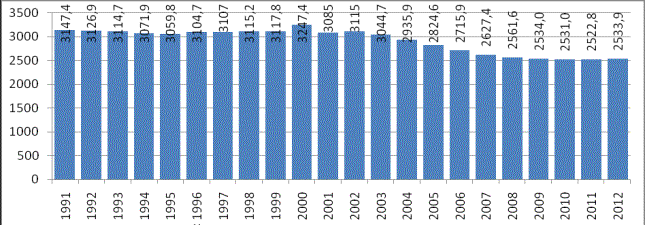
Figure 1 - Number of
students in schools,
thousand
As you can see from the graph,
the number of pupils enrolled in the school for the past 10 years are significantly reduced.
At this reduction may affect a number of factors, they are
fertility decline, social and financial
status, etc., but in 2012 there is a significant increase in this indicator. Formation of
market relations in the sphere of education, the development of competition
took place against the backdrop of
sharp fluctuations in the parameters
that form the demand for educational services. If we consider that
the ratio of the formation to some extent reflects the people's hopes for a
sustainable existence in the
future, important is the fact that
50% of the population was the desire to continue their studies in higher education,
40% - in colleges,
indicating that growth in the number of
universities and colleges (see Figure 2) and only 10% of
high school graduates did not think
about raising the level of their
education. Attractiveness of higher education for the population grew in the national economy the number of
employees with higher and specialized
secondary education remained stable.
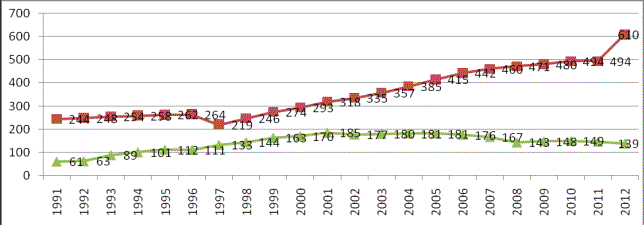
-  number of colleges
 - number of
universities
- number of
universities
Figure 2 - Dynamics of the number of colleges and universities
As you can see from the figure
in the 2011-2012 the academic year in
comparison with the 1991-1992
academic year, the number of higher
education institutions has increased 2.28 times, it is connected with
the increasing number of non-state
institutions, so in this academic year, the number was 64.4% of the total number of universities.
In particular it is noteworthy growth of private higher education institutions. It indicates a rather high level of trust on the part of the population to non-state universities. So the number of the issue of government and private higher education
institutions is over the past three
years is about the same amount.
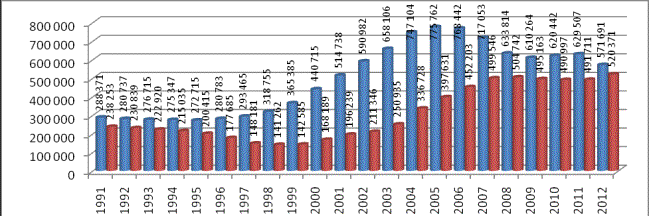
-  number of students of colleges
 -
number of students of
universities
-
number of students of
universities
Figure 3 - Dynamics of the number
of students of colleges and universities
There was also a significant increase
in the number of students in
higher education by 2.0 times, respectively.
Marketing plays an important role in the
development of educational institutions. Marketing of educational services has its own
characteristics only in the practical
application, and all the basic principles it does not differ from marketing in any market
for goods or services.
Motives which drive people
in modern society in an effort to improve their own level of education varied. As the requirements for this particular
type of product is objective and understood by human lack of knowledge and skills it in any
field. The manifestation of the need for education is the human desire to get a
new level of education or to obtain
any additional qualification in
which this person needs.
Quality of higher education is crucial to the successful development of almost any country in the coming twenty-first century. The
revolutionary changes in technology at the turn of the century, based on the highest
level of intellectual resources and
related geopolitical competition for
the world's leading countries such
resources are the most important
factors that determine not only
the economy but also the policy of
the new century. In connection with the level of intellectual potential of the
country that directly determines
the quality of higher education in
the country it becoming the most important factor not only in economic and social
development, but also a factor of
economic and political independence of the country,
its survival factor.
"Quality education" is a
complicated concept. Experts argue that "the
quality of higher education" is characterized by "multidimensionality much subjectivity, many
of criterion, the uncertainty in the estimates invariance and variability." [2]
In this
regard , in our view, the quality of education is a multidimensional concept
that includes the multilateral activities of the university , designed to meet
the needs of : personality - in cultivation, to adapt to changing socio -
economic, political, moral and psychological conditions of life of the
enterprise - in preparation competent staff capable of productivity growth ,
the spread of technological innovation society
in the formation of socially active and adapting to the realities of the
lives of citizens who are guided by universal values, ensuring national income
growth and cultural development. [3]
For the successful implementation
of activities in the education
educational institution we need
to learn how to monitor and, not
least, to predict all important for
him changes in the external and
internal environment. Promptly undertaken measures will help the educational institution to avoid a number of problems
or capitalize on the
situation. In practice, for assessing and
predicting the marketing environment education widely apply
different methods of analysis, as
well as the rating of the attractiveness
of the education market in the
region for the preparation of highly
qualified specialists.
Exactly timely policy
analysis allows educational
institution quickly take
advantage of opportunities. It should be remembered
that the same factor
will be the educational institution
for a favorable opportunity, if it is time to use it
in their work, or threatened if the first competitors will do. The given
circumstance confirms the importance
of continuous monitoring, analysis and forecasting of the marketing environment
of education for educational institutions.
Literature:
1. Ottomans S.A.
Applying the concept of marketing in the education market, Minsk, 2004
2. Posokhova N.V.
Marketing of educational services. Belgorod
State Institute of Culture and Arts. Proceedings of the scientific conference.
(http://window.edu.ru/library)
3. Pankruhin A.P.
Marketing of educational services: theory
and practice methodology. (http://www.marketing.spb.ru).