Экономические науки/6. Маркетинг
и менеджмент
Казахстанско-Британский
Технический Университет, Казахстан
Assessment of innovation Management
at an Enterprise
Abstract: Innovation process hard
to assess, measure and compare. Today, Innovation is a key component of company
success and sustainable growth. Well
deployed innovation process may be a one of the competitive advantage for a
company in any industry, particularly, in fast growing markets. This paper
focused on innovation management assessment on an enterprise, measurement
technics, metrics and indicators.
1.
Introduction.
Innovation is defined as the development and implementation
of new ideas by people who over time engage in transactions with others within
an institutional order. This definition focuses on four basic factors (new
ideas, people, transactions, and institutional context). An understanding of
how these factors are related leads to four basic problems confronting most
general managers:
- a human problem of
managing attention,
- a process problem
in managing new ideas into good currency,
- a structural
problem of managing part-whole relationships, and
- a strategic
problem of institutional leadership.
An innovation strategy should identify and prioritize the
needs for innovation, by examining the mismatch between the future as predicted
and the future as desired.
Innovation strategy must be an ongoing process not a
single-point event.
The need for innovative change often comes from slowly
developing trends, which may be difficult to recognize and respond to. As
companies and competencies mature the focus of innovation moves from products
and services to business processes. Organizations should choose the timing of
innovations with care. Network and threshold effects can give advantages to
earlier entrants.
Roadmapping is a flexible way to formulate and communicate
innovation strategy. Different formats are available for different strategic
issues. Scenario planning can help in charting the more distant future.
We agree with innovation
phenomenon is that
§
Innovation
has a major impact on the economy, it drives business cycles and employment
levels.
§
Economic
cycles can make business conditions harder, but lead to opportunities for
particular innovations.
§
Large
or small companies may equally be innovative. For managers in existing
organizations, the challenge is to maintain or increase innovation levels. For
entrepreneurial managers in start-ups, the challenge is to generate an
innovative idea that can dislodge the incumbents.
§
Most
studies have focused on the manufacturing sector, and only in recent years has
innovation research started to look at the service sector in detail.
§
The way
innovations diffuse through a population or market depends strongly on the
characteristics of the innovation itself and also on the adopters (customers).
Different types of people adopt at different stages of the market and marketing
efforts must adapt accordingly.
The
management psychology literature uses
the educational background of managers to predict innovation. Next managerial attribute is technical expertise
and innovation propensity. The consistent finding in the management psychology
literature is that the level of formal education of central decision makers is
positively related to their receptivity to innovation [1, 2].
Some things are inherently easier to measure
than others. For example, an objective such as “Improve Revenue” is fairly easy
to measure. But other strategic objectives, especially those in the Internal
Business Process and Learning & Growth perspectives have been historically
more difficult to measure.
One seemingly
difficult-to-measure objective is “Innovation”. We typically see “innovation”
as a strategic objective in the Internal Process perspective on the
organization-wide strategy map. Its roots are usually found in a “Grow the
Business” strategic theme and/or “Operational Excellence” strategic theme in
which “transformation through
innovation” is a key
driver[3].
2.
Literature
review
We cannot yet
develop a theory of innovation. But we already know enough to say when, where
and how one looks systematically for innovative opportunities, and how one
judges the chances for their success or the risks of their failure [4].
Peter Drucker viewed
innovation as the tool or instrument
used by entrepreneurs to
exploit change as an opportunity. He argued that innovation, as a discipline,
is capable of being learned, as well as practiced. While he never agreed to a
theory of innovation, he realized enough was known to develop it as a practice
– a practice based on when, where and how one looks systematically for
(innovative) opportunities and how one judges the chances for their success or
the risks of their failure.
From Drucker’s perspective, systematic
innovation consisted of the purposeful and organized search for changes, and in
the systematic analysis of the opportunities such changes might offer for
economic or social innovation [5]. I agree with Drucker at that point.
Due to the strategic intend of innovation itself varies
across organization, innovation process is defined as ideation, evaluation,
selection, development and implementation of new or improved products or
services that must tie with the intended objective. These objectives include an
increment numbers of new ideas, its quality, efficiency in the implementation
of quality ideas as well as improvement in result achieved from the new ideas
implemented[3].
In establish the working measures for innovation process,
common characteristics, inter-relationship of innovation process and
deliverables must be identified [4]. Gupta [6], has proposed three measures to
show innovation performance at various stages: CEO Recognition of Employees for
Exceptional Value Creation, Employee Ideas for Improvement and Innovation Sales
for new products, services or solutions. Other measures are also included such
as allocation of time in percentage for research innovation management, new
idea deployment degree of differentiation, time to innovate, and rate of
innovation. Besides the characteristics, the measurement for innovation process
is explored through different types of innovation process generation. This has
been simplified into five types of innovation process generation: technology push,
need pull, coupling model, integrated model and system integration and
networking model [6].
Malinoski and
Perry [3] proposed the assessment of organization through measure next
objectives or variables:
1. Increased number of new ideas.
2. Improved quality of
ideas.
3. More efficient
implementation of quality ideas.
4. Improved resultant success achieved from the implementation of new
ideas.
3.
Discussion.
A performance
indicator that meets the above-mentioned selection criteria requirements and
captures the four intended results listed above is Return on Product
Development Expense, or RoPDE™ (pronounced “roh-pee-d’ee”).
RoPDE is a
comprehensive KPI (key performance indicator) for measuring the performance of
product/service innovation and development. To establish RoPDE’s thresholds, a
comparison is made to profitability metric, such as Operating Income Margin,
EBIT or EBITDA. Figure 1 is an example of one company’s RoPDE dashboard by
fiscal year. [3]
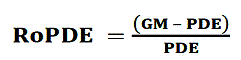
where (GM) is Gross
Margin, and (PDE) is Product Development Expense.
GM* may also be
called gross profit, determined by subtracting cost of sales from revenue. Cost
of sales, or cost of goods sold (CoGS), normally includes the material, labor
and overhead associated with delivering a production unit.
PDE will
typically include the engineering, technician, product marketing and associated
management labor expense, fully burdened (benefits, facilities, IT,
depreciation). Stock based compensation can be excluded if done so
consistently, which will usually simplify the calculation without reducing the
significance of the result [3].
In my opinion
RoPDE is not good enough for measurement and monitoring of innovation process
because it ignores the one of the main resources – time. It doesn’t take into
account time which needs to prepare product before actual production start.
Another lacks
of RoPDE includes:
-
RoPDE ignores complete R&D cost, enterprise might have
high R&D expenses for 10 projects which compensated by success of one
project.
-
RoPDE ignores the fact what some companies doesn’t take into
account the PDE cost or consider it a minor.
4.Conclusion.
RoPDE is good
foundation for universal method of innovation management assessment, because
use standard accounting data, can be used in any phase of product cycle but
needs improvements to consider time, R&D cost of adjacent projects and
distinctive features of the industries.
Bibliography.
1.
Kimberly, J. R. and Evanisko, M. J. (1981) “Organizational
Innovation: The influence of individual, Organizational, and Contextual Factors
on Hospital Adoption of Technological
and Administrative Innovation.” Academy of Management Journal, Vol. 24,
2.
No. 4, pp. 689–713 Rogers, Everett and F.F. Shoemaker (1971)
Communication of innovations: A cross cultural approach, The Free Press.
3.
Malinoski, M. and G.S. Perry How Do I Measure “Innovation” 2011. 1-
4.
Peter F. Drucker (2007) Innovation and Entrepreneurship: Practice and
Principles, Routledge.
5.
McKeown, M. (2008) The Truth About Innovation, Prentice
Hall.
6.
Gupta, P. (2007) Firm
Specific Measures of Innovation. Measures of Innovation Proposal.
7.
Dodgson, M. and S.
Hinze (2000) Indicators used to
measure the innovation process: defects and possible remedies. Research
Evaluation.