UDC
581.1
APPLICATION OF CELLULAR BIOTECHNOLOGY FOR STORAGE OF ASPEN
BIODIVERSITY (Populus tremula L.)
Lyutsiya Aubakirova*, Elena Kalashnikova ***
* Eurasian national university named after Lev Nikolaevich Gumilev,
010000, Astana, Republic of Kazakhstan, web: www.enu.kz
*** Russian
State Agrarian University –MSAU named after Konstantin Timiryazev,
web:www.timacad.ru
The technology of
clonal micro propagation of the
Populus tremula L. at the expense of
activation the meristem existing in a plant and induction of adventives buds’
formation from primary and graft callus tissue is elaborated.
Key words: the
Populus
tremula L, crop of a tissue, micro
sprouts, adventives buds, callus genesis, meristem.
Aspen (Populus tremula L.) -
member of the genus Populus (poplar), is a tree specie widely spread in Russia, growing on a wide variety of
soils, both in pure plantations and in mixed forests. For the Republic of
Kazakhstan Aspen is one of the most
important wood forming species, where it presents by itself the tree of the
first magnitude: its height is up to 35-40 m, diameter is up to 80-90 cm. In the forests of the Republic of Kazakhstan
aspen plantations grow in the area of 238 thousand hectares, which is more than
21% of the area covered by forest vegetation. Despite of the fact that nowadays
more than 14 thousand hectares (more than 6% of the breed) took over-mature
aspen, its annual average growth in the forests of the republic more than 4.7
m/ha. Current growth plantations of the best forms often exceeds 20 m 3 / ha.
Until recently, the aspen were viewed as "secondary" low-grade
species, often rotten from the first years of its life. Due to this in many
instructions it is recommended to replace aspen plantations with pine or oak
plantations. Currently, however, in most countries the major challenge is to
grow the forest fast growing trees to produce wood for pulp and paper, chemical
and lumber industries.
Fast-growing species allow preserving a balance between consumption and
the reduction of wood pulp for many years. Great significance in the
normalization of the balance between consumption and reproduction of forest
plantations from becoming fast growing species of wood. At the present time in
Russia and another foreign country have developed technologies for cultivation
of such plantations.
To
the establishment of plantations of energy forests great attention was paid by
many European countries - Britain, France, Germany and others. In Kazakhstan
while energy plantations are still poorly developed. In the stage of
experimental-industrial are located power stations, for which the organized
cultivation of energy forests, that is, working for the burning of wood. Widely
used waste products of wood recycling and lumbering and also energy peat for
the production of properties of heat and power energy (countries of
Scandinavia) (Alekseev, Krasovskaya, 1995).
Awareness of the problem of energy security in the world first occurred
in connection with the repeated increases in oil prices.
Particularly great importance of aspen tree as of a fast-growing tree
species, easily reviving in natural way. Its stands’ age of maturity comes in
2-2,5 times faster in comparison with the coniferous and oak species. This
allows using wood efficiently in the quality of heat sources. The cost of
cultivation of aspen wood is cheaper than pine, fir and oak, and consequently
the demand for aspen wood will grow. However, the main plantations of aspen in
the Republic of Kazakhstan is characterized by extremely low marketability, due
to the defeat of fungal diseases, causing for rot and reduces in the quality of
the wood. At the same time, there are clones of aspen which are resistant to
fungal diseases, and characterized by full arborous trunks and high
productivity.
With the increase of anthropogenic impact of human activities on the
environment leads to the sharp rise of biodiversity of vegetable, as in the
level of species and of ecosystem. The burning issue of the day in the republic
is the preservation of different types of aspen (clone) and the diversity of
stable aspen phytocenosis.
One of the promising methods for the preservation biodiversity of plants
is the application of biotechnology, cell and particular method of clonal micro
propagation, significantly reduces the time needed to obtain high-quality of
the material (Kalashnikov, 2009).
Materials and Methods. As an object of research served one-year sprouts of
15-20 cm long, isolated from the crone of an adult tree of the Populus tremula L. Sprouts contained top and axillary
sleeping buds. Cut buds were placed in a vessel with water and kept in the room temperature until the stage of a green
cone’s and young sprouts’ occurrence, which was further, used for
introduction to the culture in vitro [4].
Sprouts were processed with the use 96 %
spirit, after what they were divided into segments (1-1,2 cm) and put in the saturated solution of hypochlorite
sodium for 30-45 minutes or in 3 % solution chloramines. Further, the sterilized segments were washed out with the use of the sterile
distilled water and put it into sterile
nutrient medium of Murasiga and Skuga [5] containing BAP(three times 6-benzilaminopurin)
in the concentration of 0,5 mg/l and 2,4-D (2,4-dichlor phenolacetic acid) 0,2
- 1,5 mg/l or IAA (0.5 mg/l) and NAA(naftilacetic
acid) 0,2 mg/l inducing the process of callusogenesiss or the activation of
developed existing meristems. [6, 7].
Explants grew up
plants in a light room, where the sustained temperature was about 26°С and 16-hours photoperiod
and 3 thousand lux intensity of light were supported. [8].
For
the regeneration of sprouts from the callus tissue there applied a nutrient
medium, containing mineral salts under the
prescription of Murasiga and Skuga or WPM with an addition of various cytokine to regeneration of runaways (BAP, kinetin) - 2,0
mg/l in a combination with 2,4-D, NAA or IAA in the concentration of 0,5 mg/l.
The
rootages of micro sprouts in vitro were spent in a nutrient medium WPM containing IMK in the concentration of 3 mg/l.
Results and
discussion. Researches have
shown that in the process of cultivation explants in vitro within 3-4 weeks in a nutrient
medium MC, containing 2,4-D and BAP there was observed the formation
unorganized growing callus tissues fabrics of friable type in a basal parts of
a sprout. It is experimentally fixed that the process of callusogenesis is in
direct dependence on the concentration 2, 4-D in a nutrient medium. However,
with the raised concentration of the given auxin there observed the decrease of
a considered indicator (Tab. 1) which is revealed by the intensity in growth of
callus tissue.
Tab. 1 The influence of various concentrations 2,4-D on callusogenesis
in the crop of Populus tremula L tissues
|
Concentration 2,4-D, mg/l |
The formation of a callus, % |
Increment of callus tissues, mg |
|
0,2 |
0 |
0 |
|
0,5 |
40,1±8,2 |
39,7±1,4 |
|
1,0 |
66,7±9,8 |
62,0±2,1 |
|
1,5 |
43,4±7,9 |
56,0±1,2 |
Thus, it has been revealed that the basic condition
for the callusogenesis in the crop of Populus tremula L tissues is an addition exogenous auxin 2, 4-D in concentration of 1
mg/l.
As the main factor, initiating secondary
differentiation of cells is the balance of phytohormones , the influence of
auxins- indolylasetic acids (IAA) has been investigated; naftilasetic acids (NAA);
2,4-dichlorfenolasetic acids (2,4-D) and cytokine - 6-furfuralaminopurine (kinetin)
and 6-benzilaminopurine (BAP) to the formation morphogenetic structures in the
callus tissue of the Karelian birch. As an initial material heterogeneous
globular calluses of green color were used. As the basic environment МС environment was used. The account of the received data
was drawn in 30 days from the moment of the cultivation of callus tissues in inducing
environments (Tab. 2).
Tab. 2 Influence of phytohormones (mg/l) to the morphogenesis of the
crop of Populus
tremula L tissues.
|
Considered indicators |
Kinetin 2 |
BAP 2 |
||||
|
IAA 0,5 |
NAA 0,5 |
2,4-D 0,5 |
IAA 0,5 |
NAA 0,5 |
2,4-D 0,5 |
|
|
The number of morphogenetic
callus , % |
42,3±3,7 |
33,2±2,6 |
12,3±2,7 |
73,6±6,4 |
45,3±4,7 |
15,7±4,3 |
|
Average number of adventives
buds for 1 callus, piece |
4,6±0,4 |
3,7±0,3 |
3,3±0,7 |
8,1±0,9 |
4,7±1,3 |
4,0±1,0 |
After four-week cultivation from callus
tissue there started the formation of
morphogenetic structures presented by dense dark- green areas (meristematic centre),
consisting of a cone of increase and leaf rudiments. Further plants-regenerators
were formed from them. From the table 2
it follows, that the maximum increase in coefficient of reproduction is reached by addition to the nutrient medium IAA in
concentration of 0, 5 mg/l and BAP 2 mg/l. The average of the induced buds de novo in this variant makes 8, 1 pieces on one callus. In
other variants considered indicators were for 1, 5-2 times lower, and generated
adventives buds distinguished with reduced growth.
Repeated
cultivation of callus tissue on investigated variants of nutrient mediums again led
to the formation of adventives on the average of 6-8 pieces for one callus,
from which, in consequence, micro sprouts were formed.
Generated sprouts propagated with the use of the method
of activation of development in a plant meristem (cutting) which is based on
removal of apical dominance. Thus divided into the segments, containing two buds
and cultivated on non hormonal to a nutrient medium with half maintenance in
its structure of macro salts under the prescription WPM or Murasige and
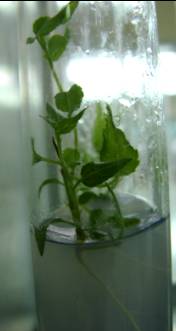
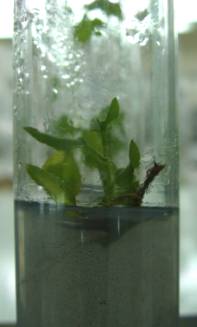
Skuga. In these conditions an active growth of buds and formation of the micro
sprouts characterized by normal morphology are observed. FiG.1
A B
FiG.
1 - Development of the aspen micro shoots of axillary buds: A - WPM, B - Murasige and Skuga
The multiplied micro sprouts implanted on nutrient
medium WPM containing IAA in
concentration of 3 mg/l. The percent of the root plants has made 85, 3 %.
Thus micro cuttings received in this way were transferred to rooting
medium containing IBA at a concentration of 2 mg / liter. Cultivation of
microshoots during 1-1,5 months in these conditions contribute to
gross-perpetuating of microshoots, which later were ready to transfer to the
conditions in vivo (FiG. 2). The entire cycle of micro propagation realized in
a light room where the temperature was 23, 24-hour photoperiod and the light
intensity of 1250 lux.
Formed aspen plants under in vitro conditions differ on biometric
indicators, despite the same period of their growth in vitro. Plants
regenerated the triploid forms were characterized by more rapid growth of
(2,0-5,5 cm height) and 95% had well-developed root system.
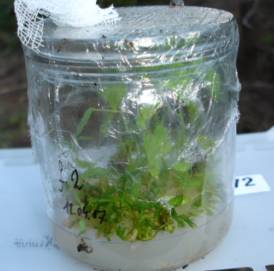
FiG.
2. - Tube plants of aspen
An adaptation vitro plant was carried out in greenhouses, which were
equipped with the installation of artificial fog. Relative humidity ranged from
90% to 65% as the acclimation of plants. Our experience has shown, the term
transplant plants from the conditions of the in vitro conditions in vivo, has a
significant impact on the survival rate of test-tube plants. The best time to
transplant test-tube plants is spring or early summer. Plants with 2-3 leaves
and well developed root system capable of adapting to the conditions in vivo.
Regenerated plants were grown in pricked out
packets or transferred directly into the soil, consisting of accessible
forms of nitrogen (NH4 + NO3) - not less than 130mg/kg, phosphorus (P2O5) - not
less than 250 mg / kg of potassium (K2O) - not less than 400 mg / kg, the mass
fraction of moisture - not more than 65%, the pH of saline suspension - 6,6.
Fertilizing of plants was conducted daily with mineral fertilizers "Kemira
lux” by adding a chalk or lime.
Equally important, in our view, in vitro adaptation of plants to soil
conditions has the height and physiological state (e.g., degree of rooting) of
regenerated plants. The received data testifies about the existence of
genotypic dependence and the ability of plants to adapt to the conditions in
vivo. It was established that the triploid aspen were characterized by high
adaptative capacity (65%) compared with diploid forms (30%) and had a high
shoot 2 times larger than the diploid form.
Adapted plants reached a height of 25-30 cm were carried to the area of
plantations. An inventory of uterine plantation in the end of September showed
that the growth of seedlings in height of open ground for triploid and diploid
forms of aspen was 25.8 and 15.2 cm respectively.
Thus, in vitro methods to allow receiving successfully sufficient
quantity of planting material of highly productive aspen, and resilience to the
core rot. Potential method is far from exhausted, and some of its stages can
still be improved. Genetic identity of planting material with maternal copy
allows carrying forestry practically on the basis of grain - to grow plants
with known properties (Shabunin, Podolskaya, 2005). The most promising in terms
of the Republic of Kazakhstan
References:
1.
Alekseev V.V., Krasovskaya T.M. The use of forest fuel / / Vestnik of Moscow University. Cer.
Geography, 1995. - № 4. - S. 21-26.
2.
Bagaev S.N. Bagaev E.S. Genetic reserve of giant aspen / / Forestry. - № 1990.
- № 4. - S. 45-48.
3.
Kalashnikova E.A. Cell engineering of plants. Textbook, 2009, Univ: RGAU-MAA,
93 sec.
4.
Shabunin, D., B. Podolskaya .Aspen from the tube / Forest Russia, 2005. - № 10.
- S. 24-25.
5. Ualikhanova Zh, Biotechnology of a plant. Almaty, ЖСШ «Дәуір», 2009.
6. Taliansky M.E.
Biotechnology and plant growing / in book. Biology of our days. М, Knowledge, 1987. - s.77-95.
7. Butenko R.G.Biology of cells of tall plants in
vitro and of biotechnology on their basis. М, the
FBK-PRESS, 1999.
8. Kalinin Ф.Л., Sarnatskaya Century В, Polishchuk V. E. Methods of crops of tissue and cells in physiology
and biochemistry of plants. Kiev, Naukova Dumka, 1980.
9. Murashige Т, Skoog F. A revised medium for rapid
growth and bioassays with tobacco cultures//Physiol. Plant, 1962. Vol.15, № 3.
P. 473-497.
10. Kataeva N.V., Butenko R.G. Clonal micro
reproduction of plants. М: the Science, 1983.
11. Laboratory-practical lesson of an agricultural
biotechnology: Methodical instructions. Under the editorship of V.S.Shevelukh M
MACA, 1991.