ГЕОГРАФИЯ И ГЕОЛОГИЯ/9. Экономическая география
Doctor of geographical scientists, academician of
National of Sciences of the Republic of Kazakhstan, professor Beisenova
A.S.,
Askerbekova A.M.
KazNPU named after Abai, Kazakhstan
KAZAKHSTAN’S POTENTIAL
FOR WIND POWER
This
article considers the problem of development of wind power as one of the most
perspective and available sources of alternative power engineering in
Kazakhstan.
Abstract: Kazakhstan is a country
rich in natural resources—particularly oil, natural gas, and coal—but it should
nevertheless diversify its energy supply to include non-carbon sources. Wind
power are particularly well-suited to this country, which has one of the best
wind sites in the world and the highest per capita solar insulation. Wind
energy is already competitively priced with new coal plants, and concentrated
solar thermal power, which can serve both base and peak loads, will soon be
competitive with natural gas. Moreover the costs of both these energies are
insulated from fluctuations in fuel prices and legislation that will restrict
carbon emissions, providing a level of investment certainty unavailable with
fossil fuels. Together, these technologies will allow Kazakhstan to drastically
reduce its reliance on coal, and could actually position the country to become
a clean energy exporter in a region with high energy demands but limited
generating capacity.
Keywords: Kazakhstan, Wind Power, Energy, Wind farm, Climate Change
Introduction
Kazakhstan
is a country rich in natural resources—particularly oil, natural gas, and
coal—but it should nevertheless diversify its energy supply to include
non-carbon sources. Not only is there an environmental imperative for this
shift, there is also an economic rationale. National coal production has fallen
due to both an increase in mining accidents and the declining economic
viability of coal in Kazakhstan (Energy Information Administration (EIA) 2008).
Moreover, coal-fired power plants in Kazakhstan lack flue gas treatment, and
thus cause extensive regional air pollution (United Nations Development Program
(UNDP) and Global Environment Facility (GEF) 2004). The production of oil and
natural gas, while a boon for the economy, has also resulted in extensive
environmental damage. All three of these resources contribute to global climate
change through the emission of carbon dioxide. As international efforts to cap
or tax carbon begin to gain traction, substitutes for carbon-intensive energy
sources will capture a greater market share. As Kazakhstan’s economy continues
to grow, its energy needs will also expand. By channeling a portion of its
considerable oil and natural gas revenues into clean energy production,
Kazakhstan would be able to accomplish several related objectives. Not only
would it diversify its own economy and lay the foundations for a sustainable
energy future, but, in a region with growing energy demands and irregularly
dispersed natural resources, Kazakhstan could take a leadership role in both
providing and developing renewable energy. This can be accomplished by
investing now in wind .
Wind energy. Energy transferred with the motion of air in
the lower atmosphere that arises from differential heating of the earth. The
energy in the wind can be extracted as mechanical energy to do work such as
grind grains (a wind mill) or generate electricity (wind turbine).[2]
Wind energy is
important because it holds immense potential in supplying electricity across
the world. Unlike other sources of electricity that require fuel in processing
plants, wind energy generates electricity through wind, which is free. Wind is
considered a native fuel that does not need to be transported or mined,
eliminating two costly expenses from long-term energy expenses
ADVANTAGES OF WIND POWER:
1. Renewable
Energy : Wind energy in itself is a
source of renewable energy which means it can be produced again and again since
it is available in plenty. It is cleanest form of renewable energy and is
currently used many leading developed and developing nations to fulfill their
demand for electricity.
2. Reduces
Fossil Fuels Consumption :
Dependence on the fossil fuels could be reduced to much extent if it is adopted
on the much wider scale by all the countries across the globe. It could be
answer to the ever increasing demand for petroleum and gas products. Apart from
this, it can also help to curb harmful gas emissions which are the major source
of global warming.
3. Less Air
and Water Pollution : Wind
energy doesn’t pollute at all. It is that form of energy that will exist till
the time sun exists. It does not destroy the environment or release toxic
gases. Wind turbines are mostly found in coastal areas, open plain and gaps in
mountains where the wind is reliable, strong and steady. An ideal location
would have a near constant flow of non-turbulent wind throughout the year, with
a minimum likelihood of sudden powerful bursts of wind.
4. Initial
Cost : The cost of producing wind
energy has come down steadily over the last few years. The main cost is the
installation of wind turbines. Moreover the land used to install wind turbines
can also be used for agriculture purpose. Also, when combine with solar power,
it provides cheap, reliable, steady and great source of energy for the for
developed and developing countries.
5. Create
Many Jobs : Wind energy on the other
hand has created many jobs for the local people. From installation of wind
turbines to maintenance of the area where turbines are located, it has created
wide range of opportunities for the people. Since most of the wind turbines are
based in coastal and hilly areas, people living there are often seen in
maintenance of wind turbines.
Despite these advantages there few disadvantages too
which makes wind turbines not suitable for some locations
Wind power capacity has expanded
rapidly to 336 GW in
June 2014, and wind energy production was around 4% of total worldwide
electricity usage, and growing rapidly. [Annex 2 3]
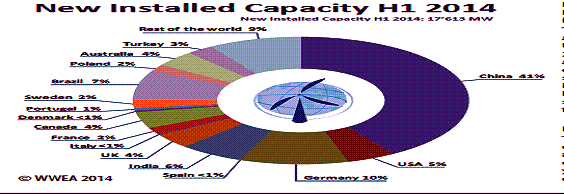
Annex 2-New installed capacity
The actual amount of electricity that
wind is able to generate is calculated by multiplying the nameplate capacity by
the capacity factor, which varies according to equipment and location. Estimates of the
capacity factors for wind installations are in the range of 35% to 44%.[4]
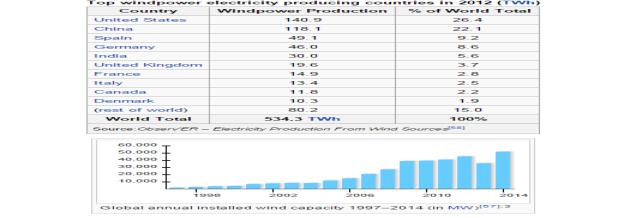
Wind potential in Kazakhstan. Kazakhstan is exceptionally rich in wind resources.
About 50% of Kazakhstan’s territory has average wind speeds about 4-5 m/sec at
a height of 30m, the deminimus figure for good technical potential wind energy
development. In some estimates the wind potential of Kazakhstan forms about
1820 billion KW/h per year spread over the significant territory of Kazakhstan.
Most windy sites are located in Caspian sea area in Atyray and Mangistay
oblasts, in center of Kazakhstan in Akmola, Karaganda oblasts and some areas in
the South of Kazakhstan. A country wide-wind atlas is available (Annex 3.)
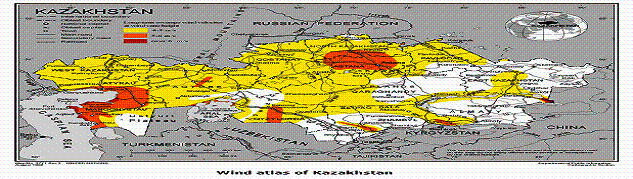
Annex 3- Wind atlas of
Kazakhstan.
With a density of wind capacity about 10
MW/sq.km there is a possibility to install thousands MW of wind farms in
Kazakhstan. The success in developing wind energy in Kazakhstan is largely
dependent of the availability of reliable meteorological data on wind
potential. Detailed meteorological data is used in feasibility studies for the
justification of the construction of large wind farms. Detailed wind data is
gathered using specialist meteorological equipment mounted on masts at a height
of 30-80 meters over a minimum of one year. Such measurements have been
accomplished for Djungar Gates and Chylyk Corridor in a frame of the UNDP/GEF
project on wind energy in 1998-2000. Thus, in Djungar Gates – wind potential is
estimated as 525W/m2, in Chylyk corridor is about 240W/m2 accordingly. Power
production of wind turbines in these places could achieve 4400kW/h/MW and
3200kW/h/MW respectively. The data confirm about excellent wind potential in
Djungar Gates and good wind potential in Chylyk Corridor. Both sites are
considered as very perspective for large wind farm construction.
The UNDP project on wind
energy continue carry out detailed wind study on most promised sites in
Kazakhstan in order to evaluate wind potential and to prepare the Kazakhstan
wind atlas. The data will be used for the feasibility study for wind farm
construction and small wind installation.
On the basis of study, funded by UNDP and
executed by Kazselenergoproekt and Energieteam Company (Germany), a list of
prospective sites was prepared for the construction of large wind farms in
Kazakhstan. The sites for the construction of wind farms were selected on the
basis of long-term data from meteorological stations on average wind speed,
computer analysis of Kazakhstan territory taking into account the following
factors:
1.
availability of
electricity grid and sub-stations for transmission of wind power;
2.
suitability of the
topography and the altitude of the site;
3.
presence of electricity consumers;
4.
presence of transport communications;
5.
practicality of wind
farm construction;
6.
presence of preliminary
developmental works of wind farms construction;
The list includes 20
sites around territory of Kazakhstan and attached as [Annex 4].
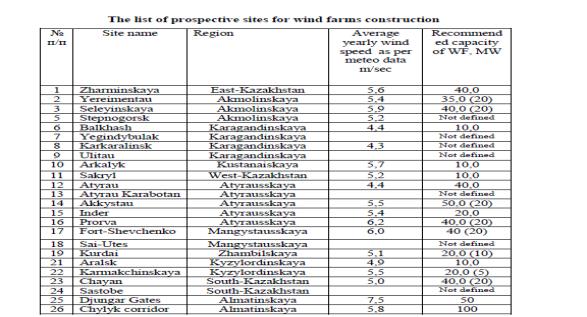
Annex 4- The list of prospective
sites for wind farms construction
The success in
developing wind energy in Kazakhstan is largely dependent of the availability
of reliable meteorological data on wind potential. Detailed meteorological data
is used in feasibility studies for the justification of the construction of
large wind farms. Detailed wind data is gathered using specialist
meteorological equipment mounted on masts at a height of 30-80 meters over a
minimum of one year. Such measurements have been accomplished for Djungar Gates
and Chylyk Corridor as part of the UNDP project on wind energy. Thus, in Chylyk
corridor the average wind speed is about 5.8 m/sec
at the height of 10m with a generation potential of 240W/m2 and in Djungar
Gates – 7.5m/sec and 525W/m2 accordingly. Energy production from wind turbines
in these places could achieve 3200kW/h/MW and 4400kW/h/MW respectively. The
data confirm about excellent wind potential in Djungar Gates and good wind
potential in Chylyk Corridor. Both sites are considered as very perspective for
large wind farm construction. The UNDP project on wind energy continue carry
out detailed wind study on most promised sites in Kazakhstan in order to
prepare wind potential assessment and the Kazakhstan wind atlas. The data will
be used for the feasibility study for wind farm construction and applying small
wind installation.
Economical aspects of
wind energy development
Kazakhstan is exceptionally rich in
wind resources. Many sites around the territory of Kazakhstan have average
yearly wind speeds of 6 m/sec and above, the level that provides acceptable
technical performance for a wind energy development. The cost of energy from a
wind farm in such places will be about 5,5 to 6,5 cents/kWh taking into account
the necessary performance of the capital invested. This compares very
favourably with the alternative of generating power from high cost gas and coal
when including the cost of long distance transmission.
In order to fully understand the
role of wind it is necessary to consider a number of issues. Wind energy is
naturally intermittent in nature and therefore can only form a part of any
energy system; it is necessary to balance wind power with schedulable forms of
generation. Nevertheless, the incorporation of wind energy to a system will
reduce the overall dependence on fossil fuels.
Kazakhstan traditionally relies on
its vast reserves of coal for power generation. This coal is located largely in
the Central of the country, around Karaganda, and Ekibastus. The majority of
power generation plant serving the country are also located in this area, with
large transmission lines delivering power to where demand exists. In Western
Kazakhstan it is expected that gas production associated with the petroleum
industry will provide a future source of electricity.
Accordingly, many places in Kazakhstan
rely on power to be transmitted over very large distances from the centres of
power generation. Such transmission results in significant losses of power due
to aging transmission infrastructure, inefficiency and also from theft.
In the United Kingdom the total
power production is nearly 300 bn kWh/year, carried on a transmission system of
14 000km. Therefore, the density of power on the system is 21MWh/km. In
Kazakhstan 67 bn kWh are carried on a system of 24 000km, equivalent to
2,8MW/km. In other words the Kazakhstan power industry must invest in 10 times
as much infrastructure for an equivalent amount of transmission as the UK. Such
reliance on infrastructure means either significant cost, or significant losses
due to long transmission and aging systems.
Increasing power supplies to such
remote areas to meet expanding demand would involve significant capital
expenditure to upgrade, replace and renew transmission infrastructure in
addition to the capital expenditure for the upgrade, replacement and renewal of
generation plant. By placing appropriate generation close to the point of
demand in such areas, capital expenditure on transmission infrastructure can be
reduced and losses avoided. The structure of transmission charging in
Kazakhstan is to pay a transmission charge that varies with the location of the
consumer. This system does not incentivize efficiency and does not allow the
recognition of savings to the overall network through local power generation.
If an allowance is made for the
necessity of capital expenditure on infrastructure in the commercial assessment
of a project, then the price per kWh supplied locally to the generation plant
that is required by a wind power project is balanced by the associated savings
in transmission improvements.
This cost compares with the energy
from new coal energy station. Thus, for regions with very good wind potential
and an energy deficit, wind farms can be an economical alternative for the
construction of new coal power stations, at the same time possessing
indisputable ecological advantages.
Coal fired power stations currently
operating in Kazakhstan are selling electricity at a price of about 1 US
cent/kWh, broadly similar to the marginal cost of operation. New capacity,
which will be necessary to meet the rapidly increasing demand for power in many
areas of the country, will not be able to operate at such low income levels but
will charge at a level to cover the cost of capital investment.
Power is transmitted by the state
owned electricity transmission company, Kegoc, with a charge structure based on
the location of the customer. There are eight transmission regions each with a
unique flat charge. Regional charge bands are loosely based on average
transmission distance and bulk volume of electricity supplied.
In order to meet increasing demands
for power in areas remote from the centers of power production it is necessary
to consider the investment required to upgrade and expand existing and to
construct new transmission infrastructure.
The true price of power supplied to
a remote area of Kazakhstan therefore should reflect the marginal cost of
production + the cost of capital employed in new plant + marginal cost of
transmission (which must include losses)+ the cost of capital employed in the
new infrastructure. The price of power from a newly-constructed local wind farm
compares well to this total when the true costs are reflected.
Unfortunately the current convention
of charging flat rates for transmission does not facilitate savings on cost of
capital required for infrastructure expansion, or on losses, by reflecting the
true cost of transmission over long distances. A wind power generation project
located in a remote area serving local demand saves the network a significantly
greater amount than a wind farm located close to, and operating in direct
competition with, a coal-fired power station. The savings can be demonstrated
but unfortunately, for the wind farm to be able to benefit from the system
savings, it will be necessary to create a charging mechanism that balances the
inequality.
Over the past 20 years it has become
normal global practice to compensate for disadvantages in the market by
granting renewable energy generation certain privileges. State regulation
provides support for the development of renewable energy and can be combined
with international financial mechanisms such as the flexible mechanisms of the
Kyoto Protocol. Regulation can ensure that the true value of wind energy is
reflected in the incomes while Carbon Credits generated by a wind farm can be
traded on international markets to provide a valuable additional income.
However for the use of Kyoto Protocol mechanisms it is necessary for
ratification by Kazakhstan.
It is not suggested that wind power
should replace coal or gas-fired power generation. Wind is a complementary form
of generation that adds additional value to a fossil fuel based generation
system. A system without wind power may be reliant on large, centrally located,
environmentally damaging power plant transmitting power over long distances. It
is sensitive to world fossil fuel prices and to physical damage to the system.
By including wind in the system, a degree of security is provided from
fluctuations in fuel prices, physical security of the network is enhanced and
cost effective power can be provided to outlying regions of the country.
Ecological aspects of
wind energy development
Wind farms do not consume organic
fuel and by this way do not emit to the atmosphere products of fuel combustion
neither do they produce solid waste products. Each KW/h of energy from wind
farms, which replaces energy from coal station, prevents harmful emissions to
the atmosphere of sulfur oxides, nitrogen oxides, fly ash and greenhouse gases,
as well as storing of ashes-slag waste products. The installation of a 500MW
wind farm with yearly production of 1.5 million MW/h of energy will prevent
yearly emissions to the atmosphere of:
- 1, 5 ml tons of GHG
- 12000 tons of sulfur oxide
- 7800 tons of nitrogen oxide
-12 600 tons of fly ash as well as of the dumping of 420 000 tonnes of
bottom ash/slag material.
The down side to the development of
windfarms includes the possible bird strikes. Research has shown the impact on
birds is significantly less than that from collision with auto transport,
buildings, constructions and others. Noise is insignificant and is mitigated by
the installing turbines remote from habitation, at least 1km from the nearest
dwelling.
Social aspects of wind
energy development
The development of wind energy has
the following social effects:
- creation of conditions for social and economical development in energy
deficient regions and remote rural regions by the improvement of access to
energy,
- contribution to the development of local industry, small and medium
business and the creation of new jobs,
- contribution to country industrialization and the development of
modern technologies, science and techniques.
Thus, Kazakhstan possesses
significant energy resources such as fossil fuel, and has established a
developed power industry, which secures energy consumption and covers power
demands of the country for long term perspective. Yet, the analysis
demonstrates the irrational use of energy resources. Kazakhstan’s GDP proves to
be a rather power-consuming one and significantly exceeds the corresponding
indicators of the developed countries, causing decline in the economical
competitiveness of the country. Mainly Kazakhstan relies on coal reserves for
centralized power generation and transmission, and such state of affairs
results in significant power losses and extensive environment contamination.
Kazakhstan possesses significant
renewable energy resources primarily hydro and wind energy. Successful use of
such renewable sources may provide local energy supplies and contribute to
network security and stability, cost reduction and environmental preservation
in long term prospective. Kazakhstan is rich in wind energy resources and has
big wind energy development potential. Meanwhile the power industry of
Kazakhstan does not seem to apply this modern and highly-developing technology.
One of the barriers is lack of the legislative and regulative support, which
would take an account of the renewable energy benefits for the community within
the market boundaries of the power industry
Conclusion
Kazakhstan is in
a position to both diversify its economy and meet its electricity needs by
supporting the development of carbon-free energy. Wind are particularly
well-suited to this country, which has the highest per capita solar insolation
and one of the best wind sites in the world. In the near term, Kazakhstan
should expand its existing wind program to meet the needs of the
electricity-deficient but wind-rich southern region. From this base, wind
technology can be introduced to other regions of Kazakhstan with favorable
conditions. In the long term, the government should augment wind with
concentrated solar thermal plants located throughout the Kazakh steppe.
Together, these technologies will allow Kazakhstan to drastically reduce its
reliance on coal, and could actually position the country to become a clean
energy exporter. To achieve these goals Kazakhstan should not limit itself to
existing legislation, but should set an aggressive renewable portfolio standard
that requires a significant percent of electricity to be generated from
renewable sources.
Bibliography
1. Report Prospective of Wind Power Development in
Kazakhstan (Prepared in
a frame of the UNDP/GEF and Government of Kazakhstan wind power project”)
Almaty, 2006
2. http://www.windenergy.kz/rus/articles/
3. The
WorldWind Energy Association 2014 Half-year Report WWEA Head
Office Bonn, Germany
4. Cherednichenko,
V.S. and A.V. Cherednichenko 2007. Potential of Renewable Energy Sources Usage
in the Republic of Kazakhstan (based on MARKAL Model).
http://www.reeep.org/file_upload/5272_tmpphpp706wP.doc [Accessed 15 April
2008].
5. .
A Comparison of Wind Power Industry Development Strategies in Spain,India and
China. Prepared for the Center for Resource Solutions.
http://www.resourcesolutions.org Petersen, Erik. 1999.
6. Mission report about assistance with a 5 MW pilot WPP
at Djungar Gate South-East Kazakhstan 2005 re-consult Ltd. Christian Johannes
7. Wind resource of Kazakhstan – Wind Atlas. PB Power. 2009 PB
Power.