Engineering science/mechanical Industry
УДК 666.97.052
Candidate of technical sciences Nurmukhanova A.Z., Candidate of physical and mathematical sciences Mukhtarova M.N., Nurseytova A.K.,
Konakbaev B.O.,
Ermaganbetova S. D.
Kazakh National University named after Al-Farabi, City
of Almaty
Republic of Kazakhstan
Analysis of the causes of concrete made installations’
failures
Before the
country’s building complex there are major problem issues which include the
further industrialization of construction area, serial converting it into a
single process of building the objects from prefabricated elements,
acceleration, creation of advanced technology systems, machinery that provide
comprehensive concrete mechanization works, replacing of time-consuming manual
work by mechanized.
Concrete and
construction mortar is one of the basic building materials. Widespread use in
construction is explained by benefits such as the ability to use in any environment
where there are astringent and local building materials or waste products.
Moreover, concrete and mortar have good performance properties such as high
compressive strength, and in the case of reinforcement - bending and
stretching, high durability, cold resistance, heat resistance.
Normal setting
and hardening of astringent materials occurs at 20 ° C. In the case of
temperature lowering the setting and hardening speed slows down, and at subzero
temperature these processes are slow. In order to create normal conditions for
the concrete hardening in the cold season we need to preliminary heat
aggregates and water or use chemical additives for concrete’s hardening.
For the
preparation of concrete mixes or mortars hardening at subzero temperatures,
liquid antifreeze additives are used (sodium nitrite, sodium nitrite in
combination with calcium chloride, potassium, calcium nitrite in combination
with urea, a compound with urea, calcium nitrite, calcium chloride, calcium
nitrite). The content of additives should not exceed 10 ... 15% of water dose
or 5 ... 7% of the cement dose. In order to increase mixture’s fluidity
simultaneously with antifreeze additives plasticizing are introduced. For
storage convenience is recommended to prepare chemical saturated mortars’
additives. The amount of additives is set in the laboratory and the driver must
strictly withstand them.
The temperature
of the mixture at the outlet of the mixer in winter conditions should not be
below than 5 ° C. The temperature of
the mixture while existing of the mixer, as well as water temperature and
aggregates are being controlled not less than in 2 hours.
Mixing plant
(Figure 1) works as follows.
Inert materials
are loaded by front loader into the storage hopper 1. To improve the fluidity
of inert materials the installation is equipped with vibrators 2, further
through the shutters inert materials are preceded into the hopper.
Simultaneously
with a supply of inert materials cement’s 3 batcher, water and chemical are
filled by the specified quantity. Cement and batcher 4 are supplied from the
cement warehouse. Supply control is carried out by control panel. Water supply
is provided by the tank’s pump. Pump control is made from the driver’s cab.
For the operation
of gate dosing and unloading concrete mixers, mixing plant is equipped with
compressor installation 5 with receivers, pneumatic cylinders control cabinets
mounted in the upper and lower blocks. Limit switch unit mounted door lock at
the lower block’s door while opening the door of lower block is de-energizes thecontrol circuit.
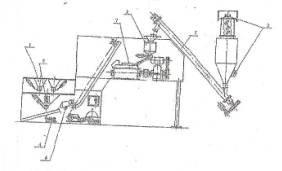
1-Batcher
of inert materials, 2-vibrator, 3-batcher of concrete, 4-pump K 20/30, 5-screw,
6-skip rink, 7-mixer
Figure
1
When approaching
the unloading position and opening the shutter, roller shutter runs into the
wall of the bucket mixer neck. Inert materials for receiving the neck are
poured into the mixer 7. After unloading of inert materials is completed, water
dispenser’s valves, cement and if necessary chemical additives are opened, and
at that moment the concrete mixing is made. Bucket returns to the discharge of
the metering device, which is signaled by a limit switch installed in the
loading bucket. Where in the dispensers
of water, cement and chemicals’
additives are closured, and the cycle of
their loading repeats in parallel with the blending in mixer
plant.
Smooth operation
of concrete prepared plants requires high reliability of its constituent
machines, which should regulate the correctness of their operation and quick
recovery in case of failures.
Literature:
1.
Nurmukhanova A.Z., Povetkin V.V., Sosnin V.А. Certificate of authorship № 66405 Centrifugal mixerfrom 15.12.2010,
bul. № 12 s. Astana.
2.
Nurmukhanova A.Z. Evaluation of the
technical condition of the equipment stationary concrete preparatory works.
//Proceedings of the X Anniversary International Scientific Conference
"Science and Education - a leading factor in the strategy" Kazakhstan
- 2030 ". Issue 2 -Karagandy, 2007. - P.454 – 456.
3.
Nurmukhanova A.Z. Analysis of the
causes of failures betonoprigotovitelnyh installations. //Proceedings of the X
Anniversary International Scientific Conference "Science and Education - a
leading factor in the strategy" Kazakhstan - 2030 ". Issue 2 -
Karagandy, 2007. - P.457 – 459.
4.
Erehinsky V.V. Efficiency and
quality of construction. Gorkiy: Volga - Vyatka book. publishing house, 1981.
-223 p.
5.
Kessel L.A. Cost-effectiveness of
new technologies and methods for its determination. – М.: GosINTI, 1976 y.