Murtazaev S.S.
Tashkent State Dental Institute
ANALYSIS
OF СEPHALOGRAMS BY TWEED
MERRIFIELD METHOD IN REPRESENTATIVES OF THE UZBEK POPULATION.
Objective: To conduct cephalometric analysis
of the representatives of the Uzbek population by Tweed Merrifield method.
Material and methods: A dental examination of 96 ethnic
Uzbeks, including 49 women and 47 men, with the generated normal bite.
Cephalometric analysis was carried out by Tweed Merrifield method.
Results: The study found significant
differences in parameters such as: FMA,
Total Chin, Post Face Ht, Ant Face Ht, Index.
Conclusion: The data limited the usefulness of
international standards, which are recognized ethnic and other features of the
surveyed groups.
Keywords: Normal bite, Tweed Merrifield analysis, lateral
cephalograms, ethnicity rate.
Introduction.
We know the value of cephalometry, morphometry
of the face and jaw models that facilitate the diagnosis, planning orthodontic,
surgical treatment and assessment of the immediate and remote of the results
[1].
Cephalometric standards of people with ideal
occlusion have been developed by many researchers abroad and recommended by
them as standards in the analysis of disease [3,5]. Unfortunately, most of the
work is not given the nature and character of the material, based on which the
derived average and therefore the possibility of a statistical comparison our
data with other countries is limited. In this case, for the average data
(standards) are often used mixed performance-ethnic group of people. However,
the indicators developed by the standards of foreign authors need to check
their acceptability to the people of our geographic area. Using these average
values will hardly help in the diagnostics of dentoalveolar anomalies in the
Uzbek population. For this reason, it is advisable to examine a group of Uzbek
people with the generated normal (orthognatic) bite. This would allow us to
receive interest for the value of the national group.
Objective: To conduct
a cephalometric analysis in the representatives of the Uzbek population by the
Tweed-Merrifield method.
Material and Methods:
The study included 96 ethnic Uzbeks (49 women and 47 men) aged from 17 to
25 years with a developed normal bite. The object of the research was 96
cephalograms of young Uzbek volunteers of both genders. Cephalometric survey
was carried out using a X-ray machines Kodak company Morita and (USA, Japan).
Cephalometric analysis provided by Tweed-Merrifiel method [6,7,8,9]. All
subjects tested were born and lived in the territory of the Republic of
Uzbekistan; all of them grew up and were formed in the same geo climatic
conditions. All measurements were performed in the phototechnical laboratory of the
orthodontics department, Rostock University (Germany).
The
measurements were performed manually and with the help of a special computer
analysis program 3.2.5 package FR win professional (Computer Konkret®,
Falkenstein, Germany).We determined ethnic heritage
by surveying and identifying representatives’ genealogy for four generations:
1).The proband; 2).The proband’s mother and father; 3).The proband’s
grandmother and grandfather from the mother’s and father’s line; 4).The proband’s
great grandmother and great grandfather from the mother’s and father’s line.
Research included the probands whose ancestors belonged to the same ethnic
group.
Observable groups included
people selected according to the following criteria: normally functioning
tooth-jaw-facial system and masticatory efficiency and the decayed, missing,
and filled teeth (DMFT) index. Absence of any tooth was not acceptable. All
examined did not have any morphological and functional deviations from accepted
standards and were characterized by absence of clinical pathologies. None of
them had previously received orthodontic treatment. As for social status, all
of them were students of different institutes and universities of Tashkent
city. Received results were processed by the method of variation statistics on
computer IBM PC Pentium-IV with use of Microsoft Excel programs for Windows
2010. All values are presented as mean (М) SEM (m). For data with
normal distribution, inter-group comparisons were performed using Student’s
t-test. A value of P<0.05, P<0.001 was considered statistically
significant.
Results.
The results of
cephalometric analysis of the Uzbek population on the Tweed to the method
presented in the table. As it can be seen
from the table, in the study of the average values of the inclination of the
lower central incisor in relation to the Frankfurt horizontal mandibular plane
no significant differences were found between men and women. However, women have
a significantly larger angle of the mandible inclination towards Frankfurt
horizontally FMA. The difference of the absolute
size of the head and the individual organs of the maxillofacial area in men and
women has been noticed during the inspection study, when looking through their
cephalogram, as well as the comparison of jaws models. As a rule, men had a
large skull, conspicuous large mass of soft tissue covering the front of the
skeleton, and dental arch in males were larger. As expected, the
statistical processing of the data revealed a significant difference with
reliable basic linear measurements in men and women Total Chin, Post Face Ht
and Ant Face Ht. Table
Results by Tweed-Merrifield cephalometric analysis
method of the representatives of the Uzbek population
|
Gender |
Male |
Female |
|
||||
|
Name |
M |
m |
SD |
M |
m |
SD |
P |
|
IMPA (°) |
96,2 |
1,01 |
6,89 |
95,9 |
1,02 |
7,1 |
P>0,05 |
|
61,4 |
1,16 |
7,96 |
59,0 |
1,01 |
7,1 |
P>0,05 |
|
|
FMA (°) |
22,3 |
0,84 |
5,76 |
25,2 |
0,71 |
5,0 |
P<0,05 |
|
Occ Plane |
9,0 |
0,5 |
3,44 |
10,2 |
0,46 |
3,2 |
P>0,05 |
|
Z Angle |
76,4 |
1,23 |
8,43 |
75,7 |
1,01 |
7,1 |
P>0,05 |
|
Total Chin |
15,6 |
0,38 |
2,58 |
13,9 |
0,24 |
1,7 |
P<0,05 |
|
Post Face Ht |
54,9 |
0,74 |
5,06 |
48,5 |
0,56 |
3,9 |
P<0,05 |
|
Ant Face Ht |
67,0 |
0,69 |
4,73 |
61,4 |
0,50 |
3,5 |
P<0,05 |
|
Index |
82,8 |
1,24 |
8,53 |
79,2 |
0,99 |
7,0 |
P<0,05 |
Discussion
The Tweed method (1954) is based on the use of the diagnostic facial
triangle that form the Frankfurt horizontal (FH), the base plane of the
mandible (the MP) and the longitudinal axis of the lower incisors (LI). According
to the proposed tweed angle data obtained at the intersection of Frankfurt
horizontal plane and the lower base jaw, is 25° (1); angle obtained at the
intersection of the longitudinal axis of the lower incisors and Frankfurt
horizontal is 65° (2); angle obtained at the intersection of the longitudinal
axis of the lower incisors and the lower jaw base plane, equal to 90 ° (3). The
author notes that the aesthetics of the person depends on a degree of
inclination of the longitudinal axis of the lower incisors to the Frankfurt
horizontal (2). If this angle is 65 °, the person has a perfect
harmony. When treating any malocclusion in order to improve the appearance
of the patient is necessary to fix the axial inclination of the teeth so that the
angle approaching 65°.
Derived Tweed averages are widely used as a standard in many
countries around the world, especially in America. Unfortunately, we could not find a detailed
description of the nature and characteristics of the statistical material so
Tweed statistical comparison impossible. However, according to the average
data, our group studied is characterized by the same features that are listed
in Tweed analysis, but they are less pronounced. Our group has smaller FMA angle sizes (an average of 2°), and FMIA (an average of 5°). The lower incisors show greater vestibular
inclination relative to the mandibular plane to 6°(Figure).
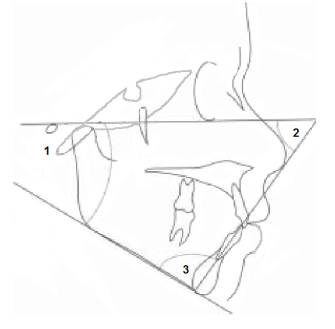
Fig. - Tweed’s Facial Triangle
Our data support the idea that the cephalometric
analyzes are often based on a comparison of the data obtained from the survey
of the particular patient (patient group), with the average values in this
population (e.g. European). Therefore, in recent decades in the foreign
literature it appeared a number of works devoted to the study of morphometric
parameters and cephalometric norms for the individual ethnic groups and
nationalities that have their own characteristics [2, 4].
Based on cephalogram analysis from ethnic Uzbeks with orthognatic bite
and formed dental arches, we obtained average cephalometric indicators of
angular and linear measurements.
The data serve as a basis for judging the deviation norm in the facial
skeleton and, in particular, in its gnathic parts at ethnic Uzbeks. These
parameters will be the norm in the criteria for cephalometric studies for the
treatment of patients with dentoalveolar anomalies. This facilitates the
clinical diagnosis, preparation of management plan for orthodontic, surgical
treatment and assessment of their immediate and long-term results.
Conclusions:
1.
Installed by us average data for Tweed method
Merrifield Men and women need to be considered when diagnosing and planning
treatment of patients with dentoalveolar anomalies.
2.
Our surveyed group has much greater vestibular inclination of the lower incisors to the mandibular
plane.
3.
All of the above
limits the usefulness of international standards, which seems to reflect the
ethnic and other features of the surveyed groups.
References
1. Ahsan A., Yamaki M.,
Hossain Z., Saito I. Craniofacial
cephalometric analysis of Bangladeshi and Japanese adults with normal occlusion
and balanced faces: A comparative study // J. Orthod. Science – 2013.- Vol. 2.- P. 7-15.
2. Bayome M., Sameshima G.T., Kim Y., Nojima K., Baek SH., Kook Y.A.
Comparison of arch form between Egyptian and North American white populations
// Amer. J. Orthod. Dentofacial Orthop. – 2011. – Vol. 139. – P. 245-252.
3. Hideki L., Shunsuke N., Akihiko N., Amy L. Comparison of cephalometric
norms between Japanese and Caucasian adults in antero-posterior and vertical
dimension // European J. Orthod. – 2007. – Vol. 29. – P. 493–499.
4. Hwang H.S., Kim W.S., McNamara J.A. Ethnic Differences in the Soft
Tissue Profile of Korean and European-American Adults with Normal
Occlusions and Well-Balanced Faces // Angle Orthod. – Vol. 72, № 1. – 2002. –
P. 72-80.
5.
Kim J.H., Gansukh O., Amarsaikhan
B., Lee S.J., Kim T.W. Cephalometric comparison of Mongolian and Korean adults
// Korean J. Orthod. – 2011. - Vol. 41, №1. – P.42-50.
6.
Merrifield
L.L, Klontz H.A, Vaden J.L. Differential diagnostic analysis system // Amer. J.
Orthod. Dentofacial Orthop. – 1994. – Vol. 106(6). – P. 641-648.
7.
Merrifield
L.L. Differential Diagnosis with Total Space Analysis // J. Charles H. Tweed
International Foundation. – 1978. P. 10-15.
8.
Tweed
CH. The Frankfort‑mandibular incisor angle (FMIA) in orthodontic
diagnosis, treatment planning and prognosis // Angle Orthod. – 1954. – Vol. 24.
– P. 121‑69.
9.
Tweed
CH. The Frankfort-mandibular plane angle in orthodontic diagnosis,
classification, treatment planning, and prognosis // Amer. J. Orthod. Oral
Surg. – 1946. – Vol. 32.- P. 175-232.