Trubachev S.I., Kolodezhnyj V.A.
National technical
University of Ukraine “Kiev Polytechnic Institute”
THE
VIBRATIONS OF MECHANICAL SYSTEMS WITH ENERGY DISSIPATION
The accounting of energy
dissipation in mechanical systems, which
based on the hypothesis of Boca-Schlippe-Kolar,
was conducted mainly for systems with 1–2 degrees of freedom [2, 3]. This is
explained by the fact that the solutions of problems of the system’s oscillations are investigated
by analytical methods with a small number of degrees of freedom. It should be
emphasized that the study of mechanical systems’ dynamic based on a
discrete-continuum models, which are formed on the basis of the variational-grid
approach and suggests a spreading of the hypothesis of Boca-Schlippe-Kolar on a
system with many degrees of freedom.
The
problem of forced oscillations of a system with N degrees of freedom will be
considered in the framework of the theory which based on the hypothesis of
Boca-Schlippe-Kolar.
The differential equation of
the oscillatory system with one degree of freedom, taking into account the
frequency-independent energy dissipation is given by [1]:
|
|
(1) |
 ,
,where  are the coefficients of inertia, stiffness
and frequency-independent friction;
are the coefficients of inertia, stiffness
and frequency-independent friction;  is
the correction factor;
is
the correction factor;  is the own circular frequency;
  is an arbitrary exciting force.
The equation (1) is differ from
the analogous equation in which the friction is taken into account by the
Kelvin-Voigt hypothesis only in the presence of the correction factor  .
.
Therefore, the hypothesis of Boca-Schlippe-Kolar is called
"corrected" for the hypothesis of the Kelvin-Voigt. According to the
hypothesis of Boca-Schlippe- Kolarthe friction is independent from
frequency, which is typical for metallic structures. When using the hypothesis
of Kelvin-Voigt, it’s assumed that the friction depends from the frequency, and
this hypothesis is a good description for vibrations of structures which made
out of polymeric materials.
In solving the problems of
oscillations of numerical methods in the process of sampling designs turn to
systems with N degrees of freedom.
The set of equations of
oscillations of a system with many degrees of freedom can be represented by
matrix equations:
|
|
(2) |

in which  ,
,
 ,
,
 are the matrices of inertia, stiffness and
damping;
are the matrices of inertia, stiffness and
damping;  is the matrix correction factors;
  ,
,
 are the column vectors of arbitrary
generalized coordinates and generalized random forces.
are the column vectors of arbitrary
generalized coordinates and generalized random forces.
The form of the matrix  is generally not known and its presence is a
major challenge for solving the matrix equation (2).
is generally not known and its presence is a
major challenge for solving the matrix equation (2).
The friction that occurs in the
system, we’re considering the internal, which is caused by material’s imperfect
elasticity. Then, we can be assumed that the friction coefficient is a small
part of the stiffness:
|
|
(3) |

where  is the coefficient of not-in-phase deviations
from Hooke's law.
is the coefficient of not-in-phase deviations
from Hooke's law.
We generalize the relation (3)
in the event of a system with N
degrees of freedom, considering the coefficient  by the characteristic of the material:
|
|
(4) |

Let’s present a system of
equations (2) in the diagonal form with using a linear transformation:
|
|
(5) |

where  ,
,
 are the columns of vectors of an arbitrary
and major generalized coordinates;
are the columns of vectors of an arbitrary
and major generalized coordinates;  is the matrix of amplitude coefficients
of the characteristic vibrations of the system with N degrees of freedom. Each column of this matrix defines its own
proper irregular form of the oscillations, in generally.
is the matrix of amplitude coefficients
of the characteristic vibrations of the system with N degrees of freedom. Each column of this matrix defines its own
proper irregular form of the oscillations, in generally.
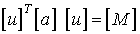
Natural vibration modes are
satisfied the orthogonality conditions and formulas for the reduction of
kinetic and potential energy:
|
|
(6) |
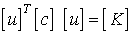 ,
,where  and
and  are the diagonal matrix of the main
coefficients of inertia and the main stiffness coefficients.
are the diagonal matrix of the main
coefficients of inertia and the main stiffness coefficients.
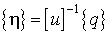
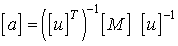
From (5), (6) we can be
obtained:
|
|
(7) |
|
|
(8) |
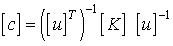 .
.To find the normalized
vibration modes with unit norms on the kinetic energy it’s necessary to divide
the elements of each column in non-symmetric matrix  on the appropriate energy norm.
We obtain
|
|
(9) |
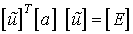
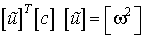 ,
,where  is the normalized vibration modes.
Substituting (4), (5) in (2) and multiplying the result by
is the normalized vibration modes.
Substituting (4), (5) in (2) and multiplying the result by  on the left, taking into account the
expression (6), we obtain a system of equations in the main generalized
coordinates:
on the left, taking into account the
expression (6), we obtain a system of equations in the main generalized
coordinates:
|
|
(10) |

For the full separation of the
variables is need to be taken
|
|
(11) |
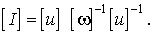
The expression (11) for the
matrix of correction factors is the most common. It allows us automatically to
take into account the frequency-independent friction in complex structures, which
with the help of the discretization into finite elements are modeled by the
matrix equations of the form (2).
It should be emphasized, that
the using of (11) without the assuming (4), the complete separation of
variables will not allow.
Thus, to solve the problem of
oscillations of a system with N
degrees of freedom, in view of frequency-independent energy dissipation, it’s
necessary to determine the spectrum of natural frequencies and vibration modes.
If you use numerical methods the infinite-dimensional space of admissible
functions is replaced by finite through the discretization of system. The
generalized eigenvalues problem is replaced by an approximation
|
|
(12) |

To find the spectrum of natural
frequencies and vibration modes we proposed to use the method of increasing
stiffness [3], which is based on the minimization of functional of the
Rayleigh-type:
|
|
(13) |
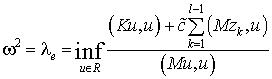
Here  is the earlier found the eigenmodes;
  is the coefficient, which is certainly higher
than the desired eigenvalue.
is the coefficient, which is certainly higher
than the desired eigenvalue.  ,
,
 are the matrix of stiffness and mass of the
system.
are the matrix of stiffness and mass of the
system.
The expression (13) shows, that
the using of a method of increasing the rigidity does not require the formation
of the vector orthogonal to previously found eigenvectors, which saves the
computational resource.
Conclusions
In this paper we present the
matrix equation taking into account energy dissipation in order to describe the
process of forced oscillations for systems with N degrees of freedom that allows this approach to study the
dynamics of plate-shell structures of aircraft. We obtain the matrix equations
describing the energy dissipation in mechanical systems with N degrees of freedom and based on the
hypothesis of Boca-Schlippe-Kolar.
To determine the spectrum of
natural frequencies and vibration modes, which are used in the matrix equation,
the method of stiffness is used in the work. It is more efficient and
economical in terms of computational cost compared with traditional approach,
where each last form and frequency determined by minimizing the Rayleigh-type
functional on the subspace, which is orthogonal to the previously obtained
eigenvectors. This makes it possible to solve the problems of a large dimension
with limited memory resources of a PC.
References
1.
Василенко Н.В. Теорія коливань і стійкості руху [Текст] / Н. В. Василенко, О. М. Алексейчук // – К.: Вища
шк., 2004. – 525 с.
2.
Бидерман В. Л.
Теория механических колебаний [Текст] / В.Л. Бидерман // – М.:
Высш. шк., 1980. – 408 с.
3.
Бабенко А. Е. Определение частотного
спектра и собственных форм колебаний упругих систем методом повышения
жесткостей [Текст] / А. Е. Бабенко, О. А. Боронко,
О. Н. Василенко, С. И. Трубачев // Проблемы прочности. –
1990, №2. – С. 122–124.