Amperometric
detection of methanol and formaldehyde with biosensor based on methylobacteria
biocatalysts.
Kuznetsova T.A.
Tula
state university, 300600, Tula, е-mail: tatulyakuz@mail.ru
Aerobic methylobacteria is a special
physiological group of microorganisms using methanol and it oxidized and
substituted derivatives as an only carbon and energy source. Methylobacteria cells
contain a high concentration of methanol- formaldehyde- and formate-dehydrogenases,
connected with bacterial respiratory chain and are able to oxidize toxic
one-carbon compounds. Membrane localization of dehydrogenases makes the
interaction of methylobacteria cells with artificial electron acceptors easier that
enabled to use it as biocatalysts in mediator amperometric biosensors. Such
systems can be used during biotechnological processes based on methylotrophs for
monitoring initial substrate and intermediates, for determining the
concentration of C1 compounds in waste waters.
The work objective is development of amperometric
mediator biosensor based on methylobacteria biocatalysts for the selective
detection of methanol and formaldehyde.
In this work we used aerobic methylobacteria Methylobacterium genus, obtained from Doronina
N.V. (Institute of Biochemistry and Physiology of Microorganisms, Pushchino).
Electrochemical measurements were carried out using a potentiostat-galvanostat
IPC-Micro 8.65 «Kronas» (Russia), integrated with the PC. The work mediator electrode
was filled with graphite paste, which contained 10% ferrocene and immobilized biocatalysts
(cells, enzyme fraction and MDH of methylobacteria) on the surface.
Taken into account the cytoplasmic (formaldehyde
dehydrogenase) and membrane (methanol dehydrogenase (MDH)) localization of dehydrogenases
we decided to use enzyme fraction of methylobacteria as biocatalysts in biosensor.
Cytoplasmic and membrane fractions was obtained by differential centrifugation
of disintegrated cells using Avanti J-30I «Beckman Coulter, Inc.» (USA). Sensors
based on cytoplasmic and membrane fractions were characterized by a substantial
increase of the relative responses for formaldehyde (FA) in comparison with cells
sensor (Fig. 1).
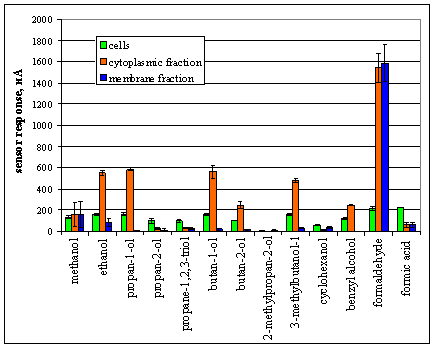 Fig. 1. Substrate specificity of cells and enzyme
fractions of
Fig. 1. Substrate specificity of cells and enzyme
fractions of
M. dichloromethanicum DM4 obtained by ameprometric mediator biosensor with ferrocene
as an electron acceptor.
Since the selectivity of biosensor assay is
determined by the specificity of biological material, the using of membrane
fraction M. dichloromethanicum enabled
to carry out selective analysis of the FA level in the presence of methanol and
other alcohols.
MDH M.
nodulans showed a wide substrate specificity range regarding primary
alcohols, but it did not oxidize secondary and benzyl alcohols (Fig. 2).
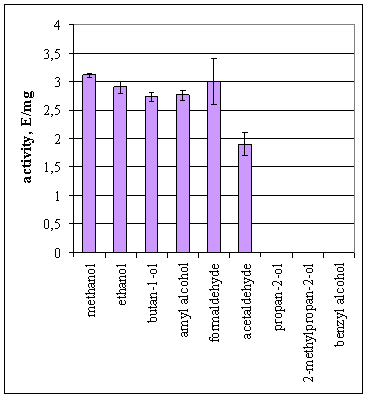 Fig. 2. Substrate specificity of MDH M. nodulans ORS2060T under homogeneous
conditions in the presence of FMS and DCPIP.
Fig. 2. Substrate specificity of MDH M. nodulans ORS2060T under homogeneous
conditions in the presence of FMS and DCPIP.
The enzyme displayed the highest level of
affinity to methanol. FA and acetaldehyde were also substrates, which inhibited
MDH at high concentrations. In this connection, for the selective detection of
methanol with MDH biosensor the sensor response for FA must be suppressed. It
is known that cyanide forms an adduct with PQQ, being a competitive inhibitor
of the MDH when using methanol as a substrate. In the presence of 2 mM KCN the KM
values to methanol and formaldehyde were differenced significant – 0,23 mM and
7,2 mM, respectively.
The effect of cyanide concentration in the
buffer solution on the MDH-sensor responses for methanol and formaldehyde were
studied. With increasing cyanide concentrations up to 10 mM the inhibition level
of MDH-biosensor responses for methanol and formaldehyde were differenced even
more. There was practically complete inhibition of the sensor responses for FA
while the oxidation activity of immobilized MDH towards methanol decreased
slightly. As a result of cyanide effect selective detection of methanol in the
presence of FA were allowed
The detection limit, linear range, sensitivity and
stability of the mediator amperometric biosensors based on membrane fraction of
M. dichloromethanicum for FA
detection and MDH-sensor for methanol detection were determined and are listed
in Table 1.
Table 1. Performance
characteristics of amperomeric biosensors based on membrane fractions and MDH of
methylobacteria.
|
|
Membrane fraction of M.
dichloromethanicum (FA) |
МДГ M. nodulans
(methanol) |
|
Sensitivity
coefficient, nA/mmol*L-1 |
25±3 |
7200±300 |
|
Detection
limit, mmol/L |
0,05 |
0,0045 |
|
Upper
limit of analytical range (KM), mmol |
7,0±0,5 |
0,49±0,03 |
|
Relative standard deviation , (n=15), % |
7,3 |
7,6 |
|
Long-term stability (10 days), % |
63 |
12 |
The work was
supported by the Federal Goal-oriented Program “Scientific and
Scientific-Pedagogical Cadres of Innovative Russia” for 2009–2013, agreement №
14.B37.21.0561 and № 14.B37.21.1231.