Economics / 14.
Economic Theory
PhD student Venger T.A.
Taras Shevchenko National University of Kyiv
Influence
of external debt of the banking sector on debt sustainability of Ukraine
There
was a significant shift in the structure of the Ukrainian external debt towards
the private nonguaranteed debt during the last decade. Although the external
public debt continues to grow in absolute terms, the debt-to-GDP ratio as well
as its share in the gross external debt stock decrease steadily (see Fig. 1).
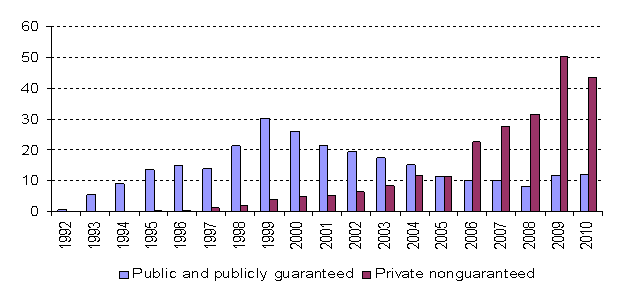
Figure 1. Ukrainian gross external debt
dynamics, % of GDP
Surge
of the external private debt was mostly caused by the intensive borrowings of
commercial banks. Their external debt increased by about six times within the
period 2005–2008. This was determined by few reasons:
-
Improved macroeconomic conditions. Recovery after the economic crisis,
steady economic growth and stable exchange rate driven by the current account
balance surplus in 1999–2005 made international banks more interested in the
Ukrainian market. Having entered the market they provided their affiliates with
low interest rate loans.
-
Lack of domestic savings. Before the 2008–2011 financial crisis the
loans-to-deposits ratio in the Ukrainian banking system reached 180% [3, P.
15]. To compensate the savings gap commercial banks increased borrowings from
international markets that resulted in the rapid increase of their foreign
currency debt.
Increasing
debt of commercial banks was caused by a shift in their loan portfolio towards
consumer crediting. As shown in Figure 2, there was a relative decrease of
lending to the real sector in 2004–2008. The share of the consumer loans, on
the contrary, increased from 18.2% in 2004 to 38.2% in 2008. According to the
National Bank of Ukraine the volume of consumer lending in 2008 reached 186.1
billion UAH with over 64% (119.4 billion UAH) in foreign currency, which is the
highest rate in the region [2, С. 4].
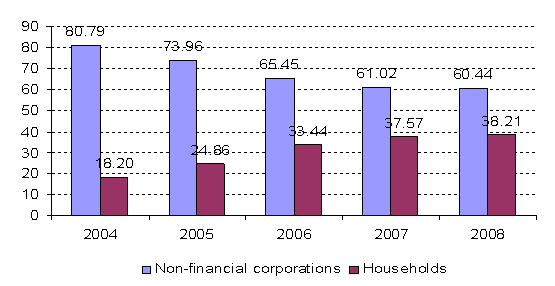
Figure 2.The structure of the Ukrainian banking
sector loans by borrower, %
The
largest share of consumer loans were concentrated in trade (about 35% of total
loans) [4, P. 160]. They were used mostly for purchasing imported durable goods
that had a negative impact on the trade balance. As shown in Figure 3, the
surge in consumer lending in Ukraine during 2005–2008 is related to decrease in
current account balance. This trend was accelerated by the global recession that
adversely affected the volume of the Ukrainian exports earnings. In 2008 the
current account deficit reached a record -12.8 billion USD (-7% of GDP) mark.
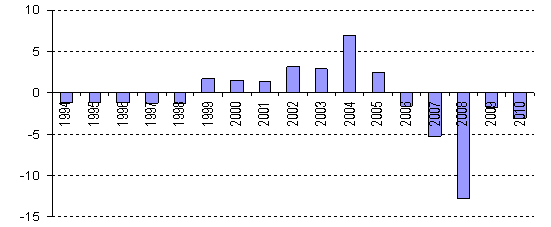
Figure 3. Ukraine’s current account balance,
billion USD
Growth
of the foreign currency denominated external debt (no matter public or private)
increases the currency risks and makes national economy more vulnerable to
exogenous shocks. Lack of the international capital market liquidity caused by
global financial crisis resulted in the repayment problem for the Ukrainian
banking system. To service its debt properly the banking sector had to
accumulate large amount of foreign currency in the domestic market. Growing
demand for the hard currency that coincided with the foreign exchange earnings
decrease led to the national currency devaluation and increased the real value
of external debt. The latter put a number of banks on the brink of default [3,
P. 15].
To bail
out the private sector the Government of Ukraine and the National Bank of
Ukraine undertook actions to stabilize financial system that included
recapitalization and refinancing the commercial banks. The latter increased the
amount of public and publicly guaranteed external debt. Since the beginning of
the crisis in 2008 to mid-2011 foreign liabilities of the National Bank
increased from $329 million to $9.8 billion including $7.4 billion debt to IMF (Figure 4).
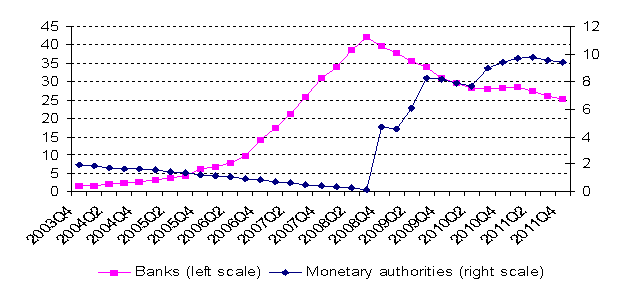
Figure 4. Commercial banks’ and monetary authorities’
external debt dynamics, billion USD
Thus,
the rapid growth of commercial banks indebtedness during the first decade of
2000s contributed to the spread of the global financial crisis on the national
economy that resulted in dramatic increase in the Ukrainian public and publicly
guaranteed debt.
References
1. Воробйова О.
Визначення рівня та концентрації кредитних вкладень в соціально-економічну
систему Держави / О. Воробйова // Науковий вісник: фінанси, банки,
інвестиції. – Сімферополь, 2010. – №2(7). – С. 52–66.
2.
Куценко О. Споживче кредитування в Україні: огляд ринку та практики
[Електронне джерело] / О. Куценко. – К., 2011. – 26 с. – Режим доступу :
http://www.finrep.kiev.ua/download/consumer_lending_sep2011_ua.pdf
3. Лютий І.
Фінансово-економічна криза 2008–2010 рр.: деякі чинники та уроки /
І. Лютий, О. Юрчук // Вісник НБУ. – січень 2011 р. – С. 10–16.
4. Україна в 2010
році: щорічні оцінки суспільно-політичного та соціально-економічного розвитку:
монографія / за заг. ред. А. В. Єрмолаєва. – К. : НІСД, 2010. – 528 с.