Экономические науки / 9.
Экономика промышленности
Saikenova Zh.T., Ph.D.
Sorokina L.I.
D. SerikbayevEast
Kazakhstan State Technical university,
The Republic of
Kazakhstan
Income approach in valuation of
business: sequence of execution andfeasibility of application
"XXX"
JSC was established and registered in
accordance with the legislation of the Republic of Kazakhstan and has a state
license for the construction, installation, design, special works and
extraction of ore by underground methods.
The
spectrum of activity of the enterprise is wide. The main thing is
penetrating and reinforcement shafts to
1,000 meters or more depth, the construction chamber, inclined and horizontal
mining, design of underground and above-ground buildings and structures to
develop technological projects of deposits development, construction and
installation works.
The
company's ability to generate income is the most important indicator in the
assessment of its value. Hence, one of the main approaches to evaluation of
business is income approach which allows determining the market value,
depending on the expected future income.
The
most common method of the income approach is discounted cash flow techniques.
This method of evaluation is considered to be the most acceptable, taking into
account the investment motives, since any investor does not buy a set of assets
consisting of buildings, structures, machinery, equipment, intangible assets
and so on but he buys the stream of future income allowing return on
investment, profit and improve their well-being. From this perspective, all
businesses in industry sector produce only one type of commodity production –
money [1].
In
assessing the business can apply one of two models of cash flow. In this case,
to assess the business of "XXX" JSC was chosen model of own capital
of cash flow.
Prediction
can be made using the method of extrapolation. As the trend curve was taken
linear function, and the construction of the regression equation makes it
possible to forecast revenues for subsequent years (using MS Excel).
Forecast
gross revenues and expenses needed to calculate the corresponding indicators in
the formula and cash flow will be made based on the results of the company for
the years 2012-2014 [5]. As a prediction method will be applied according to
the linear method of revenue over time. Revenue prediction of JSC the years
2015-2017 can be determined from the linear regression equation (Formula 1):
y = 2 051 237,33 - 260 162,50х, (1)
у – annual revenue, thous. KZT;
х – year.
Revenue prediction is shown in Table 1.
Table 1 - Revenue prediction of “XXX” JSC for 2015-2017
|
Indicator, unit of measure |
Year |
|||||
|
2012 |
2013 |
2014 |
2015 |
2016 |
2017 |
|
|
1 Revenue |
1941776 |
1229510 |
1421451 |
1010587 |
750424,8 |
490262,3 |
Figure 1 graphically shows the dynamics of the company's revenue for the
period 2012-2014 and linear trend.
Net working capital (NWC) is current assets less the
amount of current liabilities. NWC consists of the following components:
stocks, receivables and current liabilities. Next, to determine the cost it is
needed to predict the cost of administrative expenses. To determine them, you
can be used the method of fixed ratio. The meaning of the method is the
percentage of each item costs to revenue saved from year to year, that is, all
items will grow at the same rate as sales. To determine the percentage will be
used the arithmetic mean of the relevant items of the 2012-2014 year to the
corresponding value of proceeds.
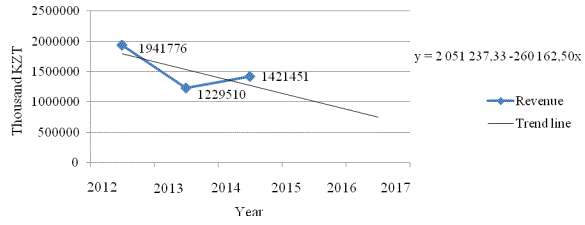
Figure 1 Dynamics of revenue for the period
2012-2014 and the trend line
Calculation of financial indicators characterizing the
activity of the company is presented in Table 2.
Table 2 - Financial indicators characterizing the
activities of "XXX" JSC
|
Indicators, Thousand KZT |
Year |
|||||
|
2012 |
2013 |
2014 |
2015 |
2016 |
2017 |
|
|
1 Revenue |
1 941 776 |
1 229 510 |
1 421 451 |
1 010587,33 |
750424,83 |
490262,33 |
|
2 Prime cost |
1 523 686 |
928 144 |
926 499 |
738 191,67 |
548153,87 |
358116,07 |
|
3 Gross profit |
418 090 |
301 366 |
494 952 |
272 395,66 |
202270,96 |
132146,26 |
|
4 Administrative cost |
240 336 |
241 964 |
243 641 |
165 726,67 |
123062,51 |
80 398,34 |
|
5 Sales profit |
177 754 |
59 402 |
251 311 |
106 668,99 |
79 208,45 |
51 747,92 |
|
6 Other costs |
100 564 |
101 347 |
103 584 |
69 761,01 |
51 801,95 |
33 842,89 |
|
7 Other profits |
69 422 |
154 628 |
158 961 |
92 079,94 |
68 375,16 |
44 670,39 |
|
8 Profit before taxation |
146 612 |
112 683 |
306 688 |
128 987,92 |
95 781,67 |
62 575,41 |
|
9 Net profit |
117 289,6 |
90 146,4 |
245 350,4 |
103 190,34 |
76 625,33 |
50 060,33 |
Prediction of NWC calculation is shown in Table 3.
Table 3 - Prediction of NWC
|
Indicators, thousand KZT |
Year |
||||||
|
2011 |
2012 |
2013 |
2014 |
2015 |
2016 |
2017 |
|
|
1 Revenue |
1481425 |
1941776 |
1229510 |
1 421 451 |
1010587,33 |
750 424,83 |
490 262,33 |
|
- |
460351 |
-712266 |
191 941 |
-410 863,67 |
-260 162,50 |
-260 162,50 |
|
|
3 ∆NWC |
- |
-495306 |
-512 250 |
-477 321 |
-476 974 |
-467 981,5 |
-458 989 |
The calculation of depreciation can be presented as
the average value of the ratio of depreciation to the value of non-current
assets (Tables 4 and 5).
Table 4 - The ratio of non-current assets and
depreciation for 2012-2014 of "XXX" JSC
|
Indicators |
Year |
||
|
2012 |
2013 |
2014 |
|
|
1Non-current assets value, thousand KZT |
1
936 507 |
1
716 807 |
1
724 079 |
|
Accumulated depreciation, thousand KZT |
78987,2 |
84172,0 |
88380,6 |
|
3 Depreciation and non-current assets value ratio |
0,0407884919 |
0,0490282251 |
0,0512625002 |
|
4Average value of the ratio of depreciation to the value of
non-current assets |
0,0470264057 |
||
Table 5 - Prediction of
depreciation
|
Indicators |
Year |
||
|
2015 |
2016 |
2017 |
|
|
1 Mid-year
value of non-current assets, thousand KZT |
2 649 490,75 |
3 046 914,36 |
3 503 951,52 |
|
2 The share of
depreciation in non-current assets |
0,047 |
||
|
3
Depreciation, thousand KZT |
124526,065 |
143204,975 |
164685,7213 |
Prediction of non-current assets value is shown in
Table 6.
Table 6 - Prediction of non-current assets value
|
Indicators |
Годы |
|||||
|
2012 |
2013 |
2014 |
2015 |
2016 |
2017 |
|
|
1
Non-current assets value, thousand KZT |
2271942 |
2 326 357 |
2 303 905 |
264990,75 |
3046914,36 |
3503951,52 |
|
2
∆Non-current assets, thousand KZT |
621 528 |
54 415 |
-22 452 |
345585,75 |
397 423,61 |
457 037,15 |
|
3 Rate of additions |
1,15 |
|||||
Table 7 shows prediction of cash flows of “XXX” JSC
for 2015-2017.
Table 7 - Prediction of cash flows of “XXX” JSC for
2015-2017
|
Indicators |
Year |
|||||
|
2012 |
2013 |
2014 |
2015 |
2016 |
2017 |
|
|
1 Net
profit, thousand KZT |
117
289,60 |
90
146,4 |
245
350,40 |
103
190,34 |
76
625,33 |
50
060,33 |
|
2 Depreciation,
thousand KZT |
78
987,20 |
84
172 |
88
380,60 |
124
526,07 |
143
204,98 |
164
685,72 |
|
3 Investment in non-current assets, thousand KZT |
621
528 |
54
415 |
-22
452 |
345
585,75 |
397
423,61 |
457
037,15 |
|
4 Change of NWC, thousand KZT |
-495
306 |
-512
250 |
-477
321 |
-476
974 |
-467
981,5 |
-458989,00 |
|
5 Change of receivables, thousand KZT |
7
762 |
14
042 |
15
145 |
0 |
0 |
0 |
|
6 Cash
flow, thousand KZT |
|
|
|
96
328,15 |
149
272,42 |
212
794,21 |
|
7 Discounted rate,, % |
0,18 |
|
|
|
|
|
|
8 Coefficient of discounting (1/(1+R)t) |
|
|
|
0,85 |
0,72 |
0,61 |
|
9 Discounted cash flow, thousand KZT |
|
|
|
81
634,03 |
107
205,13 |
129
513,12 |
The
most common discount rate for the cash flow of own capital are as follows:
-
Capital asset pricing model;
-
A model of cumulative construction.
The
method of cumulative construction takes into account all kinds of risks of
investments related to both factors common to the industry and the economy
character and the specifics of evaluated enterprise [2].
Discount
rate in this model is calculated by this formula:
R = Rf + ∑Ri,
(2)
R – discount rate, %;
Rf – risk-free income rate, %;
Ri – i-risk premium, %
In Kazakhstan as a risk-free rate can be used interest
rate on deposits of the most reliable banks. The highest interest rate is 6%.
Risk-free investments tend to bring a minimum level of income and to assess the
risk premiums in the valuation activity widely used method of expert
determining of risk premiums for an individual enterprise.
In Kazakhstan's valuation practice peer review risk
premiums are usually represented as follows (Table 8):
Table 8 - Premium for risk of “XXX” JSC. Calculation
of discount rate
|
Title |
Percents |
|
1 Risk-free income rate 2 Management team of the company 3 Diversity of market outlet 4 Diversity of sources of recourses 5 Diversity of production 6 Business solvency of the enterprise 7 Size of the enterprise 8 Other risks |
6,0 1,0 2,0 2,0 2,0 2,0 0 3,0 |
|
Total |
18,0 |
Justification of the choice of risk premiums:
1 In the event of a change in leadership is necessary
to take into account the changes in the quality of governance. Risk premium is
1%.
2 Financial structure (sources of financing of the
company). The company has a large debt to the staff, which is growing every
year, in addition to this, there are other debts. The risk premium is 2%.
3 Trading territorial diversification. The company has
the ability to expand its range, as product sales territory is vast and covers
the whole region and beyond demand. Risk premium is 1%.
4 Diversification of clientele. The company has a wide
range of customers. The risk premium is 2%.
5 Other risks. Risk premium is 3%.
The discount rate is determined by adding up the
risk-free rate and listed in the table risk premiums:
R = 12% + 6% =
18%.
The market value is calculated in accordance with the
Gordon model [3].
Next, it is needed to calculate the residual value in
post-forecast period (Formula 3):
RV = CFp/
DR-g = CFp-1(1+g)/ DR-g , (3)
RV – expected value in post-forecast period, thousand
KZT;
CF – cash flow for the first year of post-forecast,
thousand KZT;
DR – discounted rate, %;
g – long-term (conditional permanent) growth rate of
cash flow in the remaining period, %.
Minimum growth rate of cash flow is 1%.
Now, knowing all components of the Gordon model, we
can calculate the residual value of "XXX" JSC (Table 9).
Table 9 - The calculation of the residual value
|
Datum |
Calculation |
|
1 CFp-1 |
129 513,12 |
|
2 Tg(temp of growth) |
0,01 |
|
3 R |
0,18 |
|
4RV=CFp-1*(1+g)/(R-g) |
726712,53 |
|
5 Coefficient of discount |
0,61 |
|
6 RV |
442299,68 |
|
7 RVt=∑ CFt/(1+DR)t + RV/(1+DR)t |
760651,96 |
Amendment: at "XXX" JSC there are no assets
which are not engaged in the manufacture and there is no excess or shortage of
working capital.
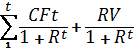
The final stage of the calculation is to find the
total value of enterprise income approach (Formula 4):
 (4)
(4)
Thus, the company's value, calculated by the income
approach is 760, 6 million KZT.
References:
1 A.A. Sigankov Valuation of business. Lectures. Мoscow,
2010.
2 S.V. Valdajtsev Valuation of business: 3 edition, 2008.
3
V. M. Rutgaizer Valuation of
business. INFRA, Moscow
2009.
5
www.kase.kz