Using of ICT technologies to teach English language
Khausova K.B.
L.N. Gumilyov Eurasian National University
Information and communication
technologies today have transformed the way humans communicate as well as doing
things. In education, ICTs play vital roles in facilitating teaching and
learning. They have transformed classroom communication methods and modified
instruction strategies. Also, ICTs have made teaching and learning interactive
and collaborative instead of the traditional teacher- talking and students
listening approach. Large class sizes are common phenomenon almost word-wide.
In order to achieve quality education in large classes, teachers have to take
extra steps. Also, teachers of English Language utilize
ICTs in teaching almost every aspect of English Language teaching. From my point of view, this study
through qualitative approach has described the way multimedia devices are used
to facilitate the teaching and learning of English Language in large classes.
It has also pointed out the how the internet technologies (email and websites)
can be utilized in teaching learning English in Large classes. Therefore, in
spite of large class sizes, the teacher can still perform as in small classes
with the aid of information and communication technologies. Literacy in Information and Communication
Technologies (ICT) is fundamental to life in our modern technological society.
To equip students to be literate lifelong learners and global citizens of the
21st century we must successfully integrate ICT into both the English
curriculum and English pedagogical practice. Now, ICT has been used in almost
all fields of life, including in education [1, 12].
The utilization of ICT in education has recently started to appeal the
potential and significant progress in language learning. It has become a major
issue in education world and has been used from preschool through to university
that could facilitate students and teacher in teaching and learning process. The computers play significant role in the
learning process especially in learning language. The technology in this era
has been grown up not only from the quality but also the efficiency. They are
moving fast without any limit from every product. The need of technological
innovation has brought the communication revolution and rapid development of
technological application in teaching and learning. This technology made
contribution on improving language communication in the world. Every school in
abroad has used the ICT to facilitate the teacher to teach the students in the
classroom. Many kinds of application that they use in the classroom improved
and enhanced the better lesson.
ICT covers any product that will store, retrieve, manipulate,
transmit or receiving information electronically in a digital form. For
example, personal computers, digital television, email, robots. So ICT is
concerned with the storage, retrieval, manipulation, transmission or receipt of
digital data. Importantly, it is also concerned with the way these different
uses can work with each other. ICT as a whole can be described as the utility of
technology to support the effort of conveying information and communication
particularly in the area of education. The technique includes digital technologies
mostly of electronic information – processing technologies, such as computers,
internet, mobile phones, networks, broadband, and so on.
b. The benefits of ICT in general
ICT is found to be advantageous in several ways as
mentioned by Herington, (1) technology facilitates exposure to authentic
language; (2) technology provides the access to wider sources of information
and varieties of language; (3) technology gives the opportunity to people to
communicate with the world outside; (4) technology allows a learner – centered
approach; (5) technology develops learner’s autonomy. ICT help people in order
to get information and to communicate each other in wider range[2,56].
c. ICT Tools in Language Context
There are some kinds of technologies classified into
information and communication technology commonly used in language context,
such as: Interactive
multimedia
 Interactive media is the integration of digital media
including combinations of electronic text, graphics, moving images, and sound,
into a structured digital computerized environment that allows people to
interact with the data for appropriate purposes. The digital environment can
include the Internet, telecoms and interactive digital television.
Interactive media is the integration of digital media
including combinations of electronic text, graphics, moving images, and sound,
into a structured digital computerized environment that allows people to
interact with the data for appropriate purposes. The digital environment can
include the Internet, telecoms and interactive digital television.
- Computer
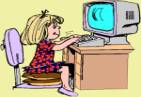 Computer can
be utilized with other multimedia learning devices or it can stand alone (a
standard PC) and still serves its basic purpose as an electronic medium of
language learning.
Computer can
be utilized with other multimedia learning devices or it can stand alone (a
standard PC) and still serves its basic purpose as an electronic medium of
language learning.
Computer is an electronic device which is capable of
receiving information (data) and performing a sequence of logical operations in
accordance with a predetermined but variable set of procedural instruction
(program) to produce results in the form of information or signals based on
Oxford dictionary. It is consist of CPU, monitor, keyboard and some other
apparatus.
·
Audio devices
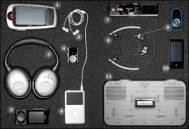 Audio
devices can be used with other media to form an interactive multimedia.
However, it can also be utilized separately as independent tool. Audio devices
include speaker, earphone, CD, and etc.
Audio
devices can be used with other media to form an interactive multimedia.
However, it can also be utilized separately as independent tool. Audio devices
include speaker, earphone, CD, and etc.
·
Internet
 Internet can be used as a medium of language learning
through email, www (world wide web), text, audio and video conferencing.
Internet can be used as a medium of language learning
through email, www (world wide web), text, audio and video conferencing.
·
Television
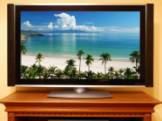 According to Oxford dictionary, television is a system
for converting visual images (with sound) into electrical signals, transmitting
them by radio or other means, and displaying them electronically on a screen.
According to Oxford dictionary, television is a system
for converting visual images (with sound) into electrical signals, transmitting
them by radio or other means, and displaying them electronically on a screen.
·
Telephone
This telephone medium has not been widely used for
language teaching because of the poor quality of analogue transmissions.
However, there is new invent of digital quality and lower connection cost which
potential for conference calls.
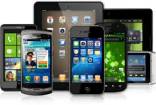 Mobile gadgets such as cell phone and smart phone
which are equipped with programs like computer, which enable it to perform as
mini personal computer. By using this gadget and its internet connection,
everybody could enjoy chatting, browsing, and discuss each other with the wider
range. The advancement of science and technology makes the size and price of
those gadgets are getting cheaper and reachable.
Mobile gadgets such as cell phone and smart phone
which are equipped with programs like computer, which enable it to perform as
mini personal computer. By using this gadget and its internet connection,
everybody could enjoy chatting, browsing, and discuss each other with the wider
range. The advancement of science and technology makes the size and price of
those gadgets are getting cheaper and reachable.
·
Interactive whiteboard
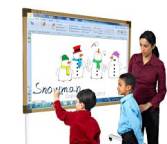 An interactive whiteboard or IWB, is a large
interactive display (such as a touch screen monitor) which is connected to a
computer and projector. A projector projects the computers’ desktop onto the
board’s surface, where users control the computer using a pen, finger or other
devices.
An interactive whiteboard or IWB, is a large
interactive display (such as a touch screen monitor) which is connected to a
computer and projector. A projector projects the computers’ desktop onto the
board’s surface, where users control the computer using a pen, finger or other
devices.
Advantages:
1.
The information required will be more
quickly and easily accessible for educational purposes.
2.
Innovation in learning is growing in the
presence of e-learning innovations that further facilitate the educational process.
3.
Progress of ICT will also allow the
development of virtual classroom or classroom-based teleconference that does
not require the educator and learners are in one room.
4.
System administration in an institution
will be more easily and smoothly because of the application of ICT systems.
Disadvantages:
1.
Progress of ICT will also occur of
violation of Intellectual Property Rights (IPR) for the easy access to the data
that is causing people plagiatis will commit fraud.
2.
Although the system of the administration
of an educational institution like a system without a gap, but if there is a
recklessness in running the system would be dangerous.
3.
One of the negative impact of television
is to train children to think short and survive concentrated in a short time (short
span of attention)[3].
Conclusion
In sum, not all lessons can be incorporated into the
Internet. In teaching using the Net, we have to convince that using the Net
adds something new, some real value to our teaching. But also, students should
be trained to use the available technology efficiently. We should collaborate
with other teachers in the school and in the system, because cooperation and
mutual understanding is very important especially when the school has few
Internet accounts. Through the net, the student can communicate or collaborate
with other students or experts in the field across geographically boundaries.
Moreover, they can join a news group on a particular topic of interest. What is
most interesting about the Net, as far as communication is concerned, is that
it is race, age, national origin, and gender blind. The Net also enables
students to publish projects’ findings to be seen by their peers around the
world. This might give some students the motivation they need to complete their
work on time, to be mindful of their language. Therefore, every student can
benefit from a Net communication project.
BIBLIOGRAPHY
1.
Hartoyo (2008). Individual Differences in
Computer-Assisted Language Learning. Semarang: Pelita Insani Semarang, p12-24
2.
Victoria L. Tinio, (1999). Modificating
teaching through ICT. The American journal. 12, p56-63
3.
Ebiefung, Aniekan. 2000. Teaching Using
the Internet. University of Tenneessee at Chattanooga. Retreived on July 02
2009, from: cecasun.utc.edu