Shtabinskaya T.T.
Grodno State Medical University, Belarus
Prognostic significance of ERK 2
expression in low-grade colorectal cancers
Grade(G) its a type of cancer, which
describes how much cancer cells look like healthy cells when viewed under a
microscope. Healthy tissue usually contains many different types of cells
grouped together. If the cancer looks similar to healthy tissue and contains
different cell groupings, it is called differentiated or a low-grade tumor. If
the cancerous tissue looks very different from healthy tissue, it is called
poorly differentiated or a high-grade tumor [1]. The cancer’s grade may help
the doctor predict how quickly the cancer will spread. In general, the lower
the tumor’s grade, the better the prognosis. But a lot of people with low-grade
cancer have died in first 5 years after resection. There are molecular and
biological markers, which help to predict cancer disease.
Erk1
and 2 - are extracellular - regulated multifunctional kinases that are involved
in the proliferation or differentiation of cells, they also take part in the
transendothelial migration of colorectal cancer cells and may stimulate
angiogenesis and invasion [2].
The
aim of our study: to determine Erk2 value for prognosis of the disease in
patients with low-grade colorectal cancer.
Material and Methods.
The
data for the research were the 55 observations of colorectal cancer cases (20
men and 35 women) aged 37.3 to 82.8 years (63.43 (56,9-69,5)) with
histologically verified low-grade cancer of the colon (G1-2). The study was
performed on paraffin sections using mouse monoclonal antibodies to Erk2
(ab72096) at 1:100 dilution according to standard procedure.
Quantitation of the level of expression was
performed by Aperio Image Scope program, it was described in the previous
article [3].
Statistical
analysis was performed using STATISTICA 10.0 (SNAXAR207F394425FA-Q).
Results.
Almost
all colorectal cancer (90.9%) were located in the distal site. In 29 patients
it was verified high-grade adenocarcinoma (52.7%) and 26 - moderately
differentiated (47.3%). In 39 cases (70.90%) was T3, in 14 cases (25.45%) - T2,
1 patient - T1, and 1 patient - T4. At the time of diagnosis in 32 patients
metastases were found in the regional lymph nodes (N1-2 - 32 (58.2%)).
Hematogenous metastases were diagnosed in 6 patients (10.9%). In 20 patients
(36.42%) with time having relapses, with 6 of them during the first two years after
surgery, and 13 for five years. On average, the tumor recurred after 2.46 years
(1,90-3,69). The most important indicator of the effectiveness of treatments -
long-term results. Under this concept, most researchers assume overall
(observed) survival. Overall survival (January 2016) was 6.2 years (3,5-12,5).
The most accurate indicator reflecting essentially a cure for cancer is
adjusted progression-free survival. Adjusted progression-free survival was 3.1
years (2,2-4,3).
We
evaluated the expression of ERK2 in the parenchyma and stroma of colorectal
cancer, as well as the edges of the incision. No significant differences of
ERK2 expression in tumor tissue (p = 0.4) (Figure 1) or in the edges of the
operating sections (p = 0.86) (Figure 2) adjusted depending on disease-free
survival is not detected.
251658240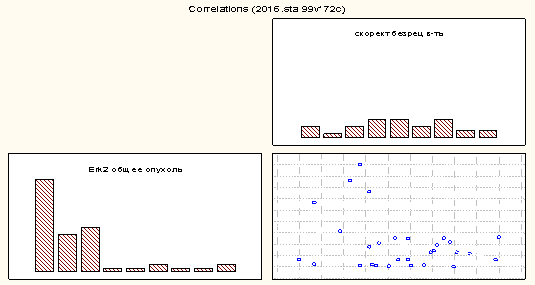
Figure
1. Correlations Erk2 expression in tumor to an adjusted progression-free
survival of patients with low-grade adenocarcinomas.251658240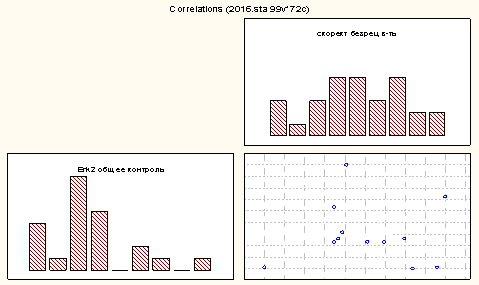
Figure
2. Correlation of expression Erk2 in operating margins cuts with adjusted
progression-free survival of patients with low-grade adenocarcinomas.
Results.
Further research of ERK2 expression should be carried
out in conjunction with other markers of angiogenesis, as the self-antigen can
not be used for the prediction of low-grade cancer.
Literature:
1.
Ueno, H. New criteria for histologic
grading of colorectal cancer / H. Ueno, Y. Kajiwara, H. Shimazaki // Am J Surg
Pathol. – 2012. - №2. – Р. 193-201.
2.
Fang, J.Y. The MAPK signalling
pathways and colorectal cancer / J.Y. Fang, B.C. Richardson // Lancet Oncol. – 2005. - № 6. – Р. 322-327.
3.
Штабинская,
Т.Т. Прогностическое значение уровня экспрессии фактора роста эндотелия сосудов
в колоректальном раке / Т.Т. Штабинская, М. Боднар, С.А. Ляликов [и др.] //
Научно-практический журнал УО «Гродненский государственный медицинский
университет». – 2015. - № 3(51). - С. 64-69.