Philological Sciences/5.
Methods and techniques for controlling the level
of a foreign language
Doszhan Gulzhan Amangeldievna
PhD., Associate
Professor
Zhanysbay Moldir Darkhankyzy
Master Student of
Eurasian National University named after L.N. Gumilev
Astana, Kazakhstan
Developing students’
communicative competence in foreign language lessons
Abstract: This article discusses the types of communicative competence and the ways of its
development. Communicative
competence is a very important linguistic term which reflects language
learners’ the grammatical knowledge of syntax, morphology, phonology, as well
as social knowledge of how and when to use utterances appropriately. At the same time, the author analyzes the results
of the practical work that was held during the internship.
Key words: competence, communicative competence, linguistic
competence, sociolinguistic competence, discourse competence, modern
technologies.
It is apparent that
in the 21st century, the trend of globalization is leading to closer
relationships between countries. Of all the different languages, English, as an
international language is widely used in communication between people and
countries. That is why, the demands are high to the quality of the knowledge of
foreign languages. The English language has spread and developed globally,
which is a fact that cannot be ignored.
As the main
foreign language taught and employed in communication with foreigners, the use
of English has dramatically increased in Kazakhstan, especially in the last
decade. Our President N.A. Nazarbayev said in his speech “85% of over 10 mln books published all over the
world are in English. Science, development, informational technologies are
conducted in English. 3500 foreign companies work in Kazakhstan. We speak
English with them, and with their help we develop our industry.” [1] By these words he encouraged Kazakh people
to learn English, and increase the knowledge of foreign languages. However, English Language Teaching (ELT) in Kazakhstan has not affected
the traditional teaching model whereby students learn English just to pass
exams and teachers lecture mainly to help students achieve this goal.
Nowadays communicative competence is a very important linguistic term
which reflects language learners’ the grammatical knowledge of syntax,
morphology, phonology, as well as social knowledge of how and when to use
utterances appropriately. [2, p 114] In 1966 this term appeared thanks to Dell
Hymes, a famous American linguist, sociolinguist and anthropologist. After that
communicative competence became the topic for discussion among lots of
linguistic scholars.
In Kazakhstan and
many other countries foreign languages classes are mostly based on the idea
that the goal of language acquisition is communicative competence: the ability
to use the language correctly and appropriately in social communications.
After the influence of communicative
language teaching to the methodology of foreign language teaching and learning,
it has become widely accepted that communicative competence should be the basic
skill in any language education, central goal to good classroom practice.
With
the development of students’ speaking abilities and increasing their vocabulary
level, they simultaneously develop their listening skill and also speak
confidently during the process of communication. It is apparent that an English context is automatically created
during various activities in the classroom while English is used as the
language for communication among the students. The English speaking atmosphere
can help students cultivate their sense of the language, and create appropriate
conditions for improving their English speaking abilities. Learning English
through communication provides students an opportunity to speak and share ideas
in a relatively relaxing way. That’s why, students become the main actors in
the classroom, and their initiative and motivation are both enhanced. CLT can
introduce new teaching methods, creating a diversified teaching process.
Teachers can use various resources to help students develop their communicative
skills, which is another evidence of the diversity of the teaching method. For
instance, English teachers can use pictures to create group discussions, by
helping students understand the informational and cultural background of
various topics. Games can also be used to help students learn vocabulary and
practice their writing and speaking skills. Also, teachers can help students
create an English context when teaching grammar and different cultures. They
can ask students questions such as “If you had been born in the USA, how would
your life be different now?” “What would you do?” “What would be your
occupation?” During group discussions, students not only practice their spoken
English, but also learn about different cultures. Grammar can also be practiced
during this process. However, the opportunities of communicative activities
cannot be ignored and the traditional English classes should be changed.
Generally
speaking, in the future more students will use English in the different spheres
of activity and in choosing future careers such as business, law, and
journalism. After their graduation English will be used as a tool to
communicate or negotiate with different people in different continents. In
other words, the popularity of English in the world provides a clear reason to
reform ELT in Kazakhstan, to focus on developing students ‟listening and
speaking skills” so they learn to communicate effectively with others. Canale
and Swain (1980) defined communicative competence in terms of three components:
1. grammatical
competence: words and rules;
2.
sociolinguistic competence: appropriateness;
3. strategic
competence: appropriate use of communication strategies [3, p 17].
Canale later
refined these models, adding discourse competence: cohesion and coherence. Now
communicative competence is made up of four competence areas: linguistic,
sociolinguistic, discourse, and strategic.
• Linguistic competence concerns the
usage of grammar, syntax, and vocabulary of a language. Linguistic competence
asks: What words do I use? How do I put them into phrases and sentences?
• Sociolinguistic competence considers
how to use and respond to language appropriately, to the given topic, and the relationships among the people
communicating. Sociolinguistic competence asks: Which words and phrases fit
this society? How can I express a specific attitude to the situation? How do I
know what attitude another person is expressing?
• Discourse competence considers how to
interpret the larger context and how to construct longer extents of language so
that the parts are clear and comprehensive. Discourse competence asks: How are
words, phrases and sentences put together to create conversations, speeches,
email messages, newspaper articles?
• Strategic
competence concerns how to recognize and correct communication mistakes,
how to work around gaps in one’s knowledge of the language, and how to learn
more about the language and in the context. Strategic competence asks: How do I
know when I’ve misunderstood or when someone has misunderstood me? What do I
say then? How can I express my ideas if I don’t know the name of something or
the right verb form to use? [3, p 23]
Secondary school students of
all activities, they are in teaching actively construct new knowledge and
develop new skills, to master the communicative use of language
ability. Specifically, the teaching through communication has the
following advantages:
- there is more interaction between students and teachers.
Communicative teaching is becoming increasingly clear feature of the change in
the way of interaction, students develop the subject, initiative and become
increasingly important. Teacher-student relationship is an interactive,
harmonious, rather than the traditional education, the kind of master-servant
relationship.
- to impart the basic knowledge and ability to
skillfully combine the development. Traditional classroom teaching of English
in the main body of the expense of home study, only emphasized the teachers on
the knowledge of the systematic and integrity, which is a teacher-centered,
knowledge-centered from the medieval "scholastic" teaching methods
inherited. One consequence of the neglect of student ability. The communicative
teaching emphasizes the learner's cognitive ability and operational
capabilities, which allow the students themselves to think about and express
their views, thus trained in real life the ability to use language to
communicate.
- greatly enhanced the student's interest. Communicative teaching
students to participate in, sometimes accompanied by scenes or simulated
scenarios, so that students more close to life, the students became the main
character, naturally they were interested in the English language, to learn
English as a pleasure. [4]
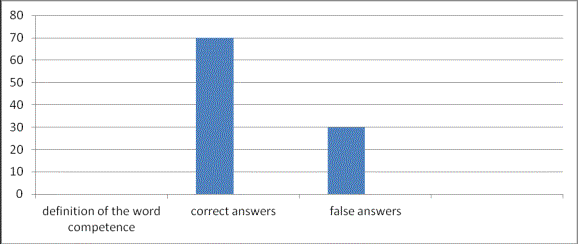
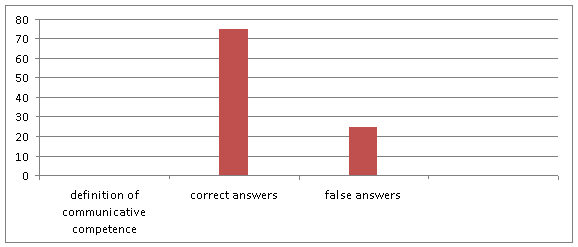
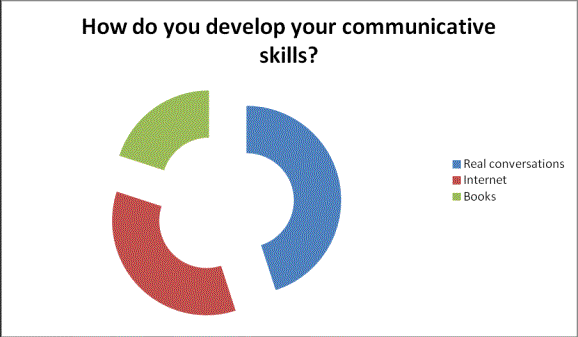
During the internship in Poland, we conducted a survey among the Polish students in the theme of “How do you develop your communicative competence?” and asked some questions. You can see the results of the survey below in percentage ratio. In the first question we asked the definition of the terms “competence” and “communicative competence”. As you see, the most part of interviewers gave correct answers.
Diagram
1.
Diagram
2.
T
H Then in the survey were asked the ways of developing
communicative competence. The participants of the survey gave responses as
below.
Diagram 3.
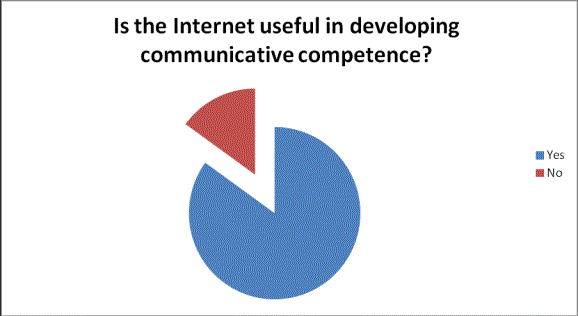
Diagram 4.
Developing students’
communicative competence is important in teaching English language at schools,
colleges and universities, and should be a priority when teaching and learning
English today. English teachers should be armed with sufficient knowledge to
guide students in the process of learning English. Therefore, it is promising to implement integrated skills into
English teaching when promoting the communicative teaching approach. We should
look at communicative competence as a task within the bigger framework of
teaching English language. Therefore, from what was said above, it will be
appropriate to implement teaching communicative competence to help students
improve their English skills.
References:
2.
Hymes, D.H. (1966). "Two types
of linguistic relativity". In Bright, W. Sociolinguistics. The
Hague: Mouton. pp. 114–158.
3.
Canale, M., Swain, M. Theoretical
bases of communicative approaches to second language teaching and testing. Applied Linguistics 1, 1980. P. 1–47.
4.
http://bagikmaniscord.blogspot.com/2013/01/advantages-and-disadvantages-of.html