Student,
Assem Atchabarova, research supervisor, Ph.D., Vladimir Sapa
Kostanay State University A. Baitursynov,
Kazakhstan
Photovoltaic
plants in agriculture
In
agriculture, there are great opportunities for the application of solar
installations - in crops, livestock, and horticulture. The result of applying -
solar greenhouse; dryers; hot water and heating captive breeding of cattle,
pigs, poultry; heating water in pools for fish farming.
For
example, consider a modern cattle-breeding complex for 500 head of dairy
cattle. Need a farm with a milking parlor - 40 kW • h batteries installed in
the summer will help cover the needs of the farm (Fig. 1). Excess energy can be
given to the electrical network.
Photovoltaic
plant consists of 280 polycrystalline modules with capacity 245-250 W tolerant
capability (-0 / + 5W). They are installed on the roof of the building.
Installed capacity of 70 kW. 280 solar panels and three inverters convert
elaborated battery DC to AC. In winter, this plant produces 10 ... 20 kW, the
rest of the energy is taken from the network.
The
cost of a solar panel in an average of 100 thousand tenge. For our farm costs
for solar panels will make about 28000000 million tenge. With the average cost
of electricity for farmers 18 tenge per kW ∙ h. Station should be
recouped in about 7...8 years. Such station will work much more payback period
(not less than 25 years). In this case, the cost of electricity will be about
half the price. Introduction of new technologies - the basis of successful business.
When
calculating for each region to be analyzed statistics solar activity for some
years. On the basis of these data must be averaged to determine the actual
power of the solar flux per square meter of the earth's surface. These data can
be obtained from local or international meteorological services. Statistical
data allow to predict the minimum error of the solar energy system, which will
be converted into electricity by solar panels.
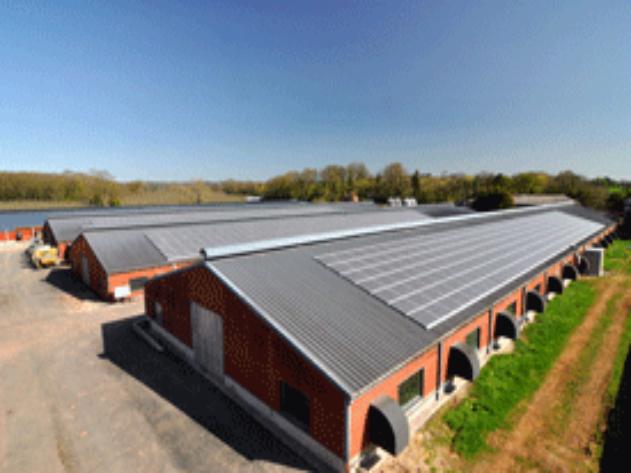
Fig. 1. The use of solar
panels to agriculture
The
main advantage of solar panels - they are extremely constructive simplicity and
the absence of moving parts. As well as a small specific gravity and simplicity
combined with high reliability. As simple installation and minimal maintenance
requirements during operation. Representing a flat elements of small thickness,
they are quite successfully placed on the converts to the sun roof slope or on
the wall. Do not require additional space and the construction of separate
bulky designs. The only condition - nothing should obscure them as much as
possible during the time.
The
efficiency of photovoltaic cells falls within the lifetime. Wafers eventually
degrade and lose their properties. The efficiency of solar cells is even less.
Prolonged exposure to high temperatures accelerates this process. For 25 years
the efficiency of the solar cell is reduced by only 10%. The normal life span
for today's solar cells is at least 25 ... 30 years.
When
choosing solar photovoltaics should pay attention to the dependence of the
voltage produced by illumination - it should be as small as possible.
The
disadvantages of photovoltaic plants include sensitivity to contamination. Even
unobtrusive layer of dirt on the surface of the photocells or safety glass can
absorb a significant share of sunlight and saves energy. In the dusty town that
would require frequent cleaning of the surface of solar cells, especially
installed horizontally or with a slight slope. The same procedure is necessary
after every snowfall, and after the dust storm.
Taking
into account the long life and the opportunity to work for a long time without
any maintenance, photovoltaics for his life may well pay off more than once,
and not only in remote areas.
References:
1.
Yurchenko, A.V.; Savrasov F.W.; Yurchenko V. The real cost of energy - from
resources to consumer // Bulletin of the Tomsk Polytechnic University. - 2009.
- P. 43-46.
2.
Stepanenko, N.I.; Gubin, V.E. Prospects for the use of alternative and
renewable-energy sources in the conditions of Siberia // Modern Techniques and
Technologies: Proceedings of IX Intern. Conf. students, graduate students and
young scientists. - Tomsk, 2003. - T. 1. - P. 47-48.
3.
Lukutin, B.V.; Surzhikova O.A.; Shandarova, E.B. Renewable energy in
decentralized energy supply. - M .: Energoizdat, 2008. - 231 p.