Tetiana Protsko, Zubchuk
Viktor
National Technical
University of Ukraine “KPI”, Kyiv, Ukraine
Perspectives
of using electronic nose in medical diagnostics
There are lot of
modern methods of rapid medical diagnostics and among them electronic nose is
one of the most suitable and accurate. Electronic noses have a clear potential
to be a non-invasive, simple and rapid but above all accurate early diagnostic
screening tool.
This review was
done as part of work on developing methods for rapid diagnosis based on
selective gas analyzers in the department of BMI, FBMI, NTUU “KPI”, Ukraine.
An electronic
nose(e-nose) is first defined as a device which comprises of an array of
chemical sensors with different selectivity, a signal-preprocessing unit and a
pattern recognition system [1]. The functional scheme of the device is shown at
the figure 1.
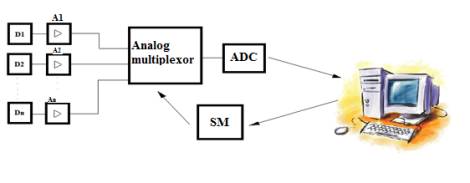
Figure 1. The functional
scheme of e-nose
In the general
case, e-nose device (Fig.1) is a set of selective sensors (D1. .. Dn), which
through amplifiers (A1. .. AN), program-controlled analog
multiplexer and analog-to-digital converter (ADC) connected to a computer
manual for the formation of a database of measurements and accompanying
information.
In a typical unit
test air is sucked through the pump inlet compartment with built-in line of
sensors. In the next step the sensors exhibited volatile substances pairs that
make up the smell , and the odorous substances interacting on the surface and /
or penetrating the volume of the active element of the sensor , forming the overall
system response . During the measurement interval response touchpad analyzed
and transmitted to the processor module. Then, the system serves pair flushing
gas (eg, alcohol) in order to remove odorous substances from the surface and
from the bulk of the active material of the sensor. Finally, in a grid of
sensors is served carrier gas in order to prepare the unit for the new
measuring cycle.
E-nose technical
parameters directly depend on the parameters of selective sensors, so the
choice of the type, number and sensitivity of sensor parameters is an important
step in the design of such devices [2].
In the device,
made by our department, we used amperometric sensors. Amperometric biosensors
are devices that allow you to identify toxic substances at a lower level than
in the case of potentiometric sensors. The principle of the amperometric
biosensors is quite simple. Specified component diffuses through a
semipermeable membrane into a thin layer of biological material in which the
reaction to form products that are responsive electrode. Functional biosensors
can be compared with sensors organisms - biosensors capable of converting the
signals coming from the environment into brain electrical signals [3].
Technical characteristics of amperometric sensors used is shown in table 1.
Table 1. Technical characteristics
of amperometric sensors
|
Gas |
Sensor type |
Min. and
max. ranges of measurement, ppm |
Response time t0,9, c |
Expansion, ppm |
Sensitivity, mA/ppm |
|
Ammonia |
NH3, Sensor E-2 |
0-20, 0-5000 |
˂40 |
1 |
0,2±0,005 |
|
Chlorine |
Cl2, Sensor E-2 |
0-5, 0-2500 |
˂40 |
0,05 |
0,05±0,001 |
|
Hydrogen
sulfide |
H2S, Sensor E-3 |
0-10, 0-1000 |
˂30 |
0,2 |
1±0,3 |
|
Sulfur
dioxide |
SO2, Sensor E-3 |
0-100, 0-1000 |
˂30 |
1 |
1,6±0,2 |
|
Nitric
oxide |
NO, Sensor E-3 |
0-20, 0-2500 |
˂20 |
1 |
- |
|
Hydrogen fluoride |
HF, Sensor E-2 |
0-10, 0-200 |
˂60 |
0,3 |
- |
Electronic nose
proved itself in several times heart failure diagnostics. Results showed that
there are different exhaled air portraits in people with or without heart
failure problems [4]. Sensing element was nitric oxide sensor.
Machado et al.
used an electronic nose to identify and discriminate between 14 bronchogenic
carcinoma patients and 45 healthy controls. The result demonstrated effective
discrimination between samples from patients with lung cancer and those from
healthy controls. In validation study, the electronic nose had 71.4%
sensitivity and 91.9% specificity for detecting lung cancer, positive and
negative predictive values were 66.6% and 93.4%, respectively [5].
Electronic noses
can be applied to identify respiratory bacterial pathogens either in vitro or
in vivo or as a potential tool for the identification of patients with COPD,
asthma, and Tuberculosis. M. Bruins et al. in his study showed that the
electronic nose can differentiate between tuberculosis patients and healthy
controls with a sensitivity of 76.5% and specificity of 87.2% when
identifying tuberculosis patients within the entire test population. The
research has demonstrated a possibility of an electronic nose as a portable and
fast-time-to-result device to screen search for tuberculosis cases in rural
areas, which lacked highly-skilled operators or a hospital center
infrastructure [6].
As for urinary
tract diagnostics, approximately 80% of uncomplicated urinary tract infections
(UTIs) are caused by Escherichia coli, 20% by enteric pathogens such as
Enterococci, Klebsiellae, Proteus spp., coagulase (–) Staphylococci and fungal
opportunistic pathogens such as Candida albicans (S. Krcmery, M. Dubrava, 1999).
Electronic noses can diagnose UTIs by examining the volatile compounds produced
by bacterial contaminants in urine samples. Based on this fact, Pavlou et al.
employed an electronic nose consisting of 14 conducting polymer sensors to
distinguish between normal urine, Escherichia coli infected, Proteus spp. and
Staphylococcus spp. The study has shown the potential for early detection of microbial
contaminants related to UTI using an electronic nose [7].
To summarize,
electronic nose can be used in each medical field, where infection is
associated with the occurrence of odors. That’s why nowadays e-nose is one of the most flexible diagnostic
methods. It can be used for respiratory infection, heart diseases, cancer and
urinary tract infection detection and has a potential to make up a vital part
in monitoring disease epidemiology.
References
1. Handbook of Machine Olfaction. Electronic Nose Technology/ T.C. Pearce, S.S. Schiffman, H.T. Nagle, J.W. Gardner . – Weinheim:
WILEY-VCH, [2003]. – 633.
2.
MDPI [Online service]: open access publishing / Chih-Heng
Pan, Hung-Yi
Hsieh and Kea-Tiong Tang An Analog Multilayer Perceptron Neural Network for
a Portable Electronic Nose// Sensors. – 2013. – 13(1). – p. 193-207.
3. Чвирук В.П., Линючева О.В., Кушмирук А.И.
Электрохимические сенсоры нового поколения системы НТУУ «КПИ» для
экологического мониторинга вооздушной среды // Збірник тез доп. п’ятої
наук.-техн. Конф. «Приладобудування 2006», 25-26 квітня 2006 р. – Київ. – c.
24-25
4. Якимчук В.С.
Диагностика состояния больных с
сердечно-сосудистыми
заболеваниями с помощью
показателей газообмена
/ Якимчук
В.С. // Eastern-european Journal of enterprise
technologies. – 2013. – №9(61) – с.
44-48.
5. R. F. Machado, D. Laskowski, O. Deffenderfer, et al., “Detection of Lung
Cancer by Sensor Array Analyses of Exhaled Breath,” American Journal of
Respiratory and Critical Care Medicine, Vol. 171, No. 11, 2005, pp. 1286-1291.
6. M. Bruins, Z. Rahimc, A. Bos, W. W. van de Sande, H. P. Endtz and A. van
Belkum, “Diagnosis of Active Tuberculosis by E-Nose Analysis of Exhaled Air,”
Tuberculosis, Vol. 93, No. 2, 2012, pp. 1-7.
7. A. K. Pavlou, N. Magan, C. McNulty, J. M. Jones, D. Sharp, J. Brown and
A. P. F. Turner, “Use of an Electronic Nose System for Diagnoses of Urinary
Tract Infections,” Biosensors and Bioelectronics, Vol. 17, No. 10, 2002, pp.
893-899