Экономические науки/9. Экономика промышленности
A. Chernyavs’kyy
Department of
special constructions of DPSK Ltd.
Economic potential of PCI technology in blast furnace production
Due to rise in the price of natural gas (mostly imported from
Metallurgical works of Ukraine will build utilities based on pulverized coal
injection (PCI) technology in 2-5 years with gross output about 7.5 million
tons. This will entail serious consequences for each metallurgical enterprise taken
separately as well as economy of
At least three problems can present difficulties in research of blast furnace
production economics nowadays.
First of all research people must take into account macroeconomic trends
of world energy market as the key question that defines the strategy of consumers
[1, 8].
Saving rates of technological innovations as well as some technical
aspects are supposed to be the second significant issue [4].
The third problem is connected with manufacturing application of
pulverized coal injection (PCI) technology on selected metallurgical works [7].
World supply for coal is limited by 250 years of
production on current level, but the same value for oil production varies only from
35 to 50 years. Another forcible argument for using pulverized coal in blast furnace
production is that assured coal resources in
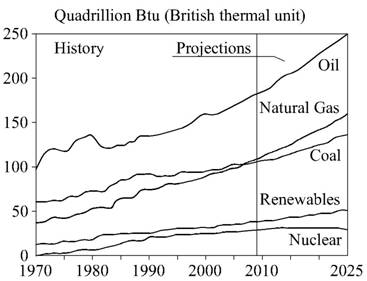
Fig. 1. World energy consumption
Gas production capacity of
Assured coal resources of
In the context of “Global strategy of
energy saving in
According to these programs, it is
planned to finish structural re-development of branch until
Metallurgical industry of
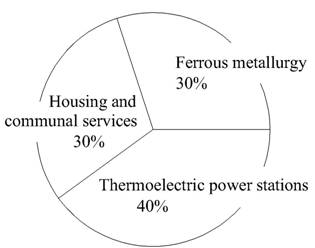
Fig. 2. Approximate structure of coal consumption in
PCI technology will completely exclude natural
gas from cast iron production process and also reduce coke rate by 23%. There will be considerable reduction in carbonic
acid atmospheric emission due to new technology.
Erection of utilities based on PCI technology requires sizeable
investments. The cost of mentioned utilities exceeds the cost of similar utilities
for liquid and gaseous fuel by a factor of 5 or 7. The most part of aggregate
investments (about 70%) meets liabilities of construction of pulverized coal
preparation and distribution workshops. Creation of large factories
specializing on pulverized coal preparation for several metallurgical works can
reduce capital inputs on construction.
Efficiency of pulverized coal use is
determined by quantity of injected pulverized coal fuel, coke replacement
factor, cost of fuel, capital expenditures and maintenance charges of pulverized
coal preparation and distribution facilities.
Principal questions of PCI system
creation decision-making are as follows [2, 3, 6].
1. What is the maximum possible consumption
of pulverized coal for each blast furnace in the nearest time?
2. What is the price of pulverized
coal fuel off-the-shelf for blast furnace production?
3. What is the payback period of PCI
equipment?
4. Finally, what is the efficiency of
using PCI technology?
Table 1
Planned pulverized coal
capacity by enterprise
|
Company name |
Capacity, million tons |
|
“Zaporizhstal JSC” |
2 |
|
“Alchevsk Metallurgical Works” |
2 |
|
“Mariupol
Metallurgical Works” |
2 |
|
“ |
1.2 |
|
“Donetskstal Plant”. |
0.3 |
Using PCI technology on Zaporizhstal
JSC can bring considerable financial benefits in the nearest future [5].
It is planned to use PCI systems on 4 blast furnaces
of enterprise. Mentioned technology can reduce Zaporizhstal’s
consumption of natural gas by 335 million cubic meters a year or almost 100%.
The reduction in coke coal consumption will come to 330.6 thousand tones a year
or about 23%.
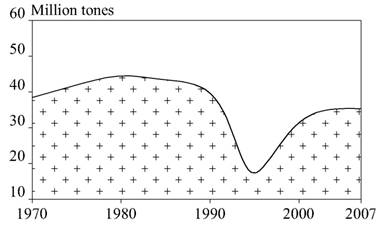
Fig. 3. Cast iron production volume, Zaporizhstal JSC
Investment structure is as follows:
- Zaporizhstal JSC
internal funds – 25%;
- special purpose crediting funds given by
European financial establishments – 75% (period of loan is 6.5 years).
Financial advantage of using PCI technology will
exceed 163 million UAH a year with planned payback period about 3 years.
Further research in the field of blast furnace production economics may
include detailed accounts of cast iron production process using enterprise
accounting data, process flowsheets etc.
References
[1] Endres A.,
[2] Fathutdinow R. (2002) Administrative
decisions. INFRA-M,
[3] Krichewsky M. (2005)
Intellectual methods in management. Piter,
[4]
[5] Kuz’menko N., Michailow N. (2003) Zaporozhstal:
a symphony of metal. Tandem, Zaporozhye.
[6] Vasilenko O., Shmat’ko V. (2003) Innovative management. CUL,
[7] Yaroshewsky S., Ryabenko
A. (1974) Application of powdered coal for cast iron smelting. Technika, Kyiv.
[8] Yatsenko A. Dubyniuk
Y. (2005) International markets of resources. CNL, Kyiv.