Agnieszka Ziomek
Poznań University of Economics, Poznań, Poland
Lars Weber
Brandenburg University of Technology, Cottbus, Germany
Demographic
issues in approach of System Dynamics
Poland
and Germany: the
common labour market problem
Abstract
The main issue of this paper
is the dynamics of population among people entering labor market and its
influence on number of work places, dispposable income as market system equilibrium
factors. The hypothesis investigated throughout German and Polish labour markets
exemplifies the fact that consequences of demographic boom are independent of
the scale of economy but influence the company performance - costs, profit and
market equilibrium changing wages, income and demand levels.
Processes of economy
system affected by demographic boom performance are modeled with regard to
System Dynamics methodology. On the basis of the model including necessary assumptions
the effect of demographic influence on the labor market within a decade is measured.
1. Introduction
Analysing the economic
growth issues three factors: capital, workforce, technology, are usually
considered, in accordance to Solow model. The workforce factor is analised by
its labour capital value and the number of workers in economy. Accordant to
theory of growth we introduce the analysis of the demographic factor influence
on economy, considered as a number of workforce employed.
In economic performance
the demographic changes usually are independent of economic growth
fluctuations. The state influence on demographic growth is generally
inefficient, as well. So demography seems to be the external factor operating
economy system and that system is affected externally by changes in total
number of persons. During last decade the dynamics of demographic issues turned
out to be significant for economy of Western and Central European economies. Two economies from this
region, of both Germany and Poland experienced a strong deregulation
in labour market performance resulting from:
-
in
Poland – fast growth of the youngest workforce generation in the period of
1998-2005,
-
in
Germany – Germany’s
population will fall from about 82.5 million to slightly more than 75 million
in 2050.
The different character
of the similar problem (demography) causes different results in each economy. The
reaction of the main economic parameters and economic policy are also not the
same.
Our ambition is to gain
awareness of the market economy evolution as the result of demographic process
implication. We present in this paper a simulation model (System Dynamics Model
build with Vensim software). This tool allows to present the structure of
factors regulating the level of jobs, income, wage affected by dynamics of
processes. The model is adapted to the situation of the market economy and presents
the general behaviour of system. Nevertheless, this core relations structure
implicates its much wider application.
The
applied System Dynamics approach is genarally known as System Dynamics or
Business Dynamics. This method is a tool for modelling, simulation and control
of complex dynamic system. System Dynamics has been developed at Massachusetts
Institute of Technology by Jay Forrester. The methodology of System Dynamics is
based on discovering and representing the feedback processes, described by
stock, flow, time delays structures and determining the dynamics of nonlinear models. The main feature of this
modelling method is that the issue modelled is presented by closed feedback loop
created essentially by stock and flow, regulated by auxiliary variables and
constant parameters.
The paper is organized
as follows: Section 2 presents the Polish demographic problem existing on the
labour market and concerning the scale of youngest unemployed persons. Section
3 is the description of German demographic issue considering elderly generation
growth among all as the result of the negative demographic growth. Section 4
introduces the core structure of the model, including basic loops. Section 5
reviews simulation experiments carried out with the model. Section 6 completes
the paper with conclusions.
2. Labour market in Poland
The situation on labour
market in Poland seems to be the major economic
problem since 1990. The deep structural changes like privatisation,
liberalisation of the market gave rise to the strong dynamics of labour force
fluctuations. Since 1990 two waves of unemployment have been observed. The
first peak of unemployment was in 1994 and the rate of unemployment increased
to 14%. The second increase of unemployment reached the level of about 19% in
2004. Moreover during the last 15 years the level of employment in Poland was one of the lowest in Europe. Since 1998 a slow decrease in
employment has been noticed. In 2001 this indicator revealed 46%, whereas in
high developed countries - 60%.
On the contrary, better
results in relation to EU-15 are visible in the level of labour activity. In
Poland the men labour activity index reached in 1995 comparable to EU contries
level-70%. Among women the labour activity is significantly higher than in EU.
In 1995 it reached the level of 62,8%, in EU-15 - approximately 49,7%.
Since 1998 a significant
decrease of economic growth, (in Poland from 7% in 1997, to 0,2% in 2003)
has changed the downward trend of unemployment. In 1998 unemployment started to
grow, and reached the level of over 3 milion inhabitants. Small and medium
enterprises and their development potential have been under the influence of
restrictive monetary policy aimed at combating inflation. Strong currency
decreased the competitiveness of Polish
export. Equally, aspects of employment incentives, infrastructure development
in economic policy have been shifted to a further plan. The economic policy was
mainly focused on decreasing budget deficit and stabilisation of public
finances. Beyond the economic activity reinforcement the demografic boom was the
significant factor which increased unemployment among people born after II World
War.
Among EU countries the increase of the group entering labour market reached the
highest level in Poland.
2.1 Demographic changes on the labour market in Poland
The dominating age group among the unemployed
consists of youth entering labour market directly after they are graduated. The
data state (see: Fig. 1) that within the period of 1998-2005 one third of the unemployed were people aged
18-24. It means that every third young man was unemployed. Moreover this age
group was the most strongly affected by
unemployment in Poland. The remaining groups of the age
structure were less experienced by unemployment. The number of elderly people
slowly incereases, (in 2003 - 3% of the number of unemployed, whereas the young
generation up to 26%). The most probable is that in 30 years Poland will be
affected by the similar problem as Germany or UK, because since 2005 the wave
of youth is getting down so in three decades the problem of aging generation
and lack of young workers is bound to occur.
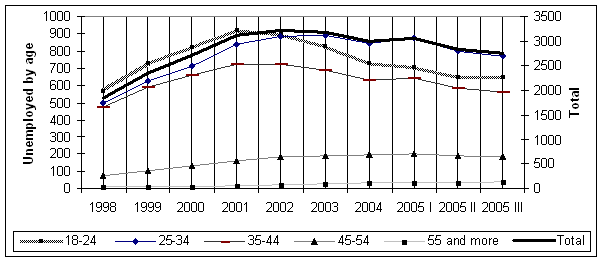
Figure. 1: Unemployed persons by
age, period: 1998-2005
Source: Central
Statistical Office.
Nevertheless, not only Poland experienced the problem of demographic
boom on the labour market. Barriers for youth seeking jobs occurred also in Italy, Slovenia, France. The rate of unemployment among
youth is twice as high as the total rate of unemployment (the indicator
included in column III, table 1, exceed 2 points for mentioned countries). One
of the lowest unemployment rates among youth occurs in Germany. In this country rate of
unemployment (9,9%) equals the rate of unemployment among youth (10,7%).
Table. 1: The unemployment rate in
chosen EU countries in 1997.
|
|
I
Total rate
of unemployment (1)
|
II
Rate of unemployment
age group 15-24 (2)
|
III
(2)/(1)
|
|
Italy
|
12,4
|
33,6
|
2,71
|
|
Slovenia
|
7,1
|
17,4
|
2,45
|
|
France
|
12,6
|
29
|
2,3
|
|
Poland
|
10,6
|
23,3
|
2,2
|
|
UK
|
7,1
|
13,6
|
1,9
|
|
Spain
|
20,9
|
39,2
|
1,88
|
|
Slowakia
|
11,1
|
20,4
|
1,84
|
|
Hungary
|
7,8
|
13,5
|
1,73
|
|
Czech Republik
|
4,2
|
6,9
|
1,64
|
|
Germany
|
9,9
|
10,7
|
1,08
|
Source: Z.
Kaźmierczak, Labour market in EU in XXI perspective, Today’s social policy
in Poland in EU aspect, AE Katowice, Katowice 2000, p. 158.
Since 1999, economy is
affected by high unemployment (over 18%
in 2005). At the same time, one third of it is young people. The elimination of
this feature from the Polish labour market is not easy and involves changes in education system,
retirement rules, expensive for budget (60% state deficit in PKB in 2006)
support for employers.
2.2 How does the demographic problem affect economy in Poland?
The scale of demographic
boom is so high that state instruments are not enough to solve this problem. The
unemployment of youth results from lack
of job-experience. Most young people prolong the learning period to avoid the
unemployment problem only temporarily.
Moreover, the low demand for young workers results from the uncertainity
of further job career and high
inflexible labour costs. Besides the problem of relatively high costs of
employment discourage employers from hiring new staff. The labour costs equal approximately 50% of the monthly wage
and the most part of this value is represented by social taxes.
One more factor
regulating the probability of employment is the method of employee recruitment.
The survey conducted during second half of 2005
brought interesting results concerning
the issue of workers recruitment.
Good connections is the most probable way
to get a job. This kind of method is used more often than advertisement in
newspapers and in internet, as well. In Poland the method of connections is the
kind of social rule used in companies. It means that the probability of
receiving a job depends on parents and friends but not on qualifications. If a
young man doesn’t have good connections
the chance for quick start on the labour market will be small.
The significant stock of
young unemployed affects the system of education. Within the last years arised
the pressure on the education system to teach more efficiently, preparing youth
to the severe requirements of the labor market, teaching interdiscplinary
faculties. Schools are obliged to teach the rules of entrepreneurship and prepare
for the present attractive professions. But it is worth mentioning that there
is no central stimulation of this policy.
Government doesn’t care about the regional coordination in education profiles.
It happened because these duties are owned by the Regional Authorities who
require and wait for the state support in this matter. After a thorough survey
and interviews with local authorities it can be said that they generally have
no idea how to adjust education to demands of employers. So the problem of
unemployment among youth is solved in another way. Youth, not having perspectives
to increase personal income, decide to work in grey area in Poland or willingly decide to work outside
in EU, also illegaly.
In Poland this phenomenon is getting strong and harmful
for entrepreneurs, they complain of workers who abandon workplace. The wage
relation between Poland and EU countries is noticeably disadvantageous
for Poland. The considerable question is how to stabilize
production when possibilities of wage increase are limited by rigid regulations
like minimum wage; roughly 170 EUR, high social taxes, competitiveness factors
(?). In future the significant issue for economy will be to stop the outflow of the youngest workers to other
countries.
To sum up it is worth
stressing that both demographic boom and the recession bring no less serious
imbalance than fluctuations of business cycles in economy. The consequences of
changes in demographic growth affect negatively economic growth in Poland. It
gives rise to difficulties in labour market stimulation by economic policy
instruments, which are able to solve only partially the problem of young
unemployed. However, in this paper the analysis on the state activity in
neutralisation of demographic problem
influence are beyond our attention.
As mentioned in the section before the demographic challenge will face Poland and Germany in the near future. This section
therefore describes the main changes in Germany.
Germany’s population will fall from
about 82.5 million to slightly more than 75 million in 2050,
which is the same level as it was 1963 (Statistisches Bundesamt, 2003, pp.
26-27). The country is highly likely to face an increasing shortage of skilled
labour and therefore fierce competition amongst companies for talented people.
Figure XX shows the change of the
population pyramid of Germany. The optimal wide base of young
people and a small top of old people has change totally. A increasing amount of
elderly people has to be carried by a small number of working people. The
fertility rate has decreased to 1,4. This is less the stabilizing rate of 2.08.
When the total fertility rate (TFR) will stay below 2.08 the German population
will continue to decline.
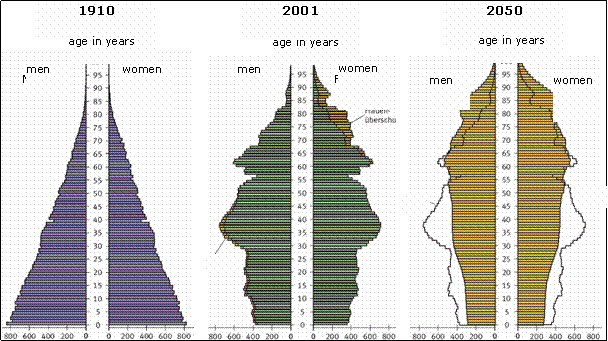
figure XX – Population Pyramid of the Germany
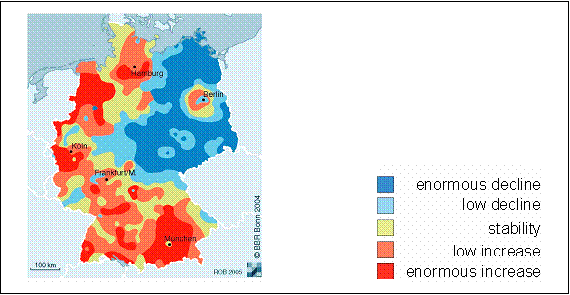
The breakdown of the Iron
Curtain and the reunification of Germany have left their footprints in the
demographic profile this country. Due to the domestic migration of working
people the country will change differently. The east part of Germany has overcome an outflow of young
people looking for jobs in West-Germany. They left behind in the eastern part
mainly immobile – elderly or unemployed – people. This works as a catalyst of
the demographic change. Everything will happen earlier in East-Germany. The western
part of this country basically has the same problems like East-Germany. The
main difference is that the positive inflow of East German workers slows down
the process of aging. Figure XX provide a forecast to 2020 based on a
continuous migration in Germany. As we can easily see Germany will be divided by that time. To
summarize a research of the labor force potential in Germany has to be done separately for East
and West-Germany.
figure XX – Development of the labor force potential, source: BBR, (2005).
Raumordnungsbericht. In:
Berichte Bd. 21, http://www.bbr.bund.de/,
p. 32. 2005-09-15.
The current unemployment rate of Germany stagnates over years with now
around 9.5%. Politicians tried to decrease the amount of unemployed but failed.
One part says that we have not done enough the opposites argue that we have
done too much and used the wrong instruments. It’s a fact that Germany as one of the strongest countries
of the EU has difficulties to get out of this stagnation with small GDP growth.
Some reforms – namely HARTZ IV – tried to mobilize the number of unemployed
with additional wages or a decrease of the benefit payments but it wont work
properly up to now. However, the situation may become a better because the unemployment
rate has ceased to drift upwards and short-shift work has been diminishing (see
OECD p. 52.).
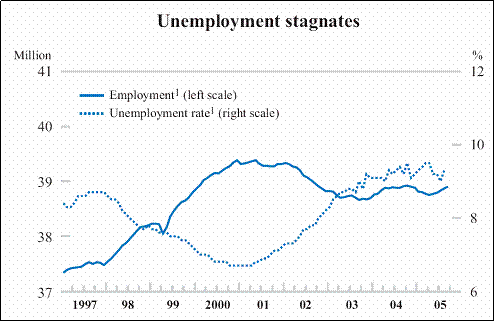
figure XX – unemployment in Germany, source: OECD Economic Outlook, Nr.
78
The employment rate is shown in figure XX. The average is about 65 %.
Young and old people of both sex lies lower than the average. The employment
rate differs in age groups and between male and female. In Germany the young people usually enter the
labor market very late. Also the older ones were able to get out of the labor
market too very early.
figure XX – employment rates in Germany, source: EU-Commission 2005, own
graph
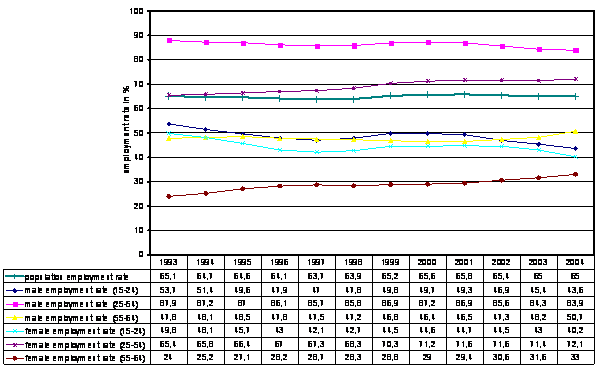

If we take a look at the activity rate than we get a similar impression
of the German labor market. The average of 70% mainly comes from the high
activity of the middle aged groups.
To conclude this section in Germany a specific number of workers will
get out off the labor market. There are less people coming after. This will
lead to that case that fewer people have to earn the pensions for a growing
number of retired persons. Following the discussion of additional wage costs Germany will have to change the social
security system otherwise we won’t be competitive on the market.
4. Core structure of the model
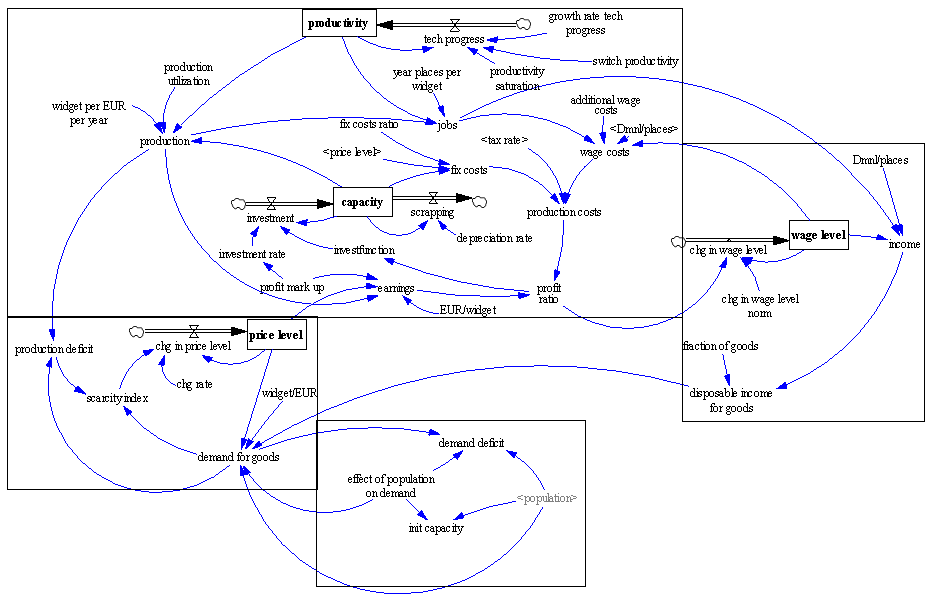
Because our aim is to understand
the behaviour of the complex system of economy, we need to understand the
dynamics of the interactions (feedbacks) among the components of the system. To
visualize the feedback structure of the system we used causal diagram, Fig 1.
Such diagrams consist of variables linked through arrows denoting the causal
direction. Each arrow has a defined polarity; positive (+) or negative (-)
which implicates the following nature of relationship:
a)
X → Y = ∂y/∂x
> 0,
b)
X →
Y = ∂y/∂x < 0.
Causal loop diagrams provide the
basis for understanding the dynamic feedback structure of the system. However,
they are not supported by quantitative description of each feedback. Dynamics
of model arise from the interaction of two types of feedback loops, positive;
self-reinforcing, and negative; self-correcting. Positive loops amplify
feedbacks of system and negative - stabilize system behaviour, counteracting
all fluctuations.
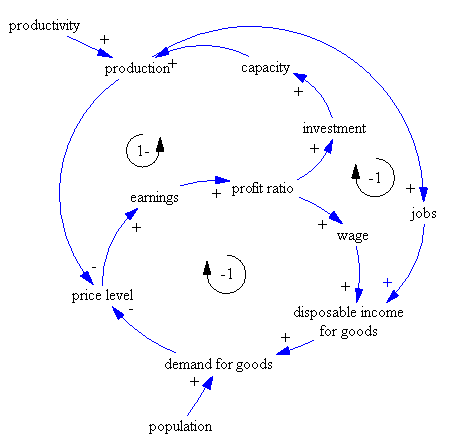
Figure 2. Causal loop diagram of the
production – demography model
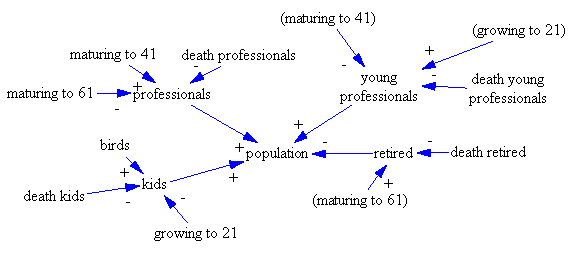
Figure 3 Causal loop diagram of the
population model
The core structure of
our market economy system illustrating the main feedback loops is shown in
Fig.2. We assume that evolution of processes starts with population changes as
external variable and consider its influence on economy through the stimulated
by population growth dynamics of labour market (see: Fig. 3). Population
progress is regulating the demand-production relation and influences the number
of offered jobs. Assuming that 60% of professionals and young professionals
group is active workforce in economy and 100% of active workforce is employed
the inequality in the market arises from the disposable income, demand for
goods and production regulated by productivity and capacity levels.
Starting
point of analysis is an existing exponential growth of population. This is the first
source of the dynamics of the whole structure. Accordingly increasing number of
labour market participants yields the changes in demand for goods resulting
in price dynamics.
The illustrated
feedbacks state that the higher increase of population causes the weaker increase
of prices. To stabilize the price level the correlated production increase is
required. As the production dynamics depends on the separate factors as
capacity, productivity the imbalance between population and production preassure
on prices is the second source of dynamics.
Moreover the model shows
that the higher production means less pressure on prices increase. Also the
higher demand we have the weaker price increase we can expect. All processes
are visible in Fig. 2 where each of three presented negative loops has one
stabilising feedback.
The aim of our model
first of all is to simulate the marked evolution under the pressure of
increasing population. It should demonstrate the behaviour of wage and job
level to show the reaction of economic system. Therefore the previously
mentioned relations have to be quantified and translated into simulation requirements.
As a consequence of
System Dynamics methodology we performed model described by mathematical
equations to precise used approach, specify relations between variables and
test our assumptions. Although these values are logically determined, they are
freely chosen to receive the outcome of individual variables not a magnitude of
simulation results. Thus the System Dynamics model is supposed to be adjustable
to a real case and maybe used to simulate the ongoing demographic progress.
Figure 4. System Dynamics model
including the complete production and demography set of variables
Figure 4. shows the complete model.
The complementary set of mathematical equations is provided in Appendix. The model structure
consists of four conceptional elements: (1) the production part, where the
capacity level is the internal variable regulating production, (2) the price
level part regulating capacity level as a result of simultaneous dynamics of
demand and production (scarcity index). Part (3) the wage and income changes
representing part, responsible subsequently for demand value and part (4)
feedbacks representing the strength of demographic boom visible through demand
fluctuations.
5. Model testing
The
simulation experiments have been performed to check the plausibility of the
model and to understand the general behaviour of the variables evolution during
the intensive population increase. The used simulation settings and chosen
values of parameters are displayed in Appendix.
The
base case scenario represents the market evolution likely to happen when the
population increase is very intensive, since 40th year of simulation, which
refers to the situation of demographic boom in any age group of population. The
numerical output of this scenario is illustrated in Fig. 5.
The simulation is
performed for the period of over 100 years. It can be seen that when the strong
demographic growth occurs the price level fluctuations inceases. The reason
lies in
Scarcity index which implicates the
changes in price values. The described evolution reduces or reinforces the
company earnings, capacity and
production. The same factor regulates the fluctuations on labour market,
because through the production level prices regulate the number of jobs and
disposable income. Having the taxes level constant (see equation (66) in
Appendix) the company level of production cost and investment depends primaly
on jobs which results from the production level and secondary - on a price
level. Below presented graphs we can see the direct convergence of fluctuations
the most important variables. Moreover as the system is definitely the negative
feedback loop the illustrated cyclical variety (60 years long cycles) suggests
the effective own system stimulation. In our model system of choosen range has
the internal stabilisator. It is the demand level which vary when the real
income exceeds or not the effect of population on demand. This is the first
source of cyclical fluctuations.
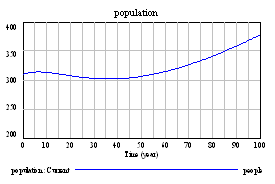
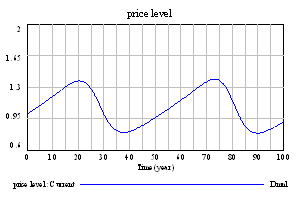

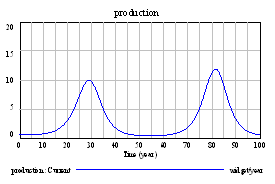
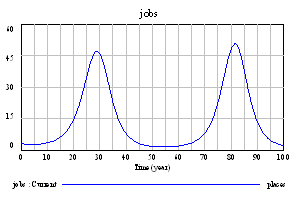
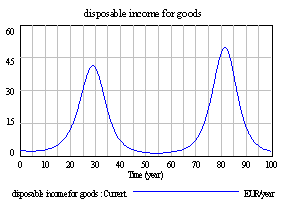
Figure 5. Simulation output for the
base case scenario
6. Conclusion and future prospects
Being aware of the complex
dynamics of any market system, the puprose of this paper was to identify the
main influencing variables and to construct a System Dynamics model.
Furthermore there exists a very real danger that economic models neglect
dynamic aspects and system performance result in extremely high nonequilibrium.
Our model, however, enables insight in the transition processes and allows for
easy understanding of the fundamental evolution of the key variables. Two
examples of demographic changes in Poland and in Germany cause pressure on the labour market.
For simplicity reasons the
model has been adjusted to fictitious
conditions basically to be a tool in explaining the economic results of a scale
of labour capital changes as well as in
understanding the importance of considering the path of performance of chosen fragment of economic
system. Thus our model provides the theoretical knowledge about the dynamics of
adjustment to serious inflow of workers entering labour market. Nonetheless, it
would be very interesting to adopt the model to a real case in order to check
the actual validity of the implications. The introductory example is the
appropriate base for model experiment. Its specific feature is that the
demographic boom affects the young age generation on labour market in Poland, so this case just exemplifies the
possibilities provided by our model.
Further
development stages of the model are likely to provide more possibilities for
analysis, where decisions can be varied during the simulation in consideration
to the institutional changes of economic system.
References:
1.
BOSSL,
HARTMUT (2004): Systemzoo 3. Wirtschaft, Gesellschaft und Entwicklung, BoD.
2.
Chromińska
B., Labour Market in Poland in 2004, Rynek Pracy, 2005/2.
3.
EU-Commission
(2005): Employment in Europe 2005, Belgium.
4.
Kaźmierczak
Z., Labour market in EU in XXI perspective, Today’s social policy in Poland in
EU aspect, AE Katowice, Katowice 2000.
5.
OECD:
Economic Outlook, ed. 2005, Nr. 78, www.sourceoecd.org
6.
STATISTISCHES
BUNDESAMT (ed.) (2003). Bevölkerung Deutschlands bis 2050: 10.
koordinierte Bevölkerungsvorausberechnung. Wiesbaden. In:
http://www.destatis.de/ presse/deutsch/pk/2003/Bevoelkerung_2050.pdf,
(2006-02-21).
7.
Sterman
J.D., Business Dynamics, Irwin McGraw-Hill, Boston 2000.
8.
Sztanderska
U., Development trends of Polish labour market, Nowe Życie Gospodarcze, 2001/21.
9.
Zdrojewski
E., Regions with the highest unemployment rate, Statistical Information,
2005/5.
Appendix
(01) activity index=0.6
Units: Dmnl
(02) additional wage costs=0.4
Units: Dmnl
(03) births= women*(fertility/cohort
size)
Units: people/year
(04) capacity= INTEG (investment-scrapping,init capacity)
Units: EUR
(05) chg in price level=scarcity index*price level*chg rate
Units: Dmnl/year
(06) chg in wage level=IF THEN ELSE (profit ratio>0,profit
ratio*wage level*chg in wage level norm,0)
Units: EUR/year/year
(07) chg in wage level norm=0.02
Units: Dmnl/year
(08) chg rate=0.025
Units: 1/year
(09) cohort size=20
Units: year
(10) death kids=mortality kids*kids
Units: people/year
(11) death professionals=professionals*mortality professionals
Units: people/year
(12) death retired=retired*mortality retired
Units: people/year
(13) death young professional=young professionals*mortality young
professionals
Units: people/year
(14) demand deficit=demand for goods-(effect of population on
demand*population)
Units: widget/year
(15) demand for goods=IF THEN ELSE (((disposable income for
goods/price level*"widget/EUR")<(effect of population on
demand*population)),disposable income for goods/price
level*"widget/EUR",(effect of population on demand*population))
Units: widget/year
IF THEN ELSE (((disposable income for goods/price
level*"widget/EUR")<goods want),disposable income for goods/price
level*"widget/EUR",goods want)
(16) depreciation rate=0.05
Units: Dmnl/year
(17) disposable income for goods=fraction of goods*income
Units: EUR/year
(18) "Dmnl/places"=1
Units: Dmnl/places
(19) earnings=profit mark up*price
level*production*"EUR/widget"
Units: EUR/year
(20) effect of population on demand=1/100
Units: **undefined**
(21) effect of social payment on tax=1e+006
Units: **undefined**
(22) "EUR/widget"=1
Units: EUR/widget
(23) "EUR/year"=1
Units: EUR/year
(24) fertility=2.5
Units: Dmnl
(25) FINAL TIME = 100
Units: year
The final time for the simulation.
(26) fix costs=capacity*fix costs ratio*price level
Units: EUR/year
(27) fix costs ratio=0.25
Units: Dmnl/year
(28) fraction of goods=0.8
Units: Dmnl
(29) growing to 21=kids/cohort size
Units: people/year
(30) growth rate tech progress=0.002
Units: Dmnl/year
(31) income=wage level*jobs*"Dmnl/places"
Units: EUR/year
(32) init capacity=effect of population on demand*population
Units: **undefined**
(33) INITIAL TIME = 0
Units: year
The initial time for the simulation.
(34) investfunction=profit ratio
Units: Dmnl
Comment: IF THEN ELSE (profit
ratio>-0.1,0.1*Abs(profit ratio),0)
(35) investment=investment rate*capacity*investfunction
Units: EUR/year
(36) investment rate=0.1*profit mark up
Units: Dmnl/year
(37) jobs=(production)/productivity*year places per widget
Units: places
(38) kids= INTEG (+births-death kids-growing to 21,10)
Units: people
(39) maturing to 41=young professionals/cohort size
Units: people/year
(40) maturing to 61=professionals/cohort size
Units: people/year
(41) mortality kids=0
Units: Dmnl/year
(42) mortality professionals=0
Units: Dmnl/year
(43) mortality retired=1/20
Units: Dmnl/year
(44) mortality young professionals=0
Units: Dmnl/year
(45) nominal social payment=not working people*"nominal
social payment p.P."
Units: **undefined**
(46) "nominal social payment p.P."=real amount to
live*price level
Units: **undefined**
(47) not working people=workforce-jobs
Units: people
(48) population=kids+professionals+young professionals+retired
Units: people
(49) price level= INTEG (chg in price level,1)
Units: Dmnl
(50) production=production
utilization*productivity*capacity*widget per EUR per year
Units: widget/year
(51) production costs=(wage costs+fix costs)*(1+tax rate)
Units: EUR/year
(52) production deficit=demand for goods-production
Units: widget/year
(53) production utilization=1
Units: Dmnl
(54) productivity= INTEG (tech progress,0.2)
Units: Dmnl
(55) productivity saturation=4
Units: 1/year
(56) professionals= INTEG (+maturing to 41-death
professionals-maturing to 61,100)
Units: people
(57) profit mark up=9
Units: Dmnl
(58) profit ratio=(earnings-production costs)/production costs
Units: Dmnl
(59) "ratio men/women"=0.5
Units: Dmnl
(60) real amount to live=500
Units: **undefined**
(61) retired= INTEG (+maturing to 61-death retired,100)
Units: people
(62) SAVEPER = TIME STEP
Units: year [0,?]
The frequency with which output is stored.
(63) scarcity index=production deficit/demand for goods
Units: Dmnl
(64) scrapping=depreciation rate*capacity
Units: EUR/year
(65) switch productivity=1
Units: **undefined**
(66) tax rate=0.05+(nominal social payment/effect of social
payment on tax)
Units: Dmnl
(67) tech progress= switch
productivity*growth rate tech progress*productivity+(1-switch
productivity)*growth rate tech progress*(1-productivity/productivity
saturation)*productivity
Units: Dmnl/year
(68) TIME STEP = 0.5
Units: year [0,?]
The time step for the simulation.
(69) wage costs=wage level*(1+additional wage
costs)*jobs*"Dmnl/places"
Units: EUR/year
(70) wage level= INTEG (chg in wage level,1)
Units: EUR/year
(71) widget per EUR per year=1
Units: widget/(EUR*year)
(72) "widget/EUR"=1
Units: widget/EUR
(73) women=young professionals*"ratio men/women"
Units: people
(74) workforce=(activity index)*(professionals+young
professionals)
Units: people
(75) year places per widget=1
Units: (year*places)/widget
(76) young professionals= INTEG (+growing to 21-death young
professional-maturing to 41,100)
Units: people