Challenges
for Software Engineering in the Context of e-learning Systems
dr Jolanta Sala, dr Halina Tańska
Kwidzyn School of
Mamagement, University of Warmia and Mazury
Introduction
The development and implementation
of e-learning[1] IT systems is usually a
prototype-oriented type of activity. There is a general tendency to
underestimate the importance of
implementation, operation and development stages and to regard them as
part of the "daily grind". According to the authors'[2]
many years of experience, they are the most laborious and fallible aspects of
the lifecycle of e-learning systems which lack adequate management. This
deficiency often results in the complete loss of an institution's achievements,
and the borne outlays are forfeited without active continuators of the process.
Unfortunately, the principles worked out in software engineering often receive
marginal attention in the Polish e-learning systems practice – it should be
noted, however, that they do not support the problems specific to this class of
systems.
Challenges for software engineering
The theory
that good work organisation standards and a systematic approach to software
development can be achieved through the effective application of the principles
and methods proposed by software engineering may sound
like an advertising slogan. Software engineering tackles all aspects of the
process of developing IT systems software. It deals with a typical production
cycle from the stage of analysis and requirements identification, through design
and implementation, to the evolution of a complete system. The key tasks of
software engineering[3] can be
summarised in four points:
- Promoting
the use of techniques and tools which facilitate the development of
complex systems.
- Popularising
methods which support analyses of new problems and facilitate the use of
previous experiences.
- Systematising
the process of software development to simplify planning and monitoring
phases.
- Instilling
an awareness among the producers and the buyers that the development of an
extensive, high-quality IT system is an undertaking which requires a
professional approach.
As a factor which supplements
conventional instruction, e-learning IT systems definitely fall within the
category of complex systems. A further debate is needed to clearly set forth
the challenges for software engineering in the context of e-learning systems.
Lifecycle
On the one hand, the lifecycle of an
e-learning system covers typical stages, while on the other, it is highly
specific. As an important methodological guideline, the lifecycle should be
regarded as a diagram which supports strategic project-related decisions at the
organisational and management level in an organisation. Universities often
break that rule and that error has more profound consequences, while in the
business community, the cyclic mechanism of economic calculation makes up for
those consequences to a limited extent. Until recently, the problem of
developing or selecting the technological (system, application) platform was
fetishized in this class of systems. We can only be grateful that this stage
has been demythologised. The identification of user (organisational)
specificity, in particular the continuous upgrading of data bases, content
bases, course bases and knowledge bases, still poses a problem in Polish
practice. The authors believe that the application and observance of spiral
lifecycle model principles is an alternative (necessary but insufficient)
antidote to the problems reported in e-learning systems (Fig. 1).
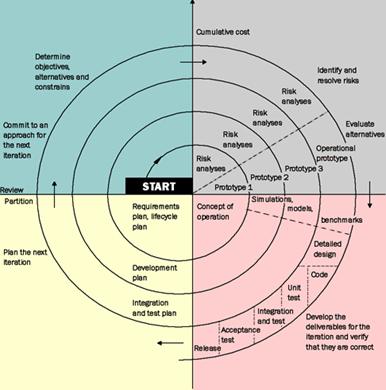
Fig. 1. Spiral model of an IT system's
lifecycle
Source: http://www.wikipedia.org/wiki.model
spiralny
The spiral model enforces the
organisation of project management procedures and guarantees the attainment of
the target solution in the long-term perspective through the implementation of
successive prototypes. Those qualities are sometimes regarded as the model's
deficits, but in view of the specific nature of e-learning systems, they are
clear advantages which should be reinforced together with other
characteristics, including continuous validation, flexibility (change of
environment, resource allocation, instability of requirements) and low risk of
failure (range, quality). This model supports the integration of all parties
involved in project-related undertakings (a crucial feature in relation to
universities). Yet as regards the range of antidotes for e-learning systems,
the authors have postulated not to restrict the system's lifecycle to software
strictly oriented towards educational platforms, but to expand its reach to
e-content, a proposal which may be regarded as heresy. The attempts to clarify
doubts as to whether e-content may be identified with software and regarded as
its integral part also pose a specific challenge. The general focus is on the
practical orientation of software engineering, but its theoretical correctness
is also closely scrutinised. Nevertheless, more attention should be paid to
progress in e-learning technology and standards which are still short of
meeting user needs and requirements. From the pragmatic point of view,
educational content (e-content, e-courses, e-capsules) constitutes an
e-learning system module which is characterised by variability and
exchangeability. The development and upgrading of e-content is still more
reminiscent of the art of programming and inputting data (knowledge) with the
use of specialised editors[4].
Perhaps a cycle for processing e-content should be devised as yet another
challenge for software engineering?
In line with general practice, there
are two main groups of e-learning system users: students/ employees and
educational institutions/units represented mainly by teachers, decision-makers
and administration staff. The above approach simplifies the structure of system
users, but due to its specific anatomy, the system should also be recognised in
view of the two significant roles it plays: that of a content supplier and a
supplier of ICT services. The ITIL (Information Technology Infrastructure Library)
standard deserves special attention in this context, but other standards are
equally vital for e-learning systems.
ITIL standard
The ITIL standard makes a clear
distinction between a business client (decision-maker who finances system
services), a user (who relies on system services) and an IT engineer (who
supplies the service). In practice, IT departments regard the above as a code
of best practice containing a set of guidelines to ensure that IT services are
provided most effectively.
Problems
relating to the upgrading of data and e-content of an e-learning system are
closely associated with its direct users, the right tools and adequate
organisational and management methods, including a motivational system. Tools
are directly related to the platform, which may deliver higher of lower
standards of performance, but management has a key impact on implementation,
operation and development. Those aspects are related to an organisation's
"own" IT team and direct users. In Polish practice, e-learning
systems are often implemented hastily, without due attention to detail and for
the sole needs of selected users (in most cases, to cut costs), while the IT
team is either non-existent or is not adequately prepared to take actions which
are specific to e-learning systems. The implementation effort is regarded as a
one-off investment and a source of benefits which never runs dry.
From a methodological point of view,
know-how support constitutes operational IT management in the ITIL service
model (Fig. 2). According to the authors' experience, automatic decisions
concerning the selection of ICT service providers which are limited to
insourcing, i.e. purchase (or acquisition of open source software) and
installation, with no consideration given to viable outsourcing options, have
fatal consequences for an organisation. Such decisions (lack of rationale as to
whether IT services should be insourced or outsourced) are usually the root
cause of subsequent problems related to e-learning systems.
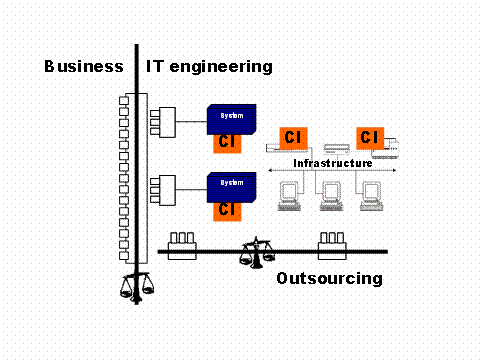
Fig. 2. Operational IT management in a service
model
Source: M. Gmerski,
Zarządzanie infrastrukturą IT wg ITIL, Infovide, Warszawa 2005, s. 19
If clear rules for the method of
recruiting candidates and developing adequate working conditions for the IT
team are not set, this deficiency will be responsible for recurring problems
and mounting difficulties which will surface already after the initial success
or shortly after. The workplace and the roles played by the IT team have to be
adequately prepared, and the relevant costs must be accounted for in the budget.
Provisional solutions may satisfy current needs at the time of implementation,
but sooner of later, they will be a source of disappointment.
Decision-makers (business clients),
users, i.e. teachers in all roles assigned by e-learning systems, as well as
personnel providing support for dean's offices and training departments in a
business environment should communicate closely with the IT team. Harmonious
collaboration among those three groups is vital. This is a methodological
guideline with universal applications. The specific nature of e-learning
systems requires the determination of rules for collaboration with content
suppliers who can be incorporated into the IT team. There exists a great
variety of solutions which proved to be effective in practice, but business and
academic communities have vastly differentiated decision-making preferences.
While the former focus on content purchase, the latter consider customised
content and multimedia production as the obvious necessity. The resulting team
may be an internal unit drawing upon the resources of a separate and specialist
group of IT engineers and specially qualified teachers.
Challenges for the future
Education and knowledge have gained
unprecedented significance in recent years. The 21st century is
referred to as the century of knowledge and information. Knowledge is perceived
as the key economic resource, while the development and deployment of knowledge
is becoming a vital component of the development strategy of every organisation.
To generate profits, knowledge has to be skilfully created, accumulated,
codified and transferred, while university students and an organisation's
employees have to be provided with a supporting environment for the effective
acquisition of knowledge. Best practice standards for knowledge management have
to be developed. We need to reinforce the view that knowledge management is a
systemic solution which, owing to the integration of all systems that make up
an organisation[5], lead to a more effective
use of its resources, in particular resources comprising both available and
hidden knowledge, and transform it into knowledge which is commonly shared by
the entire organisation.
The old motto – "learn, but
above all, learn how to learn" – has never been a more valid challenge as
it is now in the era of modern man who is surrounded by computers and computer
networks. Everyone who is serious enough about their future and personal growth
should devote at least the amount of effort that goes into active occupational
development to building own human capital (skills, knowledge, competence).
Students' and employees' knowledge, competence and skills are the key asset of
every organisation. Although difficult to assess and impossible to present in
the balance-sheet, human capital constitutes the anticipated (desired) value.
As the result, the new teaching philosophy requires a transformed approach to
preparing and conveying educational content which is needed to acquire a given
set of skills. The approach to creating and sharing knowledge bases and,
consequently, acquiring new skills and competencies, is undergoing an
evolution. Educational efforts can be supported by e-learning systems, but only
if developed based on tested practice. It has been noted[6]
that e-learning systems design relies on solutions in the area of IT
engineering and communication technology, personnel management (including
development of skills and competencies), business, etc.
It is regrettable that educational
curricula in IT engineering do not account for the specific nature of
e-learning systems, even though the demand for this class of systems in an
information society is immense. There is a deficit of the required tools,
methodological and organisational resources. Therefore, e-learning systems
usually function and are developed by trial and error of individual experts.
Students specialising in the field of IT engineering begin to take an interest
in e-learning systems by recognising the need for them; nevertheless, course
curricula are deficient in such subjects (at least as regards electives) and
fields of specialisation. Students write their degree theses (B.Sc., M.Eng.,
M.Sc.) in this area, but their accomplishments are a mere semblance of
development.
The issue of information noise also
deserves greater attention. It has become a part of daily reality in the
contemporary world where every child, grade-school and university student,
employee and unemployed can choose from an immense variety of the available
media. In this situation, there is growing pressure to acquire knowledge which
is necessary to further the development of both the individual and the society
on the whole. Yet the greater the information noise and the available choice,
the harder it is to choose the appropriate source of data, information,
knowledge and wisdom. At the same time, the multiplicity of information
channels contributes to the rapidly growing demand for e-learning systems which
enable users to quickly and safely acquire systematised knowledge. Computers
and information processed with the use of e-learning systems have changed the
society's habitual choice of method of acquiring, sharing knowledge and
deriving measurable benefits from the process. Unfortunately, it seems that
software engineering still fails to contribute the desired values to e-learning
systems practice. There continues to be a wide gap between theory, strategy,
expectations of an information society and the real support offered by software
engineering.
Conclusions
There is a broad diversity of methodological
determinants of successful and profitable e-projects in IT engineering. In view
of rather disappointing statistics (40% successful and 10% profitable
projects), those determinants should be narrowed down to four key aspects:
organisational culture, inadequate approach, time and cost. The most crucial
barrier is the absence of organisational culture which is "well"
prepared for IT implementations and has a "stable" IT team. From the
very start, organisations should assume that in addition to the adventure of
testing out a novel solution, the main emphasis should be on improving the
organisation's effectiveness.
The collaboration between teachers
and IT engineers, organisations operating in the field of education and
information technology is vital for e-learning systems. Both of the above
professions and fields obviously have their specific requirements and are
marked by an immense dynamics of changes related to the development of the
information society and the knowledge society. The new challenge for e-learning
system applications is to ensure that in addition to IT skills, teachers are
provided with professional IT support. The responsibilities relating to the
functioning of an e-learning system may not rest solely on an omnibus teacher –
a universal and self-reliant educator. Unfortunately, this is most often the
case in Polish practice. There are several simple examples to illustrate the
above: a teacher is charged with cleaning chores even though the school employs
a cleaner, a teacher develops educational content and textbooks despite the
fact that the school and the state rely on the services of specialist
publications and a library. A teacher may manage a school and a computer
network, he or she may develop e-learning platforms and multimedia e-content,
but those tasks should always be regarded as an exception, not a rule. The
immediate challenge for software engineering is to find optimal solutions to
problems in the area of e-learning systems to limit the span of the
experimental period which is proving to be very costly in practice. It is high
time for the accumulated experiences to be generalised to cater to the urgent
demand for high system quality and the continuous creation, functioning and
development of e-learning class systems.
References:
- M.Gmerski, Zarządzanie
infrastrukturą IT wg ITIL, Infovide, Warszawa 2005
- M.Hyla, e-learning. Od pomysłu
do rozwiązania, Solidex, Kraków 2003
- P. Peszko, Zdalne zarządzanie
procesem budowy multimedialnych materiałów elearningowych,
elearning 2.0 Internetowy magazyn nowych technologii szkoleniowych, numer
2, listopad 2007
- K. Subieta, Inżynieria
oprogramowania, Wydawnictwo PJWSTK, Warszawa 1999
- K.Waćkowski, e-learning w
organizacji normalizacyjnej, w: J.Kisielnicki, J.K.Grabara, M.Miłosz,
Rozwój zastosowań informatyki, PTI, Katowice 2006
- St.Wrycza, J.Wojtkowiak, Nauczanie na
odległość wyzwania – tendencje – aplikacje, Wydawnictwo
Uniwersytetu Gdańskiego, Gdańsk 2002
Abstract
The article sums up the authors' many years of
experience relating to the creation and functioning of several e-learning
systems. The authors focus on the key methodological aspects which are a
generalisation of their experience and which affect the quality and the
operational continuity of this class of systems. The range of issues addressed
by this paper is inclusive of IT infrastructure management according to the
ITIL standard, system lifecycle, content processing cycle, the preparation and
the role of IT teams which support the functioning of e-learning systems.