Energy and environment
Jan Pawlak
Chair of Electricity and Power
Engineering
and IBMER in
Abstract
There are divergences
between results of research concerning the energetic efficiency of biofuels
production and its effect on environment. Existing differences are results of
diversity of local conditions, energy crops, applied technologies as well as
methods of analysis. The rationalization of all stages of production processes
is the way to improve the efficiency of bioenergy production and likewise the
environment conservation. In this paper, the possibilities of such
rationalization were discussed on the example of the agricultural stage.
Key words: bioenergy,
energy inputs, efficiency, environment
Introduction
Any
economic activity needs energy inputs in different forms. Along with the
technological advance, the use of fossil energy sources grows. This fact has
many impacts from economic, environmental and social viewpoints. As far as the
economic aspects is concern, the growing demand for energy together with
limited resources causes the prices of fuels to increase. As a result, also
costs of production are growing. Growing energy use creates also serious
environmental problems. More recently, there has been a strong concern about
climate change such as global warming caused by anthropogenic releases of
greenhouse gases, most notably carbon dioxide, and their interactions with
humans and the natural environment.
Energy development is the
ongoing effort to provide sustainable energy resources. This can be achieved
through improvement of technology, including constructions, maintenance and
organization. Also the role of knowledge and skills is crucial. When converting
energy from primary energy sources into more convenient secondary energy forms,
both emissions and quality enabling more efficient use should be taken into
account. Results should be positive from both ecological and economic points of
view (reducing pollution and unitary costs).
The
mitigation of greenhouse gases and convenient developing strategies are now
wildly discussed. Also social and political risks of extensive use of fossil
fuels are taken into consideration. One of the solutions to solve the problems
is the renewable energy development. Growing
interest in renewable energy development is also linked to concerns about
exhaustion of fossil fuels.
The
purpose of this paper is an attempt to present the factors bringing an
influence on efficiency of energy inputs for biofuels production and some ways
to improve the efficiency. Additional purpose is to show the interrelations
between energy management and environment.
Biomass as a
renewable energy source
The increases in the cost of fossil fuels as a
result of the strong energy demand of the fast industrially growing Asian
countries and the ongoing evolution of agriculture in Western countries, are
leading to a more specific focus linked to energy issues in the rural areas
[Riva 2006]. One has also not to forget the perspective of depletion of
non-renewable energy resources as well as the environment aspects of the
growing energy use. Therefore, this century could see a significant switch from
a fossil fuel to renewable energy sources. According to Best [2006] such a
situation will cause that in this century the development of bioenergy based
economy, with agriculture and forestry as the leading sources of biomass for
biofuels can be expected.
The proposed solutions must be ecologically
sustainable, environmentally acceptable for public and the delivered unitary
costs need to be lower than for fossil fuels [Sims 2003].
The
application of any renewable energy source, including biomass, is justifiable
under condition that the amount of inputs of energy is lower than its calorific
value. The scheme below presents inputs in a case of an energy crop (Fig. 1).

Fig. 1. Direct and indirect energy inputs for
production of energy crop.
m.u. = measure unit. Source: [Pawlak 2007]
The
use of renewable energy source is justifiable under condition that its
calorific value is higher than direct and indirect energy inputs for its
production. The purposefulness of use of a biofuel is the bigger; the higher is
the efficiency of direct and indirect energy inputs for its production. To
calculate this efficiency, the following equation can be applied:
 (1)
(1)
Where: Enci - the efficiency of direct
and indirect energy inputs for production of i-th energy crop
Qci - calorific value
of produced energy crop, MJ/ha
Ieci - direct and
indirect energy inputs for production of i-th energy crop,
MJ/ha.
Efficiency
of the energy inputs Een, calculated using the formula (1) should be
expressed by the coefficient value higher or at least equal to 1 if the
production of energy from biomass is to be justifiable. On the Figure 1 labor
is shown among energy inputs. Labor should be taken into account in a case of
production costs. However most of researchers do not include it into energy
balances.
Results of
analyses of energetic efficiency of biomass production for energy are not
always positive. According to results of analysis of the 14 energy inputs that
typically go into corn production and the 9 invested in fermentation and
distillation operations 29 percent more energy (derived from fossil fuels) is
required to produce an unit of corn ethanol than is contained in the ethanol.
Ethanol from cellulosic biomass is worse: With current technology, 50 percent
more energy is required to produce an unit of calorific value than the product
can deliver. Investigators differ over the energy value of the by-products of
making corn ethanol, but the credits range only from 10 percent to 60 percent.
In any event, biomass ethanol is a bad choice from an energy standpoint [Patzek,
Pimentel 2005, Pimentel, Patzek 2006]. Also results concerning production of
biodiesel under American conditions are not much better [Pimentel, Patzek
2005]. Instead, results of research carried out in
The
above divergences are result of diversity of potential energy crops as well as
local conditions and technologies to be applied. Knowledge of influence of
different factors, such as kind of soil and climate, technology and scale of
production on efficiency of production of biomass for energy is necessary.
Research by Denisiuk and Piechocki [2005] show that the chemical composition of
straw of the same species of cereals produced in
During the
analysis of the purposefulness of the use of biomass different aspects should
be taken into accounts. There is direct interrelation between the energy
management and the environment conservation. This concerns not only emissions.
According to Tolbert [2002] dedicated woody and herbaceous crops for energy
were shown to provide soil and water quality benefits. They ensure the
decreasing of runoff, sediment losses and nutrient transport compared with
traditional agricultural crop production. However,
results of researches carried out in different countries are not always
univocal. According to David Pimentel and Ted Patzek [2006] the environmental
impacts of corn ethanol are enormous. They include severe soil erosion, heavy
use of nitrogen fertilizer and pesticides, and a significant contribution to
global warming. In addition, each m3 of ethanol requires 1700 m3
of water (mostly to grow the corn) and produces
Above
differences in opinions concerning the purposefulness of the use of biomass for
energy are probably results of diversity of local conditions, energy crops,
applied technologies as well as methods of analysis. In any case, the
rationalization of all stages of production processes is the way to improve the
efficiency of bioenergy production and likewise the environment conservation.
In this case the possibilities of such rationalization on the example of the agricultural
stage will be discussed.
Possibilities to improve the efficiency of biomass energy production
Direct and
indirect energy inputs concerning production of biomass on farms include:
·
Seed materials,
·
Fertilizers,
·
Pesticides,
·
Machinery,
·
Energy carriers,
·
Other materials.
Better efficiency of inputs of seed materials, fertilizers and
pesticides is possible under condition of implementation of the precision
agriculture system. It makes it possible to reduce material inputs and at the
same time decrease the pollution of soil and water. Indirectly, it ensures
reduction of energy inputs. These are important: in a case of nitrogen
fertilizers about 70-80 MJ per kilogramme of the pure N.
In
a case of farm machinery, the rational choice taking into consideration the
local condition is very important. It includes the technical parameters of
machines, the proper aggregation tractor – implement as well as the impact on
the environment. Also the annual use of machines has a significant effect on
indirect energy inputs. This is shown on example of tractor (Fig. 2).
As
a result of low annual use of tractor only part of energy consumed for its
production can be used for production purposes. The rest is wasted. The
prolonging of useful life can be applied only in a limited range. Therefore, it
is necessary to find other solutions in a case when low scale of production
does not ensure sufficient annual use of machine. Such solution is multi-farm
use of machines.
Very
important factor is rational management and maintenance of machines. Good
technical service ensure not only decrease the direct and indirect energy
inputs for repairs, but also direct inputs of fuels in a case of engines. Along
with implementation of the technical advance in the field of farm machinery the
role of work organization and skill of operators is growing. More and more
sophisticated and expensive machines can be effectively used only by well
skilled staff.
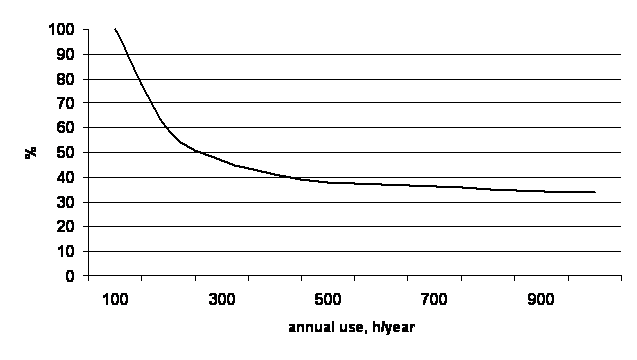
Fig.2.
Annual use of tractor versus unitary indirect energy inputs
Source:
author’s calculations
Complex
use of several forms of biomass together with energy saving technology can also
improve the biomass energy production. German experiment of bioenergy village
seems to confirm such opinion. The technical concept consists of three
components: (1) an anaerobic digestion plant supplied by energy crops and
liquid manure with a combined heat and power generator producing electricity
and heat energy, (2) central heating plant fired by locally produced wood chips
for additional winter heating, and (3) a hot water pipeline distributing the
heat energy to the connected households. Using the high yielding plants, reduction
of herbicides inputs (weedy plants are not problem in a case of energy
production) and harvesting two immature crops a year, with secondary crop sown
between the stubble are energy-saving practices. The system gives to the soil a
protective cover the year round that extracts nutrients and minimizes leaching
of nitrate nitrogen. The experiment implemented in village of 800 inhabitants
gave positive results from ecological, economic and social points of view
[Karpenstein-Machan, Schmuck 2007].
All
above mentioned solutions and factors should be considered in a holistic way.
Only complex approach, taking into consideration existing interrelations can
lead to improvement of the efficiency in biofuels production at the same time
to the reduction of threats for environment. However, even with improvement of
the efficiency of biofuels production, in the case of
Conclusion
Results
of researches of energetic efficiency and effect of biofuels on environment,
carried out in different countries, are not always univocal. Existing
differences are results of diversity of local conditions, energy crops, applied
technologies as well as methods of analysis.
The
rationalization of all stages of production processes is the way to improve the
efficiency of bioenergy production and likewise the environment conservation.
On
the stage of agriculture, better efficiency of inputs of seed materials,
fertilizers and pesticides is possible under condition of implementation of the
precision agriculture system.
In
a case of farm machinery, the rational choice taking into consideration the
local condition, ensuring sufficient annual use of machines as well as their
rational management and maintenance are very important.
References
Best G. 2006. Alternative Energy Crops for Agricultural Machinery
Biofuels - Focus on Biodiesel. Agricultural Engineering International: the CIGR
Ejournal. Invited Overview. Vol. VIII, No. 13.
Chamsing A., Salokhe V., and Singh G. 2006. Energy Consumption Analysis
for Selected Crops in Different Regions of
Denisiuk W. H., Piechocki J. 2005.
Techniczne i ekologiczne aspekty wykorzystania słomy na cele grzewcze. (Technical
and ecological aspects of the use of straw for heating). Wydawnictwo
Uniwersytetu Warmińsko-Mazurskiego w Olsztynie
De Nocker L.,
Spirinckx C., Panis L. 2000. Comparison of externalities of the
biodiesel fuel chains for passenger transport in
De Nocker L., Spirinckx C., Torfs R. 1998. Comparison of LCA and
external cost analysis for biodiesel and diesel. VITO, Flemish Institute for
Technological Research, 1-10
Karpenstein-Machan
M., Schmuck P. 2007.
Patzek T.W., Pimentel D. 2005. Thermodinamics of Energy Production from
Biomass. Critical Reviews in Plant Sciences, 24:327-364
Pawlak J. 2007. Renewable energy sources - agricultural, economic and
environmental aspects. Proceedings of
the 29th Conference of CIGR Section IV "Rational Use of Energy
and Renewable Energy Sources in Agriculture in Connection with Environment
Protection”. Warmia and
Pimentel D. 2003. Ethanol fuels: Energy balance, economics, and
environmental impacts are negative. Natural Resources Research. Vol. 12, No. 2,
Pimentel D., Patzek T. W. 2005. Ethanol production using corn,
switchgrass, and wood; biodiesel production using soybean and sunflower.
Natural Resources Research. Vol. 14, No. 1,
Pimentel D. & Patzek T. 2006. Editorial: Green Plants, Fossil Fuels,
and Now Biofuels. Bioscience 56(11): 875
Puppen D. 2002. Environmental evaluation of biofuels. Periodica
Polytechnica Ser. Soc. Man. Sci., 10(1), 95-116
Riva G. 2006 Utilisation of Biofuels on Farm. Agricultural Engineering
International: the CIGR Ejournal. Invited Overview. No. 15. Vol. VIII
Sims R. E. H. 2003. Climate Change Solutions
from Biomass, Bioenergy and Biomaterials. CIGR Ejournal. Invited Overview No.
11. Vol. V
Spirincx C, De Nocker L., Panis L.I. 2000. Comparative externality
analysis and life cycle assessment of biodiesel and fossil Diesel fuel. 1st
World Conference on Biomass for Energy and Industry, Sevilla. Proceedings Vol.
1, 171-173
Tolbert
V.R. 2002. Environmental sustainability of dedicated bioenergy feedstocks:
summary of research results. 12th European Conference on Biomass for
Energy, Industry and Climate Protection,
Wójcicki
Z. 2007. Energia odnawialna, biopaliwa i ekologia. (Renewable energy, biofuels
and ecology). Problemy Inzynierii Rolniczej 2(56), 5-18