The
Impact of the World Trade Organization Membership on the economic development
of Kyrgyzstan in the context of Kazakhstani borrowing
International
practices show that integration into the world economy is an important or even
necessary process for the countries with an emerging economy. In the Resolutions of the UN General Assembly
there is a confirmation about the necessity of this process. (1) Therefore, the
World Trade Organization (WTO) is probably the best example of integration into
the world economy.
This
international organization was founded in 1995. Deregulation of international
trade and managing trade and political relations of the Member-States is the
target objective of the organization foundation. WTO is the successor of the
General Agreement on Tariffs and Trade (GATT), signed in 1947, and implementing
the functions of international organization during 50 years (2). The list of
the WTO Member-States includes 157 units and 25 observant countries as of January
1, 2012. The share of the WTO Member-State includes about 95% of a global
commercial exchange (3).
The
problem is that Kazakhstan is not the Member of this international
organization. The process of Kazakhstani enlistment to the World Trade
Organization has started since January 26, 1996 with submitting an official statement
on acceding of Kazakhstan to WTO Secretariat. There are a lot of debates about the
future joining of Kazakhstan the WTO. Therefore, this event will influence the
development of economy in Kazakhstan and it is a burning issue. Today,
Kazakhstan is an observer of this organization and is at the final stage of
entering it. At the moment, the government has completed bilateral negotiations
on the market access for goods and services with the WTO Member-States that are
interested in the access to the market of Kazakhstan. These countries are Kyrgyzstan,
Georgia, Pakistan, Turkey, China, Korea, Oman, Japan, Cuba, Norway, Dominican
Republic, Bulgaria, Switzerland, Egypt, Israel, Brazil, Malaysia, Canada, Australia,
India, Ecuador, El-Salvador, U.S., EU, Guatemala, Argentina, Saudi Arabia and
etc. It is expected that negotiations on Kazakhstani acceding to WTO will be
finished by the end of 2012 (4).
In
order to clarify the issue with the prospect of Kazakhstani acceding to WTO, we
would like to consider the impact of WTO membership on the economy of the
country that has already been a member of this international organization. Kyrgyzstan
is a good example of it.
It is
not accidental that the experience of the Kyrgyz Republic in the international
organization is taken into consideration. The theories of these two states (Kazakhstan
and Kyrgyzstan) are similar. Firstly, they are similar according to the
territorial characteristic features. Secondly, the countries were the
Member-States of the USSR and have a similar history. Thirdly, Kazakhstan and
Kyrgyzstan have relations in the framework of the International Economic Organization
of EuroAasian Economic Community (EurAsEC).
Economic
and trade relations of these countries are considerably significant due to the
fact that Kazakhstan and Kyrgyzstan are neighbors from the beginning of their
existence. Knowingly, an economist H. Bos noted that "in most cases the
modern economic theories exactly formulate assumptions about changes in time,
but do not specify the spatial conditions". Outstanding and famous
economists and regionalists, such as P. Krugman, M. Porter, E. Meyr, E. Raynert
and other scientists, have a similar point of view and notice that “economy
exists and takes its place on the map ...” (5).
The
object of the scientific publication is the countries of Kyrgyz Republic and
Kazakhstan.
The
subject is the impact of WTO membership on the economy of Kyrgyzstan.
A primary target of the article is
to analyze the advantages of Kyrgyzstan acceding to WTO and its impact on the
economy. The nest positive moments should be considered as follows:
- export of Kyrgyz goods and
services is the most favored in the WTO Member-States;
- internal trade and tax legislation
is harmonized with the rules and regulations of WTO;
- a predictable regime for domestic
producers and investors was created in the field of trade and the service
sector;
- Kyrgyzstan has had the access to a
mechanism for resolving trade disputes of the WTO;
- the opportunity to participate in
the formulation of new rules of an international trade;
- the country has joined the WTO
ahead of its regional partners (China, Russia, Kazakhstan, and Uzbekistan) that
gave it the opportunity to influence the terms and conditions for acceding of
new countries to the organization, including the demand of price reduction on
domestic products and solve problems arising in trade with these countries;
- in 2000 the United States
abolished the amendment of Jackson-Vanik in relation to Kyrgyzstan;
- geographical distribution of KR
trade the CD was expanded from 98 countries in 1998 to 140 countries in 2011
(7).
The
graph below shows the increase of commodity turnover of Kyrgyz Republic after
entering the WTO (data are taken from the balance of payments of the Kyrgyz
Republic (8)). The turnover has grown
up from 1,291 billion dollars in 1998 to 6,207 billion dollars in 2010 and it
is more than 4.8 times. The export has been increased by almost 4.2 times and
import has grown by 5.2 times in 2001 in comparison with 1998.
Dynamics of Foreign
Commerce of the Kyrgyz Republic
(Million, USD over a
period of 1998-2011)

 export
 import
 foreign trade turnover
GDP of the country is one of the main indicators of an
economic growth. The table below shows the GDP growth of the Kyrgyz Republic on
the basis of the database of the World Bank.
|
Year |
2000 |
2001 |
2002 |
2003 |
2004 |
2005 |
2006 |
2007 |
2008 |
2009 |
2010 |
2011 |
|
GDP (billions, $ USA) |
1,37 |
1,53 |
1,61 |
1,92 |
2,21 |
2,46 |
2,83 |
3,80 |
5,14 |
4,69 |
4,79 |
5,92 |
|
GDP growth % |
5 |
5 |
0 |
7 |
7 |
0 |
3 |
9 |
8 |
3 |
-1 |
7 |
GDP growth of the Kyrgyz Republic over a period of 1998-2011
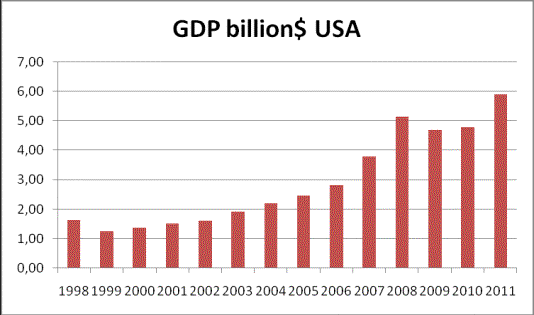
The
graph shows a significant growth of GDP since entering the WTO. Therefore, over
the period of 1998-2001 the indicator of GDP rose from 1.65 to 5.92 billion
U.S. dollars that is approximately 3.6 times.If we compare two graphs “Dynamics
of Foreign Commerce of the Kyrgyz Republic (Millions, USD over a period of 1998-2011)”
and “GDP growth of the Kyrgyz Republic over a period of 1998-2011”, we can
notice that the data are identical. It should be noted that a significant
increase in turnover of Kyrgyzstan leads to the growth of GDP.
This process
suggests that trade and, above all, world commerce are ranked to the factors mainly
hastening the economic growth and prosperity of nations. Adam Smith argued the
necessity and importance of the foreign commerce accentuating that "the
exchange of goods and services is favourable for each country; and each country
finds a clear advantage of it." Analysis of Adam Smith was the starting
point of the classical theory that is a foundation for various types of free
trade policies. (9)
The
effectiveness of foreign trade can be judged on the basis of the theory of
comparative advantage of David Ricardo. Therefore, if a country specializes in
the production of those goods that can be produced at relatively low costs
compared to the other side, the foreign commerce will be mutually beneficial
for both countries. (10)
However, there is a number of issues that create
difficulties in using the benefits of the KR entering the WTO as a small
domestic market and a low income of population; the poor quality of domestic
goods, the low level of innovation; lack of interest of foreign investors; the
transit problem through the neighboring and other countries that are not the
members of the WTO.
According to the observations of independent experts,
Kyrgyzstan has not been able to extract tangible benefits from WTO acceding.
The country has made a political move joining the WTO.
There was no significant increase of foreign
investments and the export growth. The volume of imports exceeds substantially the
volume of exports, so that the trade balance by 2011 is negative and amounts to
"-" 1,665 billion U.S. dollars.
Most
likely, the problem has begun because of the following factors. Kyrgyzstan
joined the WTO in 1998. The acceding process took only 2 years that is a narrow
term. In comparison with Russia and China, this process took 15-16 years. This
fact is important because countries sought an agreement with favorable terms,
which is not the case of Kyrgyzstan. The country has assumed a commitment of a
developed country; and it made serious concessions (Kyrgyzstan acceded to
almost all the sectoral initiatives, and non-binding agreements of WTO that
sharply limited the ability to protect the domestic market); the opening of the
home market has led to an increase in the share of imported raw materials in
the production due to an inability to compete with cheaper foreign products and
goods of a high quality; this is the result of deteriorated relations with
traditional commercial partners that are not the members of the WTO.
We
believe that the Kazakhstani government acts in a proper way; it takes its time
over the entering the international organization for disadvantageous conditions.
Kyrgyzstan's experience has shown that joining the neighboring states the WTO
should be taken into account. The importance of this issue should be considered
according to the statement of Nursultan Nazarbayev as of November 19, 2011: “It
is important that Russia enters the WTO before Kazakhstan, because shipping
corridors go to Europe through Russia”. If Russia does not enter the WTO, our
country will be in a position of Kyrgyzstan that joined the WTO, but it is among
the states that are not the State-Members of the organization" (6).
The Russian Federation
has officially become a member of the WTO on August 22, 2012. It is expected
that Kazakhstan will be a Member-State in 2013. (11)
References
1. http://www.un.org/ru/development/transition/
2. http://ru.wikipedia.org/wiki/Всемирная_торговая_организация
3. http://www.rgwto.com/wto.asp?id=5223
4. http://kt.kz/?lang=rus&uin=1138536660&chapter=1153558562
5. http://koet.syktsu.ru/vestnik/2008/2008-1/1/1.htm
6. http://www.zakon.kz/4459218-esli-rossija-ne-vstupit-v-vto-to.html
7. http://www.wto.kz/ru/info/news/market/id=46
8. http://www.stat.kg/stat.files/din.files/ved/4010001.2.pdf
9. Булатов А.С. Мировая экономика. - М.: «Экономистъ», 2005.
10. Николаева И.П. Мировая экономика. - М., 2003.
11. http://meta.kz/novosti/kazakhstan/748452-kazahstan-vstupit-v-vto-v-seredine-2013-goda.html