Associate Professor L.V. Matraeva
post-graduate A.A.Konov
Tula branch of the Russian State Trade and Economic
University, Russia
Statistical approach to the analysis of
corporate culture interaction process
How vital is this problem?
Present researches held by many sociologists show that both intercultural
and international bonds become stronger and stronger nowadays, which leads to
creating a totally new paradigm of interaction between different countries all
over the globe. As an example, we might consider the fact that even 30-40 years
ago almost all international contacts were minimized to formal, diplomatic
level, while now, due to globalization process, the intensity of cross-national
penetration has become way much stronger. Current economic and social goals,
set by transnational corporations, create all new demands on the process of
cross-cultural integration. This integration is now treated from the point of
view of productivity and cost effectiveness of international team, and it is
here that the question of cross cultural conflictness becomes the most
important. It is evident that unhealthy atmosphere at the enterprise is the
main reason of both negative moral consequences, low labor productivity,
decrease in product cost effectiveness and increase in personnel turnover.
One should also keep in mind the fact that cross-cultural disparity is
one of the most serious, though underestimated barriers for potential
investors, planning to enter industries with significant turnover. In fact,
incorrect corporate politics, inability to adapt corporate rules to basic
regulations and standards, accepted in the invested country may lead to
significant drop in effectiveness of investment project, even despite thorough
analysis of its economical constituent.
On top of that, the analysis of cross-cultural differentiation allows to
track evolutional dynamics of basic criteria, identifying human behavior. With
enough statistic data, this research can be held both on national and
international levels. This research might also be interesting if we consider
the fact that these cross-cultural criteria are very hard to modify. While
external features of corporate culture can rapidly change with time, basic ones
are strongly resistant to evolution, which, despite changing cultural paradigm,
allows researchers and investors to forecast corporate conflicts and identify
which social aspects can be used as sticking points for cross-cultural
interactions during future decades.
Naturally, corporate cultures of various nations have been formed during
hundreds of years under influence of various contradictive (and in many times
totally arbitrary) factors. The evolution of corporate cultures has walked its
way from its total absence to global recognition of its importance and
understanding that lots of hard work should be applied to grow corporate
culture in a true supporting system that will significantly augment business
productivity.
History of corporate culture
researches
Modern attention to corporate cultures is natural and can be easily
explained, since optimizing cross-cultural communication and interaction is the
primary way to augment the efficiency of direct international investments, that
have grown geometrically within last decades.
The study of national corporate
cultures and ways to integrate them is held by lots of scientists. However,
most of these studies analyze corporate cultures from empiric, qualitative
point of view, while statistic, quantitative approach isn’t highly widespread.
This situation is totally faulty, since only statistical methods of analysis
allow to identify key traits of corporate culture, established in any specific
social peer group, regardless of its scale. They also allow the researchers to
assess the differentiation of analyzed corporate culture in comparison with
other ones. These quantitative results, in their turn, allow first to identify
the qualitative criteria of corporate cultures that differ most throughout
cross-cultural interaction and then to elaborate measures to minimize negative
consequences of cross-cultural dissimilarity.In order to study the conflictness
level of global corporate cultures, we must first classify the basic
differentiation criteria, identifying the dissimilarity between corporate
cultures. Required criteria will help systemize, structure and classify global
managerial paradigm. Such criteria can be found in social researches held by
Geert Hofstede, world known scientist, specializing on corporate cultures and
cross-cultural communications.
G. Hofstede has analyzed common and
divergent traits of various corporate cultures of the world. This allowed him
to point out key criteria, cultures form according to. These criteria are as
follows:
·
Power distance index (PDI)
·
Individualism (IDV)
·
Masculinity (MAS)
·
Uncertainty avoidance index (UAI)
According to these criteria, Hofstede was able to develop personality
tests that allow to identify factor’s strength proper for tested subject.
Hofstede has applied his test system to over 30 000 people from more than
90 countries, which gave him formalized numeric description of corporate
cultures, dominating in analyzed countries, classified according to 4 criteria
that identify international diversification.
For the sake of deeper analysis, we should look in more details at these
4 criteria in order to identify specific cultural traits controlled by each of
them.
Power distance index
displays social acceptance of inequality. In other words, it displays the level
of social disproportion that will be accepted by the population of analyzed
country. Companies in countries with high levels of PDI tend to be centralized
and to have vertically stretched hierarchic structure. Managerial crew is
usually outsized and salary varies in large bounds, according to employee’s
hierarchy. Low-qualified workers are generally at the bottom of hierarchic
ladder, while the top is populated by highly ranked “white collars”.
Individualism, opposed
to collectivism, reflects the extent to which a person integrates in its peer
group. High level of individualism is natural for societies with weak
interpersonal bonds. Everyone is supposed to be responsible for his own life
and the life of his family, people are independent form the company they work
for. Vice versa, in collectivist societies, starting from their birth date
people are integrated in peer groups with high level of interpersonal
interaction.
Masculinity and
its antipode femininity display whether the role of a person in the society is
strict or flexible, i.e. masculine society tends to think that “a man should
behave as a man – earn money and protect his family, while a woman should raise
children”. Feminine society tends to accept these basic guidelines in a more
flexible way.
Uncertainty avoidance index portrays
social tolerance to uncertainty, inacceptance of vague future and strive to
discover Absolute Truth. If UAI is low in the society, people are ready to live
without concerns about tomorrow. Contrary, if Uncertainty avoidance index is
high, people fear the future and need to have exact action plan in order to
take any decisions.
According to Hofstede, the combination of these characteristics is
sufficient to identify any corporate culture, and can be used to analyze
cross-cultural interaction. However, it should be mentioned that Hofstede has
performed only qualitative analysis of assembled data, while it is evident
that quantitative statistical analysis
of this information allows to perform a deeper study of cross-cultural
conflictness, effectiveness and adaptation.
Consequently, in order to perform detailed differential analysis of
cross-cultural interaction, we should develop task-specific methodical system.
Differentional analysis of
corporate cultures
In order to explore the differentiation between corporate cultures, we
can use traditional methods of statistic analysis, which in this case will
allow to measure the difference in values of all four principal criteria – PDI,
IDV, MAS and UAI.
Basic way to do this is to calculate average values – arithmetic
average, mode, median, and identify their economical sense according to the
goals of the research. Analysis of average values leads to the following
conclusions:
Power Distance Index with minimal value 11 and maximal - 104 shows
arithmetic average of 58,6 points, which is almost equal to median value of the
interval. Meanwhile, mode for PDI equals 80, which is more that 21% higher than
median value. These results can be explained by historic and social background
of this criterion – strict hierarchic authoritarian management system has
globally dominated through centuries, alongside with high level of social
inequality. The influence of these factors started to decrease only in recent times,
leaving a deep trace on managerial cultures, especially in countries with
emerging economics.
Maximal value for Individualism is 91, while minimal – 6 points. In this
case values of arithmetic average and median are almost equal either, while
modal value is as low as 20 points. It is 27% less than median value and this
fact can also be explained economically. Demonstration of individual personal
qualities is not common for the vast majority of corporate cultures, since they
are represented by the countries from emerging markets. Workers are anticipated
to join the team of their peers and perform collectively in order to achieve
shared goals. This social paradigm naturally results in low modal value of IDV
criterion.
Masculinity criterion has symmetrical spread, its centre is in the
middle of the interval, modal, median and arithmetic average values match
within 10% interval. As a result, we might conclude that the allocation of this
criterion is rather centered. This means that cultures with both high and low
levels of MAS are commonly widespread in the world. Social attitude towards
gender roles in the society changes gradually from strict fixation to total
flexibility.
Median value of Uncertainty avoidance index equals its arithmetic
average, which means that the allocation of this criterion is centered as well.
However, its modal value is 86 and exceeds arithmetic average by more than 19%.
Practically, this incoherence reflects on international corporate culture as
indecisiveness, augmented desire to avoid insecurity, desire to have social
guarantees and structured routine job.
This primary analysis of corporate differentiation criteria allows to
identify basic trends and characteristics common to all corporate cultures
worldwide. As for cross-cultural interaction, in order to characterize and
assess its conflictness, we should analyze the differentiation of each
criterion separately.
Differentiation of each characterizing criterion allows to identify
polar criteria, being the source of cross-cultural conflicts in most cases.
This differentiation can be measured with three methods:
-
decile method
-
maxmin method
-
calculation of Gini coefficient.
Three tools are necessary in this research in order to minimize
erroneous results.
According to the results of the calculation, PDI criterion has maximal
differentiation, while MAS and UAI are less differentiated. This corellates
with the fact that UAI and MAS have centered spread and can be explained from
social aspect: at the current level corporate society suffers more from the
problems linked with hierarchical inequity than from the ones, connected with
the role of individual in the society.
This research also shows that differentiation between IDV values of
analyzed countries is higher compared to that of MAS and UAI. Therefore,
cross-cultural systems tend to generate more conflicts due to controversial
behavior of personnel in terms of manifestation of individualistic qualities,
than qualities, depending on other criteria.
This statistic research allows to form basic conclusions about potential
cross-cultural conflictness, since high level of criterial differentiation
increases the probability that levels of cultural criteria in corporate
communication will either be polar or differ significantly. This, in turn, will
provoke corporate conflicts and minimize productivity and personnel efficiency.
Analyzing corporate criteria separately allows to identify key reasons
of corporate conflicts, but it can never display the compound picture of
corporate interaction, since corporate criteria are interdependent and should
be analyzed only in synergy. Therefore for the sake of further analysis, we
will apply methods of complex differentional analysis.
Graphic imprint of cross-cultural
interaction.
The above analysis allows to identify general conflictiveness of
corporate cultures. However, it doesn’t display corporate interaction in a
complex way, since key criteria are studied separately. But corporate culture
is only formed when all four criteria interact, consequently deep analysis is
only possible, when multicriterial methods involving all four criteria are
applied. In order to continue the research, the term “corporate culture
surface” will be introduced. Corp culture surface is a surface of a polygon,
with vertexes represented by the values of 4 criteria, described above. In
order to simplify the calculations, we will use polar coordinate system in our
research, since values of differentiation criteria are in fact r coefficients, used to calculate
position of a point in polar coordinate system.
Ideally, corporate differentiation criteria should not correlate with
each other and polar graph of “corporate culture surface” should represent a
classic radar diagram, since in that case φ, the
degree between 4 parts of diagram would equal 90 degrees. However calculations
have shown that correlation between value pools of 4 criteria doesn’t equal
zero. The actual correlation between criteria can be displayed graphically, PDI
axis is displayed as a vertical line. Digits show the degree between the four
axis. The smaller the degree, the higher the correlation.

Pic. 1 – Criterial
axis in polar coordinate system
The next step is to transform values of criteria, appropriate for each
country into polar coordinates. Resulting graph is graphic imprint of corporate
culture, or “corporate culture surface”. During our research, this method of
cultural graphic interpretation has been applied to more than sixty corporate
cultures, analyzed in Hofstede’s works. For instance, graphic imprint for USA
will be the following:

Pic. 2 –
“Corporate culture surface” of USA
Numeric value of this surface equals 3092 units, calculated using
polygon surface calculation formula.
Analysis
of the above graph leads to the conclusion that American corporate culture has
high values of Hofstede criteria. This, in turn, can mean that American
corporate culture is highly likely to assimilate other cultures that have less
articulated corporate culture, if only they don’t have strongly opposite values
of one or more criteria. The above statement can be demonstrated graphically.
As an example, interaction between Japan and USA is demonstrated on the following
graph.


Pic. 3 – Corporate interaction of USA and
Japan
It is widely known that this interaction is characterized by augmented
conflictiveness. The graph shows that firstly, overlap surface of these two
cultures is insignificant, compared to overall surface, and secondly, that
there is a considerable divergence in UAI criterion (81 for Japan and 37 for
USA), IDV criterion (46 for Japan and 98 for USA) and MAS criterion (83 for
Japan and 53 for USA). Thus, three criteria out of four show significant
discrepancy in this interaction. This is the key reason of corporate conflicts
and overall inefficiency of USA-Japan interaction, and the above graph also
allows to measure this level by dividing the surface of overlapping area by
overall surface of two imprints.
The above graphic system allows to analyze any international corporate
interaction and evaluate level of conflictness and criteria that are most
likely to be the source of this conflictness. This technique allows to perform
visual analysis of more than 4,5 thousand possible interactions, including any
of 68 corporate cultures, Hofstede mentioned in his research.
Let’s study several international pairs that are likely to form along
with the flow of transnational direct investments.
According to UNCTAD’s World Investment Report, main global streams of
Direct International Investments are as follows:


Pic. 4 – Global
streams of Direct International Investments in 20010.
The diagram shows that the countries receiving most DII are USA,
Belgium, China and Great Britain. Main exporters of DII are USA and Great
Britain as well, France, Germany and Canada. As an example, let’s analyze the
following pairs: France-China and Germany-Russia.
Here come the graphical imprints of these interactions.
France-China

Pic. 5 – Cross-cultural interaction of
France (Larger polygon) and China (Smaller polygon)
The diagram shows that this interaction has high level of conflictness,
since imprint overlap area is significantly less than its total area. IDV
criterion has the most significant discrepancy (71 for France and 15 for
China), followed by UAI (75 for France and 25 for China). The surface of the
imprint of France is 3700 units, while the surface of Chinese one – only 1196
units, which indicates that corporate differentiation criteria are more
intensely developed in France increasing its ability to assimilate other
corporate cultures.
Germany-Russia
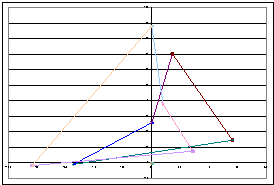
Pic. 6 - Cross-cultural interaction of
Russia (Larger polygon) and Germany (Smaller polygon)
The diagram shows that this interaction also has high level of
conflictness, although it is smaller than the one in France-China case. The
source of conflicts in this case is PDI criterion (it equals 88 for Russia and
26 for Germany). Values of other criteria differ too, however, less
significantly, for instance, MAS criterion differs by 27 points only (56 for
Germany and 29 for Russia).
Conclusion
Corporate culture is a unique element of any society, that is formed
under the influence of various arbitrary factors throughout centuries. It
usually remains concealed and tends to be treated without proper attention most
of the time. However, it influences all aspects of human behavior and its key
characteristics can hardly be affected in short-term period, no matter how
strong the impact is. The disregard of this fact, leads to numerous cross-cultural
conflicts and major inability to reach anticipated financial results,
especially if this is the case of a transnational company, striving for a share
in an emerging market. Cross-cultural conflicts create a large amount of
stress, lead to burnouts and significant decrease in productivity, which, in
its turn decreases the ROI of transnational imvestment. Thus, a significant
amount of attention should be paid to cross-cultral interaction.
Due to its nature, corporate cultures are hardly measurable and
comparable, although extensive researches are held in this domain. In the above
article we have presented a method to analyze corporate cultures by comparing
their graphic imprints.
Graphic interpretation of corporate cultures’ imprints is a simple, yet
visual way to understand and analyze cross-cultural communication. Basic
mathematical and statistical instruments, described in this article permit to
assess overall conflictness of cross-cultural interaction and to identify
social traits, being the reason of this conflictness. Advanced study of
“corporate culture surfaces” and their interaction allows to perform a deeper
analysis of transnational corporate interaction and to estimate numerous
cross-cultural characteristics, such as cultural assimilation, cross-cultural
domination, influence of a single criterion on the entire transnational
interaction, dynamics of criteria throughout time and other factors, vital for
building an effective transnational and cross-cultural business.