Korzh
R.A.
Krivoy
Rog national university, Ukraine
HARMONIC, TIME-AMPLITUDE, FUNCTIONAL AND NOISED SOUND UNIT SUBMODEL
DEVELOPMENT
Introduction
In
audio signal processing techniques in terms of the theory of musical analysis
and synthesis each sound unit is represented as an finite number of periods
(stages) which determine its behavior at the specified moment of time [1].
Sub model development
Including
the period structure with the main sound unit characteristics it is possible to
extract the following sub models:
1.
harmonic (timbre-associated);
2.
time-amplitude;
3.
functional;
4.
noised.
Harmonic sub model represents the quality side of the sound unit object and shows the
fundamental and partial tone distribution in the time-infinite oscillation
process. The sub model uses the
following parameters:
-
fundamental frequency (f0) (amplitude a0 is assumed to be
1);
-
frequency (fi),
amplitude (ai) and phase ( ) of the partials of the base tone.
So, the harmonic sub model is described as:
 , (1)
, (1)
which
is clone of the sound unit timbre function
[2].
Time-amplitude sub model shows the relative position and the mutual relationship of time (attack, hold, decay, sustain and release) to amplitude intervals. In other words, it
determines the time-amplitude frames in which there are sound waves. The sub model uses
the following parameters:
-
time period moments (tн, td, ts, tr);
-
the base amplitude (a0);
-
advanced amplitude values (ah,
ad, ar) of the base amplitude.
So, the time-amplitude sub model is described as:
 (2)
(2)
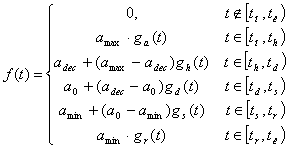
Functional sub model shows the time-amplitude
form of the sound unit, limited by
envelope functions on each time interval. The functions which set the advanced form of sound waves must be continuous within their ranges. The sub model uses the following parameters:
-
time period moments (tн, th,
td, ts, tr, tк);
-
amplitude value for each period of time (amax, adec, a0, amin);
-
functional expression for each period of time (ga(t), gh(t), gd(t), gs(t), gr(t)).
So, the functional sub model is describes as:
 (3)
(3)
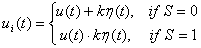
Noised sub model shows the deviation and noise
degree of the source sound
wave form form the one which generates after the external noise component
effect. The sub model uses
the following parameters:
-
sound unit equation u(t) [3];
-
noise level (k);
-
noise scheme S (additive/multiplicative).
So, the noised sub model is describes as:
 (4)
(4)
All the
previous information should be synthesized to get a compact functional expression
which describes the separate sound unit
[2]. Hence, we have the following formula:
 (5)
(5)
Having (2.32), we can find the equation which describes the
whole musical piece:
 (6)
(6)
Plot analysis
Now
let’s analyze plot dependencies on
different parameters. Firstly, consider the effect of the amplitude on the total
sound wave and its periods. Parameter a0 shows value
magnitude of the elastic body, which vibrates. The greater the scope, the
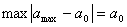
stronger and louder the sound, and vice versa. Parameter amax determines
the maximum range within the parameter a0:
 (7)
(7)
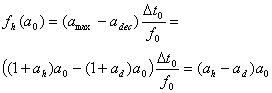
Let f0 = const = 1 Hz,  = const = 1 s, and parameter a0 make a variable, then we obtain the dependence of the hold period length on the sound vibration strength:
 (8)
(8)
Let
value of a0 in the range [0,
10], build
a plot fd(a) for different ah and ad (Fig. 1).
4 3 2 1
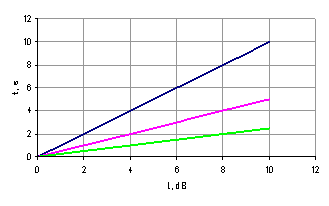
Figure 1 – Plot dependency of hold period from sound vibration strength
(1 – ah = 1, ad = 0; 2 – ah
= 1, ad = 0,5; 3 – ah = 0,6, ad = 0,5; 4 – ah = 0,5, ad = 0,5)
Figure 1 shows that the maximal length
of the holding period is reached when  , and the minimal length when
  .
Similarly, consider the dependence of the decay period length
on the amplitude of the oscillations.
.
Similarly, consider the dependence of the decay period length
on the amplitude of the oscillations.
Let f0 = const = 1 Hz,  = const = 1 s, and parameter a0 will be variable. As a result the following formula,
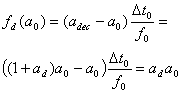 (9)
(9)
4 3 2 1
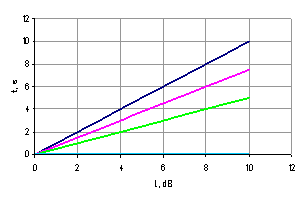
Figure 2 - Plot dependency of decay
period from sound vibration strength
(1 – ad = 1; 2 – ad = 0,75; 3 – ad = 0,5; 4 – ad = 0)
is similar to the previous (8), we can see it from the plot fd(a0) of the decay period length on the amplitude a0 for different ad (Fig. 2).
Figure 2 shows that the maximal decay period length is reached when  , and the minimal length when
  . Similarly, consider the dependence of the release period length on the
amplitude of the oscillations.
. Similarly, consider the dependence of the release period length on the
amplitude of the oscillations.
Let f0 = const = 1 Hz,  = const = 1 s, and parameter a0 will be variable. As a result the following formula:
 (10)
(10)
4 3 2 1
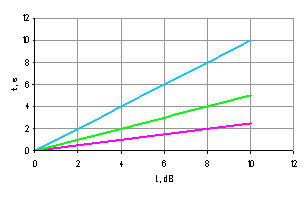
Figure 3 – Plot dependency of
release period from sound vibration strength
(1 – ar = 0; 2 – ar = 0,5; 3 – ar = 0,75; 4 – ar = 1)
Let the
values of a0 in the range [0, 10], build a plot fr(a0) for different ar (Fig. 3).
Figure 3 shows
that the
maximal
release period length is reached when  , and the minimal length when
  . And, finally, consider the dependence of the total time duration on
the amplitude of the oscillations.
. And, finally, consider the dependence of the total time duration on
the amplitude of the oscillations.
Let f0 = const = 1 Hz,  = const = 1 s, and parameter a0 will be variable. As a result the following formula:
 (11)
(11)
Let the
values of a0 in the range [0, 10], build the plot of ftotal(a0) for different ah and ar (рис.
4).
3 2 1
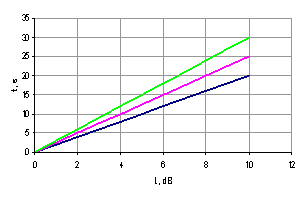
Figure 4 – Plot dependency of total
time duration from sound vibration strength
(1 – ah = 1, ar = 0; 2 – ah
= 1, ar = 0,5; 3 – ah = 1, ar = 1)
Figure 4 shows
that the
maximal
duration is reached when  , and the minimal duration when
  .
.
Conclusions
The
plots describes above helped to determine the importance of the different
quality characteristics of the sound wave unit structure. The future research
is based on them and requires more complicated operations.
References:
1.
Лэмб, Г. Динамическая
теория звука. — Государственное издательство физико-математической литературы.
— М. — 1995.
2.
Голд, Б. Цифровая
обработка сигналов (под ред. Трахтмана А. М.) / Б. Голд, Ч. Рэйдер. — М.:
Советское радио. — 1973.
3.
Корж Р. А. К проблеме
автоматической идентификации музыкальных произведений / Р. А. Корж // Инженерия
программного обеспечения. — №1 (9). — Киев. — 2012.
4.
Яковлев А. Н. Введение в
вейвлет-преобразования: учебное пособие / А. Н. Яковлев. — НГТУ, 2003. — 104 c.