The assistant of Jurisprudence Chair, Belousova O.A.
Amur State University (Birobidzhan Branch), Russia
The co-relation of the minimum rate of labour
payment and the cost-of-living adjustment in the Russian Federation
Employment of population and labour market are connected with such
categories as labour resources, labour force, supply and demand on labour
force, sales of work force, and payment for labour.
In its turn, work force is a specific ware; its countervalue mostly
depends on the expenses on support of workers viability, their training,
education and reproduction of moral, psychophysical and intellectual abilities.
In periods of economic crisis release the workers and the rise in unemployment
levels are fixed on the labour market, and, consequently, effective consumer
demand for hired labor falls. Under such conditions, the rate of labour payment
decreases sharply, it often is not able to provide a
dignified human existence. To save manpower, most states set the minimum rate of labour payment (further, MRLP) providing cost-of-living for their citizens.
The International Labour Organization has repeatedly brought up a
problem of establishing the minimum rate of labour payment, in this sphere a
number of Conventions and Recommendations were adopted, however, Russia has not
ratified any of the international acts, but later many of their acts were
included in the legislation of the Russian Federation.
The first act, in which raising the minimum rate of
labour payment for domestic workers and employees was provided, was the Decree
of the Central Committee of the Communist Party of the Soviet Union, Council of
Ministers of the USSR and All-Union Central Council of Trade-Unions Central
Committee, dated from 12 December, 1972 No. 842 [1], this document set the
minimum rate of labour payment at 70 rubles per month.
Due to the increase in retail prices in 1991, the
Supreme Soviet of the RSFSR adopted the Law of the RSFSR “On improving social
guarantees for workers” [2]. From 01 October 1991 was established the new
minimum rate of labour payment not less than 180 rubles a month, it did not
include extra payments, bonuses, and premiums and other incentive payments.
With the adoption of the Constitution of the Russian Federation in 1993, the
Russian citizens are guaranteed the right to remuneration not lower than the
MRLP adjusted by the Law [3, p. 7, 37].
But
rising inflation forced systematically to review the amounts the MRLP, so, they
increased twice in 1991, 1992, in 1993 - 4 times, and in 1994 only once, but in
1995 in the 5 times, 1996 – twice, 1997 – once (a total amount is 17 times over
7 years in the period from 1991 to 1997).
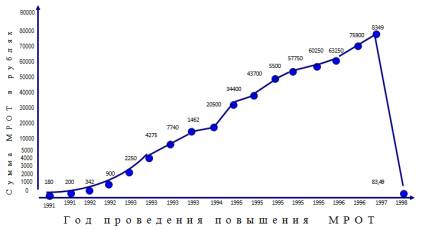
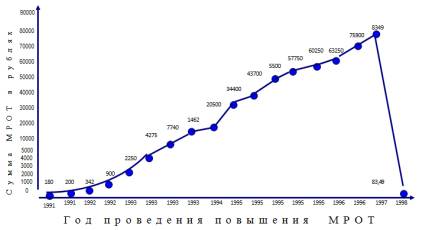
Figure 1. The growth of
the minimum rate of labour payment in the Russian Federation in the period from
1991 to 1998
The
results of financial policy and measures taken by the state, have not led to
decrease in intensity on labour market, the position of workers was compounded
with universal laying-off of workplaces and a huge growth of a number of the
unemployed. Work force as a ware has been devaluing, the employer stopped to
pay (or delayed it for months) wages, directing monetary funds on providence
and expansion of an existing property or purchase new one.
In 1997 the nation's leadership took cardinal decisions which were to
stabilize economy in Russia. Denomination of ruble and its substitution began
in 1 January, 1997, as a result the value of the MRLP was restated in the ratio
1000 rubles in money of the old sample for 1 ruble in new money [4].
In 1997 the law “On the cost-of-living adjustment in the Russian
Federation” was adopted [5]. According to the named law and on the basis of the
adopted laws “On consumer goods basket in the Russian Federation” [6] and the
Government Resolutions of the Russian Federation “On adoption of the Methodical
recommendations for determination of the consumer goods basket for the basic national
socially-demographic groups of the population in the Russian Federation and in
the constituent entities of the Russian Federation» [7] since 2000 the
Government of the Russian Federation determines the national cost-of-living adjustment quarterly, the consumer goods basket and the data of the Federal executive
authorities concerning statistics of the level of consumer costs of food,
non–foods, services and expenses on obligatory payments.
As a
result, the situation on the labour market has gradually been stabilizing, old
enterprises begin to regenerate and new ones open, the demand for labour power
increases in the field of business production. Inflation has been stopping, the
MRLP raised only once from 1998 to 2000 (in 2000).
In 2000, the Federal law “On the minimum rate of
labour payment” was adopted in which the primary purpose of the MRLP is stated:
for regulating of labour payment and for determining the level of benefits in
the period of temporary invalidity and benefits for compensation of harm for
the injury caused by the injury, occupational disease or other illness
associated with execution of labour duties» [8, art. 3].
From February 1, 2002, the
new Labour Code of the Russian Federation (further LC RF) [9], came into legal
force. There is a definition of the MRLP in Part 2 Article 129 of the present law.
“The MRLP is a size of monthly
wages determined by the Federal law for work of an unskilled worker, who
completely fulfilled the norm of work time while carrying out simple work under
normal working conditions”.
On the basis of previously
adopted legal acts compensational, additional incentives and social benefits
are not included into the MRLP. The law-maker by Part 1 of Article 133 of LC RF
ensured that MRLP is set at the same time throughout the Russian Federation
Federal by the law and it cannot be lower than the cost-of-living adjustment of workforce. However, the cost-of-living adjustment
has always been higher than the MRLP [10].
Table
1
The ratio of the minimum
rate of labour payment and the cost-of-living adjustment in the Russian
Federation in the period from 2000 to 2011
|
Гbefore |
The period of changes |
The average cost-of-living
adjustment in the RF (rub.) for workforce |
The size of the MRLP (rub. a
month) |
The ratio of cost-of-living
adjustment and the MRLP (higher) |
The percentage off the MRLP and
cost-of-living adjustment (%) |
The interest rate differential of
cost-of-living adjustment and the MRLP (%) |
|
1 |
2 |
3 |
4 |
5 |
6 |
7 |
|
2000 |
H1 |
1261,14 |
83,49 |
≈ 15,11 |
≈ 6,62 |
93,38 |
|
H2 |
1378 |
132 |
≈ 10,44 |
≈ 9,58 |
90,42 |
|
|
2001 |
H1 |
1574 |
200 |
≈ 7,87 |
≈ 12,71 |
87,29 |
|
H2 |
1684,5 |
300 |
≈ 5,62 |
≈ 17,81 |
82,19 |
|
|
2002 |
H1 |
1912,5 |
Average 375 |
5,1 |
≈ 19,61 |
80,39 |
|
H2 |
2022,5 |
450 |
≈ 4,49 |
≈ 22,25 |
77,75 |
|
|
2003 |
H1 |
2278 |
450 |
≈ 5,06 |
≈ 19,75 |
80,25 |
|
H2 |
2329,5 |
Average 525 |
≈ 4,44 |
≈ 22,54 |
77,46 |
|
|
2004 |
H1 |
2545 |
600 |
≈ 4,24 |
≈ 23,58 |
76,42 |
|
H2 |
2659,5 |
600 |
≈ 4,43 |
≈ 22,56 |
77,44 |
|
|
2005 |
H1 |
3214 |
720 |
≈ 4,46 |
≈ 22,4 |
77,6 |
|
H2 |
3295 |
800 |
≈ 4,12 |
≈ 24,28 |
75,72 |
|
|
2006 |
H1 |
3678,5 |
Average 950 |
≈ 3,87 |
≈ 25,8 |
74,2 |
|
H2 |
3711,5 |
1100 |
≈ 3,37 |
≈ 29,64 |
70,36 |
|
|
2007 |
H1 |
4054,5 |
1100 |
≈ 3,69 |
≈ 27,13 |
72,87 |
|
H2 |
4263,5 |
2300 |
≈ 1,85 |
≈ 53,95 |
46,05 |
|
|
1 |
2 |
3 |
4 |
5 |
6 |
7 |
|
2008 |
H1 |
4889,5 |
2300 |
≈ 2,13 |
≈ 47,04 |
52,96 |
|
H2 |
5051,5 |
2300 |
≈ 2,2 |
≈ 45,53 |
54,47 |
|
|
2009 |
H1 |
5552 |
4330 |
≈ 1,28 |
≈ 77,99 |
22,01 |
|
H2 |
5591 |
4330 |
≈ 1,29 |
≈ 77,45 |
22,55 |
|
|
2010 |
H1 |
6013 |
4330 |
≈ 1,39 |
≈ 72,01 |
27,99 |
|
H2 |
6263 |
4330 |
≈ 1,45 |
≈ 69,14 |
30,86 |
|
|
2011 |
H1 |
Average 7004,5 |
Average 4376,83 |
≈ 1,6 |
≈ 62,49 |
37,51 |
|
|
H2 |
Average 6751 |
4611 |
≈ 1,46 |
68,3 |
31,7 |
Analyzing the data of the table, it may be noted that,
despite the denomination of the ruble in 1998 [4], the MRLP in 2010 was less
15.11 times the cost-of-living
adjustment, this difference has declined sharply until December
2002, and in the first half of 2003, has begun to increase again. At the of end
of 2003 and the beginning of 2004, at the end of 2007 and beginning of 2008,
the difference between the MRLP and cost-of-living adjustment has been markedly
diminishing. Does it say about the growth of people well-being in these
periods?
Answering this question, the following facts should be
observed: first, the periods are connected with political events in the country
(presidential elections); second, in 2007, the abolition of Part 2 of Article
129 of the LC RF [11, Part 1 of Article 2], which contained a definition of the
MRLP. The abolition of the MRLP automatically included compensation, incentive
and welfare payments in it.
Formally the MRLP in 2007 increased more than twice,
but income of population did not. The Constitutional Court of the Russian
Federation [12] delivered a judgment that the abolishing of the rules
determining the MRLP did not lead to abolishment of the constitutional right of
citizens to receive the MRLP in the amount defined by the Federal law.
Therefore, if the previous MRLP was equal only to a salary of unskilled workers,
nowadays it is equally for all – both the skilled and non-skilled workers, and
includes both the salary and all the allowances.
Thus, formally, the MRLP
grows, the difference between it and the cost-of-living adjustment decreases,
but if we study carefully why it happens and whether the actual incomes of
population grow, the answer is unequivocally, that welfare is a fiction,
legitimized by the State. With the abolition of the MRLP definition all have
equal opportunities to receive almost equal to the cost-of-living adjustment
the MRLP, and nobody can have less than 4611 rubles – a janitor and a
Professor, a worker who lives in the southern and northern parts of our
country. And no matter what entitled to the MRLP cannot fulfill their
constitutional responsibilities for the upbringing of children and maintenance
of parents because the MRLP is not calculated on a non-working family members.
It is more important, that workers are able to perform another constitutional
duty to pay taxes, which, after deduction of the MRLP is just over 4 thousand
rubles, which is more than 1.5 times lower than the subsistence minimum (6751
rubles).
The study gives grounds to
the following conclusions: the State, establishing the MRLP by the law below
the cost-of-living adjustment systematically violate the lawful rights of
citizens referred to Paragraph 1 of Article 133 of the LC RF. It appears that
the legislator should take into account in future average cost-of-living
adjustment in setting the MRLP for the country.
Regulatory legal acts
1.
The Decree of Central Committee of
the Communist Party of the USSR, the Council of Ministers of the USSR and the
All-Union Central Trade Union Council dated from 12 December, 1972 No 842
"About increasing of the minimum rate of labour payment of workers and
public servants with simultaneous increasing of tariff rates and official
salary of average paid categories of workers busy in production spheres of the
national economy" (with amendments and additions).
2.
The law of the RSFSR dated from 19
April, 1991 No 1028-1 "On increasing of social guarantees for
workers".
3.
The Constitution of the Russian
Federation (adopted by nation-wide vote 12 December, 1993) (with the
amendments, stipulated by the Laws of the Russian Federation on amendments to
the Constitution of the Russian Federation as for 30 December, 2008 No 6-FCL,
30 December, 2008 No 7-FCL).
4.
President’s
Decree as for 04 August, 1997 No 822 "On changing of
notional amount of Russian monetary symbols and scale of prices".
5.
The Federal law as for 24 October,
1997 No 134-FL (ed. from 24 July,2009) "On the cost-of-living adjustment in the Russian
Federation".
6.
The Federal law as for 20 November,
1999 No 201-FL "On the consumer goods basket in the Russian
Federation".
7.
The Decree of the Government of the
Russian Federation dated from 17 February, 1999 No 192 “On adoption of the
Methodical recommendations for determination of the consumer goods basket for
the basic national socially-demographic groups of the population in the Russian
Federation and in the constituent entities of the Russian Federation».
8.
The Federal law as for 19 June, 2000
No 82-FL (ed. from 29 April, 2002) "On the minimum rate of labour
payment". – "Russian paper", No 118, 21 June, 2000,
"Official Gazette of the Russian Federation", 26 June, 2000, No 26,
ar. 2729.
9.
The Labour Code of the Russian
Federation dated from 30 December, 2001 No 197-FL (ed. from 01 July, 2011)
(with amendments and additions come into effect from 02 July, 2011).
10. Reference information: “The
minimum rate of labour payment in the Russian Federation”. [Electron resource]: System
Consultant Plus. URL:
http://www.consultant.ru/online/ base/?req=doc;base=LAW;n=15189;page=esse
11.
The Federal law as for 20 April,
2007 No 54-FL (ed. from 22 June, 2007) "On amendment to the Federal law
"On the minimum rate of labour payment" and other legislative acts of
the Russian Federation”.
12.
The Decree
of the Russian Federation dated from 17 December, 2009 No 1557-О-О "On
refusal to refusal to accept for consideration a complaint of the citizen
Barahtenko Maria Nikolaevna concerning violating of her constitutional rights
by the Federal law “On amendment to the Federal law
"On the minimum rate of labour payment" and other legislative acts of the Russian
Federation”.