Al Farabi Kazakh National University, Almaty, Kazakhstan
Moldir Nurseitova
PhD student
Tursunkul Bazarbayeva
сandidate of geographical sciences
ZhannaToregozhina
сandidate of chemical
sciences
THE
MAIN PROBLEMS OF ORGANIC POLLUTANTS AND HEAVY METALS IN LIVESTOCK PRODUCTS OF
KAZAKHSTAN
Abstract
In Kazakhstan the reglementations of livestock in the polluted area is
not clear. Ecological situation is stay with important environmental pollution.
Some studies were achieved to measure impact of heavy metals, organic
pollutants on different farm animals. Globally information about impact of
heavy metals and organic pollutants on livestock products is not enough. The
livestock
mainly occupies areas sometimes close to polluting industries or other sources
of pollution as industrial agriculture. Products issued from farms close to
these sources as meat, milk (also
fermented
milk (shubat and kumis), wool, traditionally used by humans could be
contaminated. Especially recent data is very few and inсludes not all livestock products. The available data shown in the
present paper, cannot explaining of the mechanisms of exposure and of
detoxification. The assessment of contamination risk is not yet known in the
situation of Kazakhstan.
Key-words: environmental situation, heavy metal, organic pollutant, animal
products,
Introduction
In
Kazakhstan ecological situation is still stay with high environmental
pollution. Reglementations of livestock in the polluted area is not clear. Some
studies were achieved to measure impact of pollution on farm animals. What is
the good practice to apply in such kind area are needed. In all cases,
scientists should know what is the intensity of risk, time of exposure and
mechanisms of toxicity and decontamination are necсessary. This review is focused to collect bibliographic data around
impact of environmental pollutants, as heavy metals and organic pollutant on
livestock of Kazakhstan.
As known, Kazakhstan has rich mineral
resources and well developed mining and production industries and the exploration
of the natural resources is a key-point in the economical development of the
Republic. Indeed, this emerging country disposes large availabilities of
petrol, gas, uranium, coal, iron and phosphorus. Moreover, an intensive
industrial base valorizes these resources. Thus their exploration is
participating highly to the Kazakh economy and the development of this country.
But the extraction and use of these resources cause numerous ecological
problems. The ecologically threatened Aral and Caspian seas in southwest, the
former nuclear testing site of Semey in the north east, several metallurgical,
chemical and petrochemical plants, huge cotton plantation areas, as well as
mining industries and uncontrolled waste burning and disposal are example of
ruthless exploitation of natural resources and make Kazakhstan of real concern
in terms of pollution.
Statement of the promlem
Nowadays,
livestock in Kazakstan mainly includes cattle, sheep and goat, horse and camel.
The population use horse and camel
breeds in addition to cows for dairy production and all types of these animals
for meat. The main livestock regions for sheep (more than 2 000 ths) are
South-Kazakhstan, Almaty, Zhambul and East-Kazakhstan. Cattle (more than 500
ths) and horse (more than 200 ths) livestock are Almaty, South and
East-Kazakhstan. Camel breeding are mainly used in southern-west part of
Kazakhstan (Fig 1) [1].
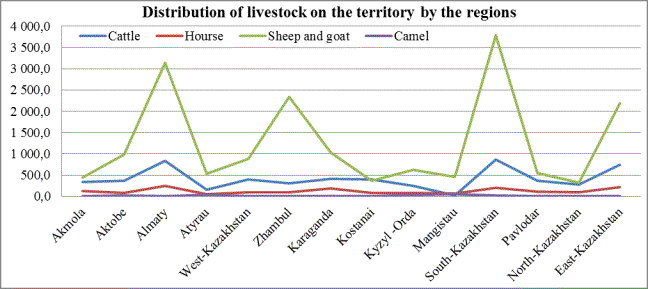
Figure
1 – Distribution of livestock on the territory by the regions of Kazakhstan
Organic pollutants and heavy metals
It
is known that human activities, increasing urbanization notably industrial and
mining processes, have been responsible for the wider diffusion of heavy
metals. Consistently, in Kazakhstan, still they are present in all types of
environment and they are interrelated. [2]. The most toxic heavy metals, lead,
mercury, cadmium and zinc can be easily accumulated in soil, plants, water.
Heavy metals situation depends of the quantity of factories, mainly industrial
emissions and waste. During the twenty years of independence, the country has improved exploration of huge
mineral richness and also, consequently wider wastes. The presence of heavy
metals in the environment: air, water, soil, plants are a main indicator of the
contamination of areas. Also, we can not exclude the transition contaminants to
food producing animals and consumers. In Kazakhstan, actually all domestic
animals graze everywhere in the steppe, especially in areas without
reglementations for environmentally polluted zones (behind emission sources:
plants, wastage and other sources of contamination) [3]. In the East-Kazakhstan
region, famous for metallurgical industry, the animal feed and meat (cattle,
horse and sheep) products contain cadmium, lead and zinc in high
concentrations. The mean cadmium concentrations in horse kidneys were found 128
mg/kg and lead concentrations for liver 2.2 mg/kg [4]. The main sources of
pollution of Oskemen was due to the activities of non-ferrous, rare metal
industry, power engineering, machine building and instrument-housing and
communal services [5]. In the South of Kazakhstan oblast where are developed
cotton industry, uranium mining, phosphorus plants and agricultural habitants,
camels milk analyzed for copper, iron, manganese, zinc, arsenic and lead mean
content was respectively of 0.07 ± 0.04, 1.48 ± 0.53, 0.08 ± 0.03, 5.16 ± 2.17,
<0.1, and 0.025 ± 0.02 ppm. In shubat (fermented Camel milk) mean contents
were 0.163 ± 0.164, 1.57 ± 0.46, 0.088 ± 0.02, 7.217 ± 2.55, and 0.007 ppm
respectively [6, 7].
In
Kyzylorda oblast no convenient data about contamination of food producing
animals are available. But, the level of lead in the hair of children of Aral
Sea regions was 30 times higher than the upper limit in the hair from children
in West Germany. In erythrocytes, the lead was approximately 5 times higher than
in children from Sweden. Cadmium was 2.5 times higher. In such conditions, the
contamination of animals cannot be excluded [8]. Also, the presence of
"Baikonur" cosmodrome in this region where in 2012 only 21 boosters
were started [9] is also a source of heavy metals exposure. Some authors noted
also that the contaminants come along the upper parts of the Syrdarya river,
from the zinc melting industry in Uzbekistan [8]. In Western part (mainly
petrol and gaz production region) the pollutants content of cobalt in the
organs of small cattle (liver, kidneys,heart, and lungs) was 2.5 times higher
than authorized level and five times higher than normal – in milk [10].
Pourjafar et al (2008) found that cows located close to oil industry (Isfahan
city, Iran) had higher blood and hair lead content [11]. Total mercury
concentrations in the topsoils of the floodplain of river Nura (Karaganda
oblast) ranged from near background levels to over 100 mg/kg. The contamination
is serious and relatively localized, with >70% of the total amount of
mercury in topsoils and >90% of mercury in river bank deposits located
within 25 km from the source [12]. As lactating ruminant may ingest daily from
1% to 10% soil when grazing [13], the contamination by soil ingestion could strongly
affect the herbivorous. Elsewhere, people in Central Kazakhstan were exposed to
high levels of Hg due to the frequent consumption of fish from Nura river or
the neighbouring lakes. Among 289 hair samples of local people near to Nura
river Hg concentrations ranged from 0.009 to 5.184 µg/g with mean is 0.577 µg/g
[14].
One of the main
sectors of Kazakhstan's economy is Oil industry. The results of transportation, processing, consumption of oil and
petroleum products, energy production, chemical and petrochemical industry,
transport and the generation of construction materials are the major potential
sources of organic pollution. Today, proven reserves of oil Kazakhstan is among
the top 15 countries in the world, having 3% of the world's oil reserves. Oil and
gas areas cover 62% of the country, and 172 oil fields. The deposits are
located in six of the fourteen regions of Kazakhstan: Aktobe, Atyrau, West
Kazakhstan, Karaganda, Kyzylorda and Mangystau regions. In this case,
approximately 70% of hydrocarbon reserves are concentrated in the West of
Kazakhstan [15].
PCBs were produced in the USSR from 1934 to 1995 and mainly used as
dielectric fluids in transformers, capacitors by name Sovol, Sovtol and there
mixtures Trichlordifenil (85%
Sovol), Gexol (25% Sovol). It was also produced, as a plasticizer in the manufacture of varnishes and polierny materials,
lubricants and fungicides to protect the hardwood. The major producer of PCBs
were companies like “Orgsteklo” (Derjinsk city, Russia), ‘Orgsintez’ (Novomoscovsk, Russia), VNITIG(Ufa). The filling capacitors were implemented in next cities Serpuhov (Russia),
Ust-Kamenogorsk (Kazakhstan), Leninakan (Armenia), Chirchik (Uzbekstan). And
nowadays in Russia,
above 200 000 transformers and capacitors with 18 000 tons of PCBs are still present /18/. However, one of the problems to study the effects of this PCBs on human
health, today, is that there is not enough information about basic composition of Sovol
or Sovtol. But, we have information that the composition of Sovol is similar to
Aroclor 1254 [16].
In Kazakhstan
according to data of Agency "Greenwomen" (2006) and analyzed production and industrial potential of the country based
on these data, areas being "hot spots" of contamination with PCBs could
be exactly located: Semey nuclear test site 14,865 capacitors; Pavlodar
Chemical Plant - 31,244 capacitors; East-Kazakhstan
oblast - 1 transformer, 1977
pieces of capacitors and capacitor installations 34;
Karaganda oblast, Zhangiztobe polygon region - 105
transformers, capacitors 1262 and 6 capacitor installations; Aktobe oblast - 520 capacitors;
West-Kazakhstan oblast - 351 capacitors and 2 capacitor installations;
Mangistau region - 323 capacitors;
Zhambyl oblast - 290 capacitors
[17].
PCB contamination of
food producing animals in Kazakhstan
is very few. In a comparative study of
the contamination of camel milk in Atyrau, Kyzylorda, Zhambul and South
Kazakhstan oblasts, only samples from Kyzylorda oblast have high level (0,95 ng/g), and mainly PCBs 52
and 138 [18]. In human breast milk from Almaty, Shymkent
and two cotton growing area of South Kazakhstan Oblast (Djetisay and Kyrov),
the cities nearest of the Aral Sea (Aralsk and KyzylOrda),
and a site of petrochemical exploration on the Caspian Sea (Atyrau), the mean concentration of
total PCBs was 410 ng/g
fat. Concentrations of six PCB congeners (28, 52, 101, 138, 153, 180)
were between 100
and 350 ng/g fat [19]. In Aral sea region, it
was revealed that the PCBs was 1900 μg/kg in lipid
of plasma of children, which was higher than in Europe [8].
PCDD/Fs in camel milk from Almaty, Atyrau, Aralsk, Shymkent were investigated.
The concentration of PCDD/Fs were higher in the Atyrau oblast. This result
could be linked with oil extraction in this region [18].
Conclusion
In spite of the importance of pollution risks in Kazakhstan as mentioned
by all the international agencies, the residues of pollutants in animal
products did not appear dramatic although some high values can be observed
locally. However, the metabolism of those pollutants in livestock animal
organisms and the transfer of those molecules to the consumers remain unknown.
Globally information about impact of heavy metals and/or organic pollutants on
livestock products is not enough. Especially recent data is very few and
inсludes not all livestock products. The available data shown in the present
paper, cannot support the understanding of the mechanisms of exposure and of
detoxification. The assessment of contamination risk is not yet known in the
situation of Kazakhstan. There is urgent need to achieve such studies for a
convenient evaluation of the polluting impact for the human and animal
population of the country.
Literature
1.
Bulletin of the National agnestva Kazakh Statistics
for 2013.
http://stat.kz/digital/naselsenie/Pages/default.aspx
2.
Violina R. Angelova, Radka V. Ivanova, Jivko M.
Todorov, Krasimir I. Ivanov. Lead, Cadmium,
Zinc, and Copper Bioavailability in the Soil-Plant-Animal System in a Polluted
Area // The Scientific World JOURNAL – 2010 – 10 – P.273–285
3.
T. Behrendt, V.D.
Bortsov A Geoecological investigation of contamination by heavy metals from
tailings of the irtysh copper processing plant // ВЕСТНИК ВКГТУ, Серия экологическая. – 2007 - №4 – С.90-93.
4.
A.A- Farmer, A.M.
Farmer. Concentration of cadmium, lead and zinc in livestock feed and organs
around a metal production center in eastern Kazakhstan // Sci. Total Environ. -
257 – 2000 – Р.53-60.
5.
Сыдыкова И.О. Потенциальные источники
загрязняющих веществ в водотоках и водоёмах восточно-казахстанской области //
Проблемы рационального природопользования и геоэкологии Восточного Казахстана -
Усть-Каменогорск, 1998 – С.17-21.
6.
E. Diacono, B.
Faye, A. Meldebekova, G. Konuspayeva. Plant, water and milk pollution in
Kazakhstan, Book: Impact
of Pollution on Animal Products. Еdited by Bernard Faye, Yuriy Sinyavskiy, Published in
cooperation with NATO Public Diplomacy Division. 2008
– Р.107-116
7.
A. Meldebekova,
G. Konuspayeva, E. Diacono, B. Faye, Heavy metals and trace elements content in
camel milk and shubat from Kazakhstan, Book: Impact of Pollution on
Animal Products. Еdited
by Bernard Faye, Yuriy Sinyavskiy, Published in cooperation with NATO Public
Diplomacy Division. 2008 –
Р.117-123.
8.
S.Jensen, Z.Mazhitova, R. Zetterstrom
Environmental pollution and child health in the Aral Sea region in Kazakhstan
// Journal The Science of the Total Environment 206 – 1997 – Р.187-193.
9.
Журнал
Новости космонавтики, http://novosti-kosmonavtiki.ru/news/4209/
10.
U. Kenesariyev,
N.Y ZHakashov, I. Snytin, M. Amrin, Y. Sultanaliyev. Assessing the extent of
pollutant accumulation in the animal foods and blood of individuals inhabiting
the Azgyr test base area // Еdited by Bernard Faye, Yuriy Sinyavskiy. Published in
cooperation with NATO Public Diplomacy Division. – 2008 – Р.163-168.
11.
M. Pourjafar, R.
Rahnama, M.Shakhse-Niaie. Lead profile in blood and hair from cattle,
Environmentally exposed Lead around Isfahan Oil Industry, - Asian Journal of
Animal and Veterinary Advances. – 3(1): - 2008 – Р. 36-41.
12. S. Heaven, M.A. Ilyushchenko, I.M. Kamberov, M.I. Politikov, T.W. Tanton, S.M Ullricha, E.P. Yanin. Mercury in the River Nura and its floodplain, Central
Kazakhstan: II. Floodplain soils and riverbank silt deposits // Journal The Science of The Total
Environment – V. 260 – Issues 1–3 – 9 October – 2000, P.45–55.
13. S.
Jurjanz, G. Rychen, C. Feidt. Dairy
livestock exposure to persistent organic pollutants and their transfer to milk:
a review. Еdited by
Bernard Faye, Yuriy Sinyavskiy, Published in cooperation with NATO Public
Diplomacy Division, - 2008 – Р.107-116.
14. Hui-Wen Hsiao, Susanne M. Ullrich, Trevor W. Tanton Burdens
of mercury in residents of Temirtau, Kazakhstan: I: Hair mercury concentrations
and factors of elevated hair mercury levels // Science of The Total
Environment – V. 409, Issue 11, - 1 May
2011, P.2272–2280
15. Information and analytical journal «KazEnergy» № 3
(53), June 2012
16. Maysterenko B., Klyuev N., Ecologo-Analitical monitoring of POPs/
Moscow, pub.house “Laboratoriya Znaniya”, 2009, p. 72-73 (in Russian)
17. Report on UNDP / GEF project on PCBs, March 13-16, 2012., Astana,
Kazakhstan
18. G.
Konuspayeva, S. Jurjanz, G. Loiseau, V. Barci, Sh. Akhmetsadykova,
A. Meldebekova, B.Faye Contamination of Camel Milk (Heavy Metals, Organic Pollutants and
Radionuclides) in Kazakhstan, Journal of Environmental Protection, 2011, 2,
90-96
19. C. Lutter, V. lyenga, R. Barnes, T. Chuvakova, G. Kazbekova, T.
Sharmanov Breast milk contamination in kazakhstan: implications for infant
feeding// Chemosphere. – Vol. 31, - Nos 9- 12, Р.1761-1772, - 1998.