Gaukhar Dauletbayeva,
Master Science of
International Finance Management
Baitursynov
Kostanay State University, Kazakstan
Kamshat Saginbekova, PhD in economics
KAZNEXT, Kazakstan
The role of financial system
for developing countries
Until the
1980s, the meaning of effective financial system for developing countries did
not receive proper attention. Countries saw the reasons for law level of development
in the lack of capital. The inflow of foreign financial means in the developing
countries did not meet the expectations, since there was a lack of stable
national financial system, and it was incapable. First of all, available stable
financial institutions and local savings were kept “under the mattress” or in
jewelry [7, P. 9]. On the other hand, ONE of the most important preconditions
for stable and capable national financial system is both the access to the
international markets of long-term capital and foreign direct investments.
It is
recommended (necessary) to differentiate the meanings of “Financial sector” and
“Financial system”. Financial sector is understood as a part of economy that
proposes opportunities for financing and investments to other sectors, as well
as consulting and broking services related hereto [8, P. 3]. Financial system is characterized as the system of supply and
demand, and, therefore, besides the system of demand, it covers the financial
sector, as well as the system of supply and the financial market (Picture 1) [10,
P. 7].
If we
consider the financial system from a business point of view, it consists of
three subsystems: financing of business activity, including the financial
sector, control over business activity and strategy of business activity.
Financial
sector originates from the financing, and it acts both as a condition and as a
part of financing of business activity.
In accordance with model of redistribution and processing of
information, there are two polar opposite opportunities for financing of
business activity: financing though the financial market and financing though
banks. This differentiating corresponds to the difference between the financial
system supported by the financial market and the financial system supported by
banks [12, P. 15].
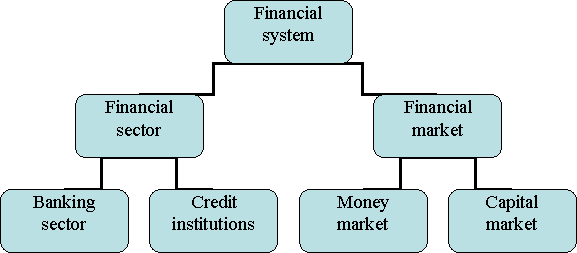

Picture 1:
Financial system*
*Source:
Issing, O. (2003), P. 7.
Control over business activity or Corporate
Governance is a part of the financial system and determined as “the totality of
rules and mechanisms those determine which stakeholders and to what extent
exert influence on important decisions in firms” [14, P. 172]. Insider and Outsider
Systems are distinguished in the aspect of corporate governance. Outsider
System is characterized by active market, Insider System – by high level of
banks’ voting right [9, P. 75].
Financial
resources have direct impact on firms’ activity. Investors, following their
interests, exert influence on the decision making process in firms, and,
therefore, on their strategy. Hence, firms’ strategy is a component of
the financial system, and it is in casual relationships with the aforesaid
parts of the financial system.
Transaction
costs and information costs are present on imperfect markets. The main goal of
the financial system is to allocate financial resources in space and time. The
functions of this goal are as follows:
-
Risk management is related to the most important function of the
financial system. Effective financial system adopts the risks of business
entities through financial leverages. They are based on the forms which reflect
various levels of national economy [11, P. 6]. The latest financial
innovations were developed in the industrial countries, which encourage to
receive corporate advantages in transfer of risks (e.g., Swaps, Futures,
Options). The meaning of insurance instruments is obvious in this case. For
example, in a number of developing countries, holding of assets in foreign
currency or purchasing of futures contracts is forbidden for entrepreneurs. The
same is for farmers in these countries, who have no access to global futures
markets, and, thus, have no opportunities for insurance of the risks connected
with fluctuations of world market prices of goods manufactured. It leads to low
production volume because of low investment volume. Financial system could
contribute to avoiding of risks by redistributing it to other market players
[8, P. 19]. Allen and Santemoro consider the risk management function as the
main purpose of financial institutions [2, P. 1472].
-
Mobilization of savings is presented as the second function of the
financial system. On the one hand, investments in entities are possible through
allocation of small savings. On the other hand, mobilization provides creditors
with opportunity to participate in assets of entities and firms through
purchasing of shares and other securities on the securities market and increase
of savings [8, P. 27]. Financial deepening is reached through the investment of
savings in the financial system, as a matter of fact, by increasing the cost of
financial assets in national economy. Rapid growths of the economy, high level
of investments, as well as high financial level, are the result of high volumes
of savings [5, P. 155].
-
Allocation of resources is the central function of the financial
system. National economy has different stages, at which there appears a high
level of demand or supply for capital. In this case, a risk of opportunistic
behavior arises due to asymmetric distribution of information, and creditor is
presented as the “Principal” and debtor – as the “Agent”. Financial
institutions play the role of intermediaries in redistribution of regional and
sector resources and bring into balance the interests of players (savers and
investors). Development of financial system – modern national economy in the
first place – is connected with reliability of contract relations between
creditor and debtor [11, P.12].
-
Monetary function is understood as the provision of effective financial
infrastructure with acting payment system. On the one hand, the central bank
and commercial banks provide other economic sectors with payment means, and, at
the same time, they maintain low level of transaction costs. On the other hand,
this function provides cashless flow of funds. Bank assets – monetary assets on
current accounts in the first place – are regarded as the means of payment and
exchange, and, therefore, they are accepted as money. In addition,
unconditional recognition of the bank assets owned by the central bank provides
the clients of commercial banks with opportunity to have required amount of
cash at any time [6, P.72].
Developing
countries show typically weak “informal” financial system, which is
characterized by limited alternatives of investments and financing [1, P. 23]. Specific
characteristics of the “informal” system include: indirect financing through
commercial banks, weak development level of the securities market, lack of
insurance and investment funds. Such market is characterized by stable position
of commercial banks, activity of which is regulated by the Government.
“Informal”
sector prevails in many developing countries and the countries with
transitional economy, where savers and investors stand outside the organized
financial market and take part in underdeveloped credit relations, in spite of
existing special financial institutions. Personal loans prevail in this case,
given directly to a natural person or through intermediaries [15, P. 47]. Chandavarkar
describes the work of the “informal” sector as: “(...) all legal but officially
unrecorded and unregulated institutional finance” [3, P.79]. He distinguishes
the following corporate advantages of the “informal” financial sector [4, P. 133]:
-
Access to loans for the population groups, which were not serviced by
the institutions of the “formal” financial sector;
-
“informal” and fast granting of a loan;
-
flexible schedule for reimbursement of a loan and its use;
-
low costs of loan servicing;
-
personal and trust relations between the creditor and debtor.
Nevertheless,
the following problems arise in the “informal” sector:
-
very high interest rates due to monopolistic position of creditors;
-
narrow choice of the main financial services;
-
obstacle for development of innovations, such as new financial
instruments and proposal of new financial services;
-
lack of long-term lending and preference to short-term loans;
-
unpredictable and unforeseen relations between the creditor and debtor,
and, therefore, high probability of debtor’s dependence on creditor.
In
spite of the abovementioned disadvantages, “informal” sector should be regarded
as the motivation for innovations of the financial leverages connected with the
“formal” sector [13, P. 210]. It may be a drag, for example, in reforming of
financial institutions or in transition to the right of ownership, but,
nonetheless, it has some advantages, depending on peculiarities of every
certain country [16, P.451].
References:
1.
Agenor, P.-R./Mantiel, P. (2006): Development
Macroeconomics, Princeton
2.
Allen, F. / Santomero, A. M. (1998): The theory of financial intermediation,
Jornal of Banking and finance, Vol. 21, S. 1485
3.
Chandavarkar, A. (2003): Money and Credit,
in: Kumar, D. (Hrsg.): The Camnridge Eco-nomic History of India, Vol. 2, S.
796-803, Delhi
4.
Chandavarkar, A. (2005): The Non-Institutional
Finance Sektor in Developing Countries: macroeconomic Implications for Saving
Policies, in: Savings and Development, Vol.2, S. 129-141
5.
Fry, M. J. (1995): Money, Interest and Banking
in Economic Development, Baltimore, 2. Auflage
6.
Geis, H.-G. (1995): Die Rolle der finanzielle
Infrastruktur bei der Kapitalbildung –
Einige Ergaenzungen, In: H. Priede (Hrsg.): Eigenfinanzierung der Entwicklung.
Berlin: Duncker & Humblot, S. 69-78
7.
Globale Finanzen und menschliche Entwicklung (2011):
Wissenschaftliche Arbeits-gruppe fuer weltkirchliche Aufgaben der Deutschen
Bischofskonferenz (Hrsg.), Bonn
8.
Hackethal, A. / Schmidt, R. (2010): Finanzsystem
und Komplementaer, Woring Paper Nr. 50, Series: Finance& Accounting
9.
Huegle, W. J. (2011):
Finanzsysteme, wirtschaftliche Wachstum und die Rolle des Staates: ein
funktionaler Ansatz unter Beruecksichtigung der Reformerfahrung
lateinamerikanischer Lander, Diss. Kцln
10.
Issing, O. (2003): Einfuehrung in die Geldpolitik, 13 Aufl., Muenchen: Vahlen
11.
Obst B. / Hinter, M. (2010): Geld-, Bank- und Boersenwesen:
Handbuch, Hagen, J. von / Heinrich J.
von Stein (Hrsg.), Stuttgart: Schäffer–Poeschel Verlag
12.
Papenfuss, H. (2009): Beschreibungsmodi
fuer Finanzsysteme, Dissertation, Frankfurt am Mein: Peter Lang
13.
Pischke, J. von (2011): Finance at the
Frontier: The Role of Credit in Development of the Privat Economy, Washington
D.C.
14.
Schmidt, R. / Tyrell, M. (1997): Financial
System, Corporate Finance and Corporate Governance, in: „European Financial
Management“, Vol. 3, S. 159-187
15.
Sell, F. (1988): Geld- und Wahrungspolitik in
Schwellenlaender, am Beispiel der ASEAN-Staaten: Ein Betrag zu der Kontrovers
zwischen „Liberalisierungsoekonomen“ und „Neostrukturalisten“, Berlin
16.
Wolff, P. (2005): Entwicklungspolitik und
Armutsbekaempfung, in: Messner, D. / Scholz, I. (Hrsg.): Zukunftsfragen der
Entwicklungspolitik, Baden-Baden: Nomos, S. 107-119