Economic
sciences / 7 Account and audit
Abenov A.T.
Kostanaysky state university of a name of A.
Baytursynov, Kazakhstan
Rationalization of structure of the
production, directed on creation of steady agriculture
Among a number of
the unresolved problems which have arisen before rural producers, the most
important on the relevance is the problem of improvement of placement and
specialization of agricultural production at all levels, since level of certain
subjects of managing to level of regions and creation of conditions for it
steady functioning and development.
Existing
techniques of determination of efficiency don't consider loss of level of
fertility of the earth as a result of maintaining agricultural production. In
this regard there is a need of addition of system of an assessment of results
of business by indicators by means of which activity of agroformations has to
go for every possible reduction of damage, first of all, to soil fertility.
In this regard, all
question is reduced to an assessment of rationality of the actual placement of
agricultural production from the point of view of completeness of the account,
first of all, the bioclimatic potential of each zone, the area, the certain
subject of managing. It assumes determination of climatic caused efficiency of
grounds concerning all traditionally cultivated types of crops. Such approach
to a solution of the problem of rational placement of cultures and branches of
animal husbandry corresponds to the principle of the best and most effective
use of the earth (fig. 1).
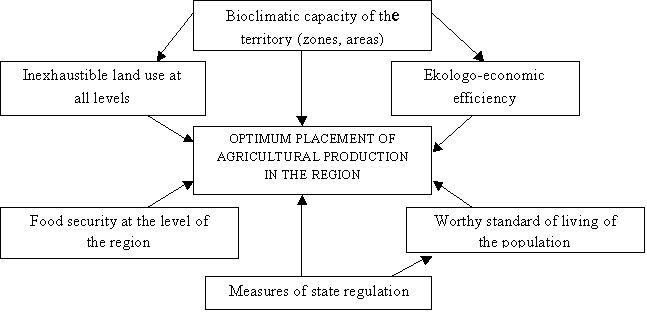
Fig. 1 - The
factors providing formation steady agriculture in the region
Such analysis has
to provide a cost assessment caused to fertility of the soil of damage, both on
separate productions, and for separate crop rotations and grounds. The
assessment of ekologo-economic efficiency of agricultural production is
reduced, in essence, to definition of the specific expenses connected with
compensation of losses of a humus at the expense of introduction of organic
chemistry, and also soil nutrients - at the expense of mineral fertilizers that
then to find the sum of ecological damage on all square of the region, a zone,
the area, agroformation, etc.
As generalizing
indicators of an assessment of ekologo-economic efficiency of use of the earth
it is possible to accept:
- the cost of
gross output of agriculture or only plant growing, minus ecological damage;
- sum of net
income and (or) the same. but minus ecological damage, etc.
The solution of this problem is closely
connected with the main economic task facing agriculture - to bring production
of main types of products to level of food security of the country. But thus it
is impossible to satisfy the current requirements of society due to
istoshchitelny use of efficiency of the earth in short periods. The scheme of
placement of agricultural production in the future has to be such that the
damage caused to soil fertility, as much as possible was compensated for the
account of introduction of rational crop rotations. Thus agricultural business
has to be effective from a position of subjects of managing irrespective of, in
what climatic conditions they function. All this. naturally, demands obligatory
participation of the state for the purpose of creation to all subjects of the
market approximately equal conditions of the competition.
In the long term
measures of state regulation have to be directed, on our deep belief, on
preservation available and creation of new workplaces in rural settlements due
to development of diversified (diversified) agriculture, population
self-sufficiency by the food, etc. First of all it concerns the territory (soil
and climatic zones and areas) with vulnerable or adverse environment.
The most
important of them treat the measures of the state support directed on creation
of workplaces in rural areas, environment improvement, and also diversification
of production and processing and trade in ready-made products of food, that is
end of a market cycle of a pas of own territory.
Development of
questions of effective functioning of the agriculture corresponding to
conditions of each agroclimatic zone, respectively, as a whole of the republic
aims at correction of the developed specialization of agricultural production
and justification of the scheme of territorial placement of cultures and
animals from the point of view of economic, ecological and social feasibility.
Therefore, the solution of the problem of placement and specialization of
agricultural production at different levels assumes carrying out scientific
researches, first, on problems of methodology of an assessment of efficiency as
from a position all-economic, and ecological; secondly, on identification of
criteria and definition of system of indicators of an economic assessment of
efficiency of functioning for all set of agricultural producers in the region.
Calculation
called above criterion allows to reveal as economic and natural resources of
agriculture as a uniform natural and economic complex are used, objectively to
estimate economic efficiency of a production activity of the agroformirovapiya
which are in a different environment, to make optimum decisions as on
enterprise, and state levels. The forecast of commercial effectiveness of
production of agricultural production (from a position of producers) has to be
carried out with use of criterion (indicator) "the marginal income"
which will provide validity of made administrative decisions.
In this regard
there is a need of addition of system of an assessment of results of business
by indicators by means of which activity of agroformations has to go for every
possible reduction of damage, first of all, to soil fertility. As such
criterion we approved an indicator "a maximum of cost of gross output,
behind a deduction. the sums of the expenses connected with production and
preservation of fertility of the soil". We consider that application of
such global criterion is justified within indicative planning.
Literature:
1 . Espolov T.I.
// Management of land resources, Alma-Ata, 2008;
2 . Ushachev I.G.
and Barkhunov N. A. // Reproduction in agrarian economy: questions of the
theory, state regulation and production efficiency, Tula, 2009.