Pedagogical sciences
Associate Professor
A.E. Tkachenko
1st year
undergraduate in "Economic Education"
Chuvilova O.N.
1st year
undergraduate in "Economic Education"
Kalashnikova E.J.
The North Caucasian
Federal University
RELATIONSHIP OF SUBJECTS
IN THE PROCESS OF INNOVATIVE DEVELOPMENT OF THE ECONOMY
There is a reduction of innovation in modern
Russia. It is due to the high commercial risk of investing in innovation
related to the necessity of large financial expenses on long payback period and
the imperfection of the organizational principles and practices of financial
and credit support of innovative processes, tax policy and lag of standard and
legal base of financial security of innovative activity. Among the reasons
hampering the innovation processes in the real sector of production we can name
insolvency of customers, lack of investment resources, providing creation of
competitive production for world and domestic market as capital resources
generated through depreciation and amortization, and borrowed formed by loans
and equity( individual share ) [2].
Countries with developed market economy spend
roughly the same share of GDP to finance basic and applied research, the
results of which are associated with high-risk or are pioneering innovations.
E.g. the U.S. spent for these purposes from 2,2 to 2,7% over the past 15-20 years , France - from 1.8 to
2.3% ,Germany and Japan - from 2 to 2.9% ; England - from 2 to 2.5% of GDP .
In Western countries members of the Organization
for Economic Cooperation and Development (OECD), the R & D spending make
2.2 % of GDP, in the states of the "Big Seven" it is 2.4%, while in
the United States - 2.6 %, in Russia this figure is at a level of 0.9 %. By
expenditures on R & D per capita, we lag behind the world leaders in dozens
of times [1].
At the same time the amount of allocated funds
for science in Russia in dollar terms is many times less than in the U.S.
despite the fact that prices for resources used in the innovation process have
reached or even exceeded the world’s.
World experience of financial support of
innovation sphere in market conditions indicates that in addition to
centralized funding various extra-budgetary funds can be used for these
purposes, forms of conditionally returnable credit that is repaid at
achievement of commercial results, or compensated from central funds in case of
a negative result.
The innovative undertaking in education,
according to the director of the department organizing research complex
innovation center "Skolkovo" Leonid Vodovatov lies primarily in
entrepreneurial initiatives, in other words in the ability to respond to changes in business outside the
university walls [3]. Innovation means maximum mobility.
If
concerning technical disciplines our country still has some reserve, in
marketing and management we hopelessly lagged behind. "Skolkovo"
experts, for example, faced the problem of ignorance of foreign languages.
The integration of higher education
institutions, business organizations, and state financial credit sector is
necessary to realize the tasks of formation of innovative economy in the
country.
In Western industrialized countries financing of
innovative activity is carried out mainly from non-state sources. In terms of
lack of solvent demand for advanced technologies and industrial innovations in
the Russian domestic market, the state is forced to sponsor and coordinate
placing of orders for the execution of R & D and innovation projects. To do
this, a system of specialized funds that provide loans or non-repayable grants
to enterprises for the intended use - R & D funding and innovation is organized.
In the conditions of backwardness of the domestic market of innovative services
and the knowledge-intensive production, specialized funds approach funding
mechanisms for innovative activity to market conditions of managing and
creation of such funds according to branch of industry allows to decentralize
decision-making concerning the financing of innovative activity [1].
The most important characteristic of Russian
economy in modern conditions is the state of science, advanced technology,
technological base, defining the competitiveness of domestic products and the
country as a whole, which demands attention of the state and society and
assignment for the accelerated development.
The state has to take care of the problem of
development of innovative strategy and ensuring financing of fundamental
science and risky, breakthrough innovations, and also of creation of the
innovative environment.
In our opinion, the relationship in this complex
system should be as follows (Fig. 1).
Both businesses and higher education
institutions should undertake a network nature of activity: a wide and varied
set of contacts. But it’s possible only in case the universities gain financial
autonomy. At the moment there are still no ways of practical implementation of
the tasks assigned to universities in order to promote innovation in the
direction of economic development. According to the president of the
Association of consultants on staff, general director of holding " Empire
of shots " Julia Sakharova, only 3% of young people is ready to start and
operate their own business. Those who do manage to start their own business are
practically imperceptible. [3].
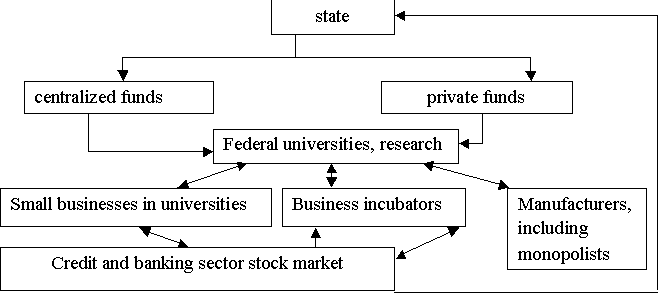
Fig. 1. Relationship
of subjects in the course of innovative development of economy
Therefore, our state should not only face the task of
the creation of favorable conditions for attracting long-term resources in the
economy, which is directly connected with the activity on the formation of a
set of organizational and economic relations developing for research and
effective use of financial resources in innovation, i.e. for financial support
of innovation processes, but also to provide the economy with highly skilled
personnel.
Now the state investment policy is realized generally
on the basis of the development programs which priorities are:
- to increase production in sectors with rapid
turnover of capital and high budgetary efficiency, providing commodity
accumulation consumer market ;
- to support high-tech industries and high-tech
industries with a high degree of processing, including the development of
cooperation with foreign companies ;
- to produce competitive engineering products as the
basis of the technical reconstruction of the economy.
In the acute shortage of internal sources of financing
of innovation a particular relevance is given to formation of attractive
conditions for import of high technologies to Russia. In this regard, it is
necessary to fix legislatively the differentiated mode of payment of the
customs duties up to their full cancellation when importing
progressive types of equipment and technologies. Thus differentiation of the
import duties has to be combined with use of protectionist measures of
protection of the domestic knowledge-intensive industry.
Venture investors who also finance innovations
including radical, use the mechanism of stock market to leave the projects.
Analysis of venture investors showed that today foreign venture funds, the funds created by the largest corporations, and
also investment and venture funds financed by the state are presented in the
Russian financial market. The object of private overseas venture capital funds
investments are not only radical innovations but also improving and
organizational innovations. This contributes to high yield projects related to
less risky projects. Russian science requires a long-term investment associated
with a certain degree of risk.
This aspect, as a rule, isn't considered for an
integration linking of science, production and innovations.
Domestic higher education institutions didn't succeed
in training personnel, capable to alter the structure of the domestic economy,
especially in lagged behind management sphere. Lack (scarcity) of professionals
(experts) capable to reformat production from within only grows.
References:
1. Matsnev O. Venture entrepreneurship: global
experience and national practice / / Problems of Economics . - № 5 . - 2006,
p.122 -131 .
2 . Chizhov A.P. What do venture investors in Russia
lack most of all? / / Business Journal
. - № 5 . - 2010, P.125 -129 .
3 . Parfenov Oleg . Somewhat and somehow ... / / Open
newspaper. - № 18 ( 510) , 9-16 May 2012 , p.10 .