Nechitailo N.V., master of natural sciences
A. Baytursynov
Kostanay State University, Kazakhstan
Role of information technologies in business
management
Until recently, information , as such, was not considered an important
asset of enterprises and companies. Management was seen as an individual art of
interpersonal communication, rather than as a global mechanism for coordinating
economic actors. Today, only a few leaders can afford to disparage the methods
of working with information. At a time when increasing the value of the
information component of the environment of enterprises, high-grade their
existence becomes impossible without corresponding changes in all the important
aspects of their life in terms of manageability and efficiency. Any enterprise
to analyze emerging issues, decision making, control operations, creating new
products or services need to be informed. Under the information refers to
meaningful and processed data that is used to solve management problems. The
data reflect events that occur both within the organization and outside it. In
order to obtain the information necessary for the successful operation of the
business is required to collect data, send them for processing, to bring them
into a form suitable for subsequent use, and transfer the results to users.
Users can specify which data to collect, and to adjust the processing methods
in terms of completeness , accuracy and presentation of the results. General
scheme of the information system illustrated in Figure 1.
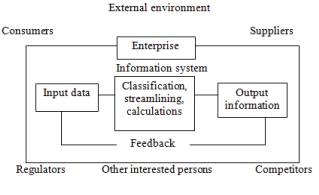
Figure 1. The
general scheme of information system
Information system (IS) can be functionally defined as a set of
interrelated elements that provide data entry, processing, and storage, and
distribution of the information used in the management of the company. [1]
Businesses create IP for services the information needs of different
levels of management. One level of the system, in turn, can be targeted to meet
the information needs of different functional areas (manufacturing, finance,
marketing, human resource management). Transaction processing system are
fundamental to service the ongoing operations of the enterprise. They represent
computerized systems that perform regular routine and record the transaction.
These are places in the hotel reservation, payment of wages, shipping products.
At the operational level, the objectives and resources are clearly defined and
structured. It is only necessary to determine whether the transaction is a set
of criteria for the system to execute it. Professional and office systems serve
the information needs of professionals in various fields of knowledge and the
needs of staff who is processing the data.
Expert systems, automated design systems for research and design units
of the enterprises provide assistance in creation of new knowledge and
contribute to the integration of the knowledge and experience of practical
activity of the enterprise. Modern graphic systems create visual images of
objects and allow the user to feel as if he is in a real situation. Such
immersion into the world created by computer, allows it to mimic the effects of
our actions on these objects.
Office systems used to increase the efficiency of work with the data
they provide communication with customers, suppliers and external
organizations. [1,2]
The ACS presented a number of General requirements.
First of all, must be compatible items with each other and with
automated systems, interconnected with the ACS. Automated system must be
adapted to modernization, development and expansion of considering the future
prospects.
Management information system must have a sufficient degree of
reliability to achieve the set goal of the system with the given conditions of
its application.
Automated control system must be sufficiently adaptable to changes in
the conditions of its use. The degree of change of the conditions of
application of the system, as a rule, it is specifically stated in advance.
The management information system should be provided to control the
correctness of execution of the functions to be automated and diagnostics with
indication of place, kind and reason for irregular functioning of the system.
In the automatic control system should be the measures of protection
against wrong actions of personnel, leading to the emergency condition of the
object or system management, from random changes and damage of information and
programs, and also from unauthorized interference and information leakage. Management
information system as any modern information system which has a complex
multifaceted structure can be divided into two components - the functional part
and providing. The functional part solves the tasks for fulfilling which is
created each individual system. These tasks are converted to their
corresponding functions of the ACS.
Management information system has several levels of management,
providing information on the current activity of the enterprise, as well as
reports on its activities in the past. Management information system support
functions of planning, control and decision-making.
The ACS summarizes data from transactional systems, processed and
summarized in the reports, which are prepared on a regular basis. ACS usually
respond fixed, known in advance the questions. These systems are not flexible
and have limited analytical capacity. [2]
A decision support system (DSS) serve the managerial level in the
organization. They help analytically justify solutions, which are not very well
structured, are of a temporary character, and not easy to foresee. Such systems
must be prepared to respond to changing environmental conditions. Although they
use the information from the office, professional and transactional systems and
management information system, they receive information from external sources
(current prices of shares, the prices of the products of competitors, etc).
DSS have great analytical potential in comparison with the systems of
other levels. They are based on mathematical models of data analysis. DSS are
interactive, and the decision maker may change the terms of tasks and to
include new data, using a user-friendly user interface.
Decision support system for senior management serve the strategic level
of the organization. They are designed to work with structured solutions and
involve the use of data on the environment (new tax laws, information about
competitors), they receive information from various information systems of the
enterprise.
Decision support system for senior management have a well-developed
telecommunications and graphical tools.
Operational level relates to the execution of daily, well-established
procedures. Appropriate decisions have met in the recent past, they are called структурируемыми, or
«programmable».
The decision of tactical level are designed for a longer period of time
than operational. Decisions badly or poorly structured due to the fact that the
objectives of the decision are not clearly defined, numerous or tempered, and
difficult predictable consequences of decision-making and their impact on the
behaviour of the decision-maker. Tactical decisions, as a rule, are aimed at
the efficient use of available resources and are characterized by indicators
such as productivity, profitability.
Decisions at the strategic level associated with prospective resources
needed to achieve the goals of the organization with efficiency in General.
A variety of information systems interact closely with each other.
Transaction systems is the main source of data for other IP, while a decision
support system management - consumers of data from systems of the lower level.
Development of mathematical methods, technical equipment and software
now makes it possible to fundamentally solve the problem of receiving an
integral effect from the introduction of information technologies at the
enterprises. Appeared the possibility to form highly efficient corporate
information system (CIS) for the management of enterprises. Increased scale and qualitatively changed
the contents of the CIS.
Presently, there are numerous examples of effective use of CIS and
Russian enterprises. A variety of corporate information systems and несокращающееся number of
developers emphasize the importance of this market in the modern economy. [3]
Literature:
1. Drozdov EA, VA Komarnicki, Pyatibratov AP
Electronic computers Unified. - 2nd ed. Mashinostroyeniye 2005. - 250.
2. Kagan BM Electronic machines and systems: the
manual. - 2nd ed., Rev. and add, Energoatomizdat, 1997. - 350.
3. Kleinrock L. Computing with queues: Trans. from
English. Springer-Verlag, 2007. - 420.