Экономические науки/ 8.Математические методы в экономике.
К.т.н., Полинский А.М.
ГВУЗ «Национальный горный университет», Украина
Monte Carlo
Simulation and its Use in Everyday Business
If you were to flip a coin 100
times, you’d expect to end up with about 50 heads and 50 tails. This is common
sense and very simple probability; however, it is also the basic principle of
Monte Carlo Simulation. Things get interesting when you have a process where
either or both of the below are true:
· There are multiple
steps and options where basic logic/calculations cannot easily determine the
expected outcome.
· The possible
outcome does not appear to follow any obvious pattern or predictable outcome.
To further explain this theory,
imagine a typical process such as an employee driving to work – for this
example we will ignore any associated cost difference, and instead focus purely
on time:
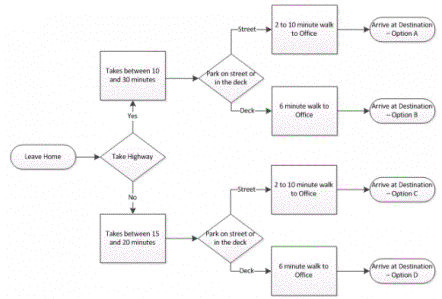
On any given day the employee in the
process above can choose between four different paths to get to his or her
destination. In some rare processes the distribution for the time ranges (e.g.
‘between 10 and 30 minutes’) may be known, for example in a factory where
employee X can assemble a widget in 10 minutes, and employee Y assembles the
same widget in 30 minutes. However, in most scenarios – and where Monte Carlo
really shows its value – is when the distribution is unknown and continuous.
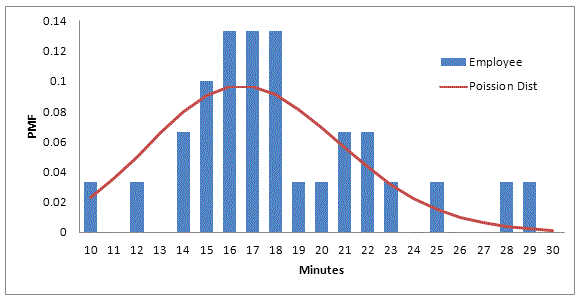
In the example, I provided a range
of how long it took the employee to get to work using the highway. Imagine now
that for a period the actual time for each decision was recorded and rounded to
the nearest minute. With this data it is possible to create a probability mass
function or ‘PMF’ (# of occurrences that it took the specified amount of
time/total attempts). The x axis represents the time taken rounded to the
nearest minute, and the y axis represents the PMF.
Using your PMF and some statistics
software (e.g. @risk), you can estimate the distribution that matches your
data. In the example above the data appears to loosely fit a Poisson
distribution with a mean of 17 (overlaid in the red).
After you have calculated all of the
distributions for the unknown functions within your process (for the example
above it would be 3, with one used twice), it is time to begin the fun part of
Monte Carlo Simulation.
For each distribution, run a
simulation a number of times (usually a minimum of 100) to calculate the mean
and any other statistics that might be useful (e.g. standard deviation) for
your process. Using your new found values, calculate the expected outcome for
each of your end scenarios. In our example, this translates to whether the
employee should use the highway or not, and whether he or she should park on
the street.
The example provided above is an
overly simplified use of Monte Carlo, and the exact steps vary depending on the
software suite you plan to use. More often than not, a tool will allow you to
map out the process/distributions and then run the simulation all together, so
rather than calculating each of the distributions separately, it will simply
show you the results of all of the final outcomes. What is great about Monte
Carlo is it allows you to use extremely complicated distributions based on
actual data, rather than just using a mean or basic probability function.
Furthermore, knowing standard deviations and how well the selected distribution
‘fits’ the data allows you to provide very accurate confidence intervals around
how good the model. Furthermore the models can also produce probability for
exceeding or beating a targeted number (e.g. what is chance the trip takes over
25 min).
Monte Carlo analysis can be used for
much more than just process assessment and design. For example, consider a
large system change where projects are underway to replace an old system that
interacts with lots of users. Process engineers can help by leveraging Monte
Carlo analysis in the following ways:
· Organizational
Change Management – by using a sample group of participants, you could estimate
costs and time involved in migrating users to a new business system. This
approach may also help identify trouble areas and where additional resources
may be required.
· Testing – using
previous testing data for the corporation, it is possible to provide estimates
around the predicted max and minimum amount of time required to test a known
amount of test sets and hence a number of testers needed.
· Project Management
– by considering the areas above (and more), Monte Carlo could accurately
provide the likely outcome of the whole project schedule and costs based on
known variances and historic results for the company.
There are many more examples that
could be listed here, and this is just the tip of the iceberg of uses for Monte
Carlo. Feel free to contact me with other ideas in which Monte Carlo analysis
could apply, and especially to ask any questions on how specifically to apply
Monte Carlo to any process problems you may be facing.
Links:
1. Berkowitz,
J., O’Brien, J., 2002. How accurate are the value-at-risk models at commercial
banks? J. Finance 57, 1093–1112.
2. Corradi,
V., Swanson, N., 2006. Predictive density evaluation. In: Elliot, G., Gringer,
C., Timmcrmann, A. (Eds.), Handbook of Economic Forecasting. Elsevier, North
Holland, vol. 1. pp. 197–284.
3. Crnkovic,
C., Drachman, J., 1996. Quality control. Risk September 9, 138–143.
4. Gaglianone,W.,
Lima, L., Linton, O., 2011. Evaluating value-at-risk models via quantile
regression. J. Bus. Econ.
Stat. 29, 150–160.