Masich I.S.
Siberian State Aerospace University, Russia
Comparative efficiency of two schemes
of local search
in the optimization of pseudo-Boolean
functions
Two schemes of local search are considered in
the paper - steepest descent and local descent with
the transition to the first improvement.
About the effectiveness of the steepest descent algorithm earlier in [1] the following results were obtained (Theorems
1 and 2).
Theorem 1. Identifying the maximum point  of the unimodal monotone on
  function f by the algorithm "steepest
descent" from the starting point
function f by the algorithm "steepest
descent" from the starting point 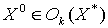 ,
,  , requires the calculation of the values
of f at
, requires the calculation of the values
of f at  points of
  :
:
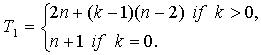
Consequence 1.
 .
.
Theorem 2. Identifying the maximum point of
the unimodal monotone on  function f by the algorithm "steepest
descent" requires on the average the calculation of values
of f at
function f by the algorithm "steepest
descent" requires on the average the calculation of values
of f at  points of
  :
:
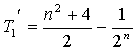 .
.
We obtain
similar estimates for the local search algorithm with the transition to the
first improvement.
Theorem 3. Identifying the maximum point  of the unimodal monotone on
  function f by the algorithm "local search with the transition to the first
improvement" from the starting point
function f by the algorithm "local search with the transition to the first
improvement" from the starting point 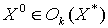 ,
,  , requires on the average the calculation of values of f at
  points of
  :
:

Proof. If
 then evaluation of complexity follows
directly from the definition of an unimodal function [2]. Let
then evaluation of complexity follows
directly from the definition of an unimodal function [2]. Let  . The
probability that the first selected point
. The
probability that the first selected point  belongs to
  equal
equal  , and the probability that
  belongs to
  equal
equal  . Thus, the algorithm after viewing one point moves at this point with
probability
. Thus, the algorithm after viewing one point moves at this point with
probability  . Correspondingly, the
algorithm will make the transition to the next point after viewing i points with probability
. Correspondingly, the
algorithm will make the transition to the next point after viewing i points with probability
 .
.
Algorithm will find a solution
with the best value of the function on the average after
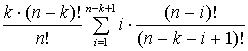
calculations. In further stages, evaluation of complexity
is calculated similarly. At the point  the algorithm will make n calculations else. Incrementally
adding evaluation of complexity we obtain
the algorithm will make n calculations else. Incrementally
adding evaluation of complexity we obtain  . ■
. ■
Consequence 2.
 .
.
Proof. Obviously. ■
Theorem 4. Determination
of the maximum point  of the unimodal monotone on
  function f by the algorithm "local search with the transition to the first improvement" requires on the average the calculation of values of f at
  points of
  :
:
 .
.
Proof. The point
 is chosen arbitrarily, thus:
  :
: 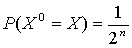 . Hence we have
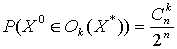 .
.
Thus, the mathematical expectation for the required calculations of f to determine  equal to
  . ■
. ■
It follows
from theorems 1-4 and consequences 1-2 that the local search with the
transition to first improve is the less time consuming algorithm than the
steepest descent. Moreover, as can be seen from the graph in figure 1, its advantage
growths when dimension increases. Figure 1 shows the graph of dependence the
value of complexity evaluation of the algorithms on the average from the
dimension of the problem (value n);
solid line - steepest descent, dotted - local search with the transition to the
first improvement.
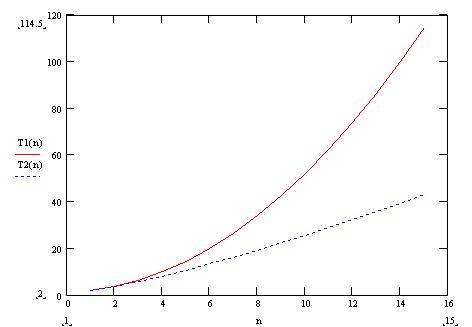
Figure 1 - Comparison of
complexity of the algorithms
References
1. Antamoshkin A.N. Regular
optimization of pseudo-Boolean functions. – Krasnoyarsk University publishing
house, 1989.
2.
Masich I.S. Heuristic algorithms for searching boundary points in
pseudo-Boolean optimization problems. Materiály IX
mezinárodní vědecko - praktická konference
«Efektivní nástroje moderních věd – 2013». -
Díl 40. Matematika: Praha. Publishing House «Education and Science», p.
54-57.