Экономические науки/10. Экономика предприятия.
Prokip M.I.
National University of Food Technologies, Kyiv
HOW TO
CREATE A STRATEGY
People do not
always clearly understand the meaning of the term Strategy.
People make
strategy much harder than it needs to be. For some, the problem is that they
focus too much on the tools: environmental scans, SWOT analyses, customer
analyses, competitor analyses, financial modeling, and so on. Other people get
into trouble because they think it's all about the broad, conceptual,
future-oriented, big picture stuff — not to be confused with tactics.
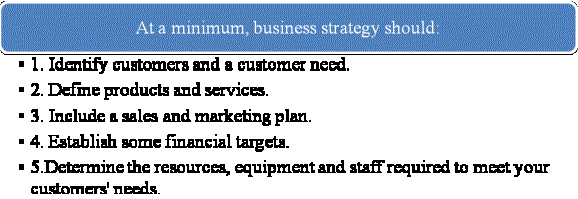
The reality is
that strategy is at some level about all those things, and you can't do a
satisfactory job with your analysis alone, or your big picture alone, or your
changes alone. You have to do a bit of work on all of them.
That's actually a
lot easier that it sounds. My preferred approach is to treat strategy- making
as developing a set of answers to five interlinked questions. The questions —
which cascade logically from the first to the last — are as follows:
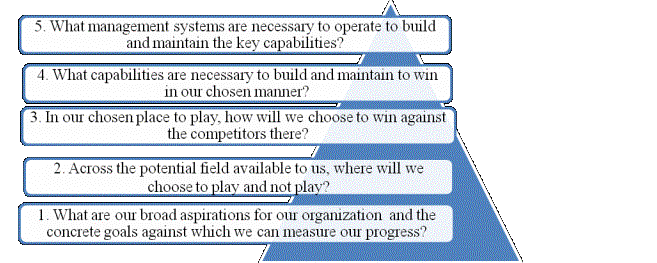
The trick is to
have five answers that are consistent with one another and actually reinforce
one another. Aspirations & Goals to be a great international player and a
Where to Play response that is domestic doesn't match well with a How to Win on
the basis of proprietary R&D (researches and development) — because the
competitors with global aspirations will almost certainly out-invest and
outflank you. Winning on the basis of superior distribution is unlikely to happen
if you don't have a concrete plan to build the capabilities and a management
system to maintain them.
So where do you
start? Most organizations start at the top with some kind of mission/vision
exercise that drives participants around the bend. The reason it drives them
crazy is that it is extremely difficult to create a meaningful
aspiration/mission/vision in the absence of some idea Where to Play and How to
Win. That is why those conversations tend to go around in circles with nobody
knowing now to actually agree on anything. Any mission or vision will do when
you don't have a thought-through Where to Play or How to Win.
That said, if you
think entirely about Where to Play and How to Win without consideration of
Aspirations & Goals, you may end up with a strategy that is effective for
its intended goal but isn't something you would actually want.
What this means
is that to create a strategy, you have to iterate — think a little bit about
Aspirations & Goals, then a little bit about Where to Play and How to Win,
then back to Aspirations & Goals to check and modify, then down to
Capabilities and Management Systems to check whether it is really doable, then
back up again to modify accordingly.
While it may
sound a bit daunting, iterating like this actually makes strategy easier. It
will save you from endless visioning exercises, misdirected SWOT analyses, and
lots of heroically uninformed big thinking. Crafting your strategy in
relatively small and concrete chunks and honing the answers to the five
questions through iteration will get you a better strategy, with much less pain
and wasted time.
The next stage is
how to develop your strategy. Turning a small business into a big one is never
easy. The statistics are grim. Research suggests that only one-tenth of 1 percent
of companies will ever reach $250 million in annual revenue. An even more
microscopic group, just 0.036 percent, will reach $1 billion in annual sales.
In other words, most businesses start small and stay there.
But if that's not
good enough for you - or if you recognize that staying small doesn't
necessarily guarantee your business's survival— there are examples of companies
out there that have successfully made the transition from start-up to small
business to fully-thriving large business.
In order to
create a strategy, you will need to analyze where you have started at. Write
down the history of your business, the purpose of the organization, the mission
and the business model you follow. Along with this, determine what the
strengths of your business are.
Define your
goals. The next step to analyzing your business is to define your goals. This
will include 'objects of desire', meaning what you want to achieve and what you
visualize for your business for the next year, two years and even ten years.
You should include a vision and objectives to this section.
Start building
your strategy. This is the point where you define how you will achieve the
goals and mission of your business. You should include things such as:
customers you want, how you will get the customers, what plans and projects
aren't working with the company, what you should do instead (with the steps).
Admit your
weaknesses. One of the overlooked parts of businesses that causes them to not
reach the goals that they want are the weaknesses. You will want to define what
these are and figure out ways to overcome them. This can include things such
as: the system you have set up, the organization's competitors, societal
forces.
Build steps to
overcome the weaknesses. You will want to focus on specific tactics and plans
to overcome your obstacles. This includes competitive advantages, as well as
how you will reach the societal forces that are causing weaknesses. Combine
this with the strategy that you have already built and you will have a plan for
success.
Conclusions should submit the following Do's and Don'ts:
DO...
1. … put
customers ahead of everything else. Figure out which problems you can solve for
your customers or which benefit you are offering.
2. .… find out
what types of individuals or companies are most likely to want the product or
service you are providing. Who are they, where are they, what are their key
characteristics?
3. … devise a
sales process and a marketing method that will take your business to the
customers most likely to “buy” them. This includes price and pricing models,
market positioning, and promoting your company in a way they are most likely to
respond to.
4. … build your
company – the structure, people, systems & processes, reporting, finances,
location, name, brand, distribution etc – to focus on and deliver to your
customers.
5. … make sure
you include digital/online in your strategy – no matter which creative sector
you operate in.
DON’T…
1. … think that a
certain level of profit or revenue or other business metrics are strategies.
They’re not. They’re targets, at best. What you need is a strategy that will
take your business there.
2. … slavishly
copy what other people have done (they will have ingredients you can’t match or
won’t want to match). Some of the best and most innovative strategies probably
break all the rules. Do it your way.
3. … assume that
your current business model is the most appropriate or best model. Think about
licensing, renting, subscription models, Freemium models, franchising, etc in addition
to sales revenue.
4. … blindly and
unchallengingly believe your business and market assumptions – especially those
that relate to numbers. As soon as you hear yourself say, “My numbers are
[very/actually/really] conservative” you’ll know they’re probably overblown and
over-optimistic. That’s when you need to challenge them most closely.
5. … unthinkingly
follow lists of dos and don’ts or tips or guides about strategy.
Each company has
its own characteristics, so that each strategy should be special and unique.
References:
1.Саєнко М.Г. Підручник. – Тернопіль: «Економічна думка». – 2006. – 390 с.
2.Roger Martin -
Five Questions to Build a Strategy – HBR (Harvard Business Review) Blog
Network– 2013 – [Electronic source]. Access to the source: http//blogs.hbr.org/martin/2013/05/the-five-questions-of-strategy.html
3. How to create
a business strategy - website brings together ideas about creativity,
innovation, and business to support Australian creative businesses and
entrepreneurs. 2012 - [Electronic source]. Access to the source:
http//creativeinnovation.net.au .