Economics / 14.
Economic Theory
PhD student Venger T.A.
Taras Shevchenko National University of Kyiv
The
Crowding Out Effect in Ukraine
It is
known in economic theory that increase of government borrowing reduces private
investments. This phenomenon is called “crowding out effect”. Originally
crowding out effect was attributed to domestic public debt: its formation
or increase boosts competition between a government and a
private sector for available credit resources and that, in turn, increases an
interest rate.
In case
of Ukraine domestic savings are not the primary source of the fixed capital
formation – the correlation between these variables is statistically
insignificant. It may be explained by existence of the deep savings gap. For
example, the credits-to-deposits ratio in Ukraine is estimated to be about 180%
[3, P. 15]. Moreover, the largest share of domestic savings consists of
short-term deposits that are unreliable source of capital investments. Thus
domestic borrowings of the general government do not crowd out private
investments in Ukraine in conventional way. But in a state of severe shortage
of domestic savings national economy is highly dependent on the international
capital market that, in turn, makes it more vulnerable to external shocks.
When in
2008 the international capital market liquidity reduced dramatically, lack of credit
resources increased the interest rate that in turn reduced lending to the real
economy. According to the National Bank of Ukraine the average interest rate on
loans to non-financial corporations increased by 4.9% in 2008–2009 and the
ratio of loans to the real economy decreased by more than 30 p.p. of GDP
compared to 2007. On the contrary, commercial banks increased lending to the
general government (from 10 million UAH in 2007 to 1.9 billion UAH in 2009).
The share of government bonds in the security portfolio of the Ukrainian
depository corporations doubled during the period 2007–2010. It was almost 80%
in 2011 (Table 1).
Table 1. Government securities held by depository corporations
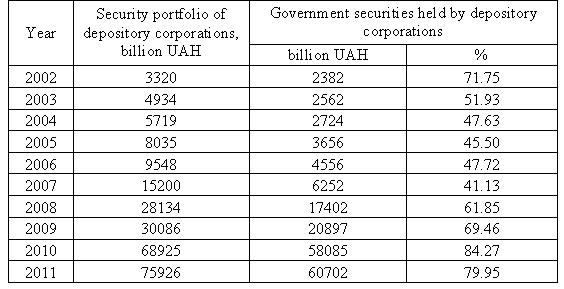
Source: [5, P. 115; 6, P. 132]
Moreover,
a number of recent studies (E. Borensztein, K. Cowan and
P. Valenzuela (2007); Ş. Ağca and O. Celasun (2009) among
others) have shown that in emerging markets private investments may be crowded
out by external borrowings as well. Increase of the public and publicly
guaranteed external debt adversely effects capital formation by lowering the
country ceilings and thus increasing sovereign risk premium for private borrowers.
In other words «…public external debt raises the riskiness of lending to the
private sector, thereby “crowding out” private access to external markets by
increasing the cost or reducing the availability of credit» [1, Р. 4]. According to the National
Institute of Strategic Studies, sovereign credit ratings of Ukraine declined
recently mostly because of the profound disbalance of public finances and
external debt servicing problems of the quasi-public corporations like National
JSC “Naftogaz of Ukraine” [4].
The
results of crowding out effect estimation for Ukraine are following
(t statistics in parentheses):
fcprivate_log =
-0.048 · edppg_gdp + 0.027 · edpng_gdp + 23.56
(-6.12)
(7.5)
Adjusted R-squared = 0.87
DW = 1.48
t = 20
Where
fcprivate_log – logarithm of the gross fixed capital formation by the private
sector; edppg_gdp – public and publicly guaranteed external debt, % of GDP;
edpng_gdp – private nonguaranteed external debt, % of GDP.
Increase
of the external public and publicly guaranteed Ukrainian debt by
1 percentage point of GDP causes reduction in private capital investment
by 5.3 basis points average. The same increase in the external private
nonguaranteed debt leads to the average growth of the gross fixed capital
formation by the private sector by 2.2 basis points.
References
1. Ağca Ş.
How Does Public External Debt Affect Corporate Borrowing Costs In Emerging
Markets? / Ş. Ağca, O. Celasun // IMF Working Paper, 2009. – No. 266.
– 36 p.
2. Borensztein E.
Sovereign Ceilings “Lite”? The Impact of Sovereign Ratings on Corporate Ratings
in Emerging Market Economies / E. Borensztein, K. Cowan, P. Valenzuela // IMF
Working Paper, 2007. – No 75. – 32 p.
3.
Лютий І.
Фінансово-економічна криза 2008–2010 рр.: деякі чинники та уроки / І. Лютий, О.
Юрчук // Вісник НБУ. – січень 2011 р. – С. 10–16.
4.
Нова архітектура
бюджетної системи України: ризики та можливості для економічного зростання. –
К. : НІСД, 2010. – 35 с.
5.
Бюлетень Національного
банку України [Електронне джерело] / Національний банк України. – №1/2009(190).
– 177 с. – Режим доступу : http://www.bank.gov.ua/doccatalog/document?id=66416
6.
Бюлетень Національного
банку України [Електронне джерело] / Національний банк України. – №9/2012(234).
– 195 с. – Режим доступу : http://www.bank.gov.ua/doccatalog/document?id=121759