Physics /2. Solid state physics
Т.А. Lychagina1, D.I. Nikolayev1, H.-G. Brokmeier2
1Joint Institute for Nuclear Research, Dubna, Russia
2GKSS Forschungszentrum, Geesthacht, Germany
Texture investigation of magnesium alloy MA2-1 after equal channel angular pressing
Magnesium alloys
find wide application in various branches of mechanical engineering, first of all in aerospace, automobile and electronic industries. Ductility of semi-finished
products from these alloys is not rather high [1] especially at deformation temperatures
below 250°C in spite of the high strength. It is connected to features of the
structure and texture formation during plastic deformation of these alloys.
Situation can considerably be improved if to find ways of magnesium products deformation
allowing generating the equiaxed fine-grained structure and diffuse or tilted
basal texture in these materials. One of the promising ways to solve the problem
is application of the severe plastic deformations with help of equal channel angular
pressing (ECAP) [2-3]. The ECAP process is characterized by development of deformation
textures. Moreover, plastic response in the samples after ECAP is highly
anisotropic and some directions actually exhibit significantly lower ductility
than the materials undergone by conventional treatment (extrusion) [4]. So, plastic
deformation of magnesium alloys strongly affected by crystallographic texture [5].
Crystallographic texture is defined
as the preferred orientations of crystallites of a polycrystalline sample with
respect to a sample orientation system. In this work the texture evolution of ECAPed samples from the alloy MA2-1 (Mg-4.5%
Al-1% Zn) has been investigated by means of neutron diffraction. The texture
measurements have been carried out at TEX-2 instrument situated at reactor
FRG-1(GKSS, Germany). The deformation experiments were done following the three
important routes of ECAP, namely A, Bc
and C up to six passes in a 90° die. Texture evolution with double initial
fibers was analyzed and related to the processing routes.
Experimental
We investigated the
texture formed after ECAP for Mg-4.5%Al-1%Zn (MA2-1) alloy. The texture of the
eight samples has been investigated by measuring the (002), (100), (101), (110)
pole figures using the TEX-2 neutron diffractometer at the FRG-1 neutron
source. Neutron diffraction is one of
the powerful techniques of texture measurements. The main advantage of thermal
neutrons is their high penetration power which allows to measure global
textures over the whole cross-section of the ECAP samples [6]. Due to high
penetration depth of neutrons, the spherical sample method could be used, so
that it is possible to obtain complete pole figures, and for most materials
data correction could be neglected. The information about texture of material
is extracted from the measured pole figures. The pole figures undergo the
experimental error. So it is very important to study sources of the pole figure
measurement errors to look after their minimization. The pole figure measurement
errors have been studied on the example of MA2-1 alloy in the following works
[7-8].
The bar extruded
with backpressure was input for ECAP. ECAP combining with backpressure enables
considerably improve strength as well as ductility of material. The ECAP scheme is presented in Fig. 1.
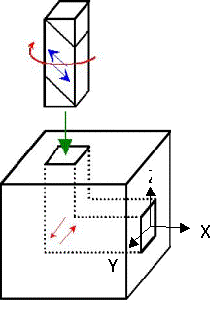
 Fig.1. The ECAP scheme.
The ECAP has been
carried out by the following routes.
The pressing in the
route A is repeated without sample
rotation, i.e. a sample orientation is not changed after each pass. The pressing
for one pass has been done with strain  at 260ºC. The
pressing for two passes resulted in the strain
at 260ºC. The
pressing for two passes resulted in the strain  at 260ºC in the
first pass and 240ºC in the second pass. The pressing for four passes
resulted in the strain
at 260ºC in the
first pass and 240ºC in the second pass. The pressing for four passes
resulted in the strain  at 260ºC in the
first pass and 240ºC in the second and third passes, 220ºC in the
fourth pass.
at 260ºC in the
first pass and 240ºC in the second and third passes, 220ºC in the
fourth pass.
The pressing in the
route C is repeated with rotation a
sample about its pressing direction by 180º after
each pass. The pressing for two passes resulted in the strain  at 260ºC in the
first pass and 240ºC in the second pass.
The pressing for four passes resulted in the strain
at 260ºC in the
first pass and 240ºC in the second pass.
The pressing for four passes resulted in the strain  at 260ºC in the
first pass and 240ºC in the second and third passes, 220ºC in the
fourth pass.
at 260ºC in the
first pass and 240ºC in the second and third passes, 220ºC in the
fourth pass.
The pressing in the
route Bc is repeated with sample rotation by 90º about
its axis and simultaneous rotation by 180º about pressing direction. The
pressing for four passes resulted in the strain  at 260ºC in the
first pass and 240ºC in the second and third passes, 220ºC in the
fourth pass. Third and foutrh passes have been done after sample rotation by 90º
about pressing direction. The pressing for six passes resulted in the strain
at 260ºC in the
first pass and 240ºC in the second and third passes, 220ºC in the
fourth pass. Third and foutrh passes have been done after sample rotation by 90º
about pressing direction. The pressing for six passes resulted in the strain  at 260ºC in the
first pass and 240ºC in the second and third passes, 220ºC in the
fourth and fifth passes, 200ºC in the sixth pass. Third, foutrh, fifth and
sixth passes have been done after sample rotation by 90º about pressing
direction.
at 260ºC in the
first pass and 240ºC in the second and third passes, 220ºC in the
fourth and fifth passes, 200ºC in the sixth pass. Third, foutrh, fifth and
sixth passes have been done after sample rotation by 90º about pressing
direction.
The ECAP procedure
was carried out using a specially designed die with an angle 90º between
two channels of square cross section (20×20mm) without any rounding of
the corners. In each route the sample
have to be turned by 90º around its transverse axis in order to set
the deformed sample back into the die. The samples size was 10×10×10mm.
The all samples have been measured so that the extrusion direction E_D (the
direction of ECAP) is in the center of the pole figures. After ECAP the samples
have been annealed at 345ºC during one hour in the air. The ECAP resulted
in the ultrafine-grained structure in the investigeted alloy with the mean
grain size 2,0-2,4 µm.
Results and discussion
The experimental PFs measured for routes A,
C and Bc are given in Fig. 2-4. The first rows present the PFs for
the input extruded sample on each figure. In the second row it can be seen the
PFs for sample after one ECAP pass. So the PFs in the second row (after one
ECAP pass) are the same for the Fig. 2-3 (routes A and C). The second row in
Fig.4 presents PFs after two passes in the route C.
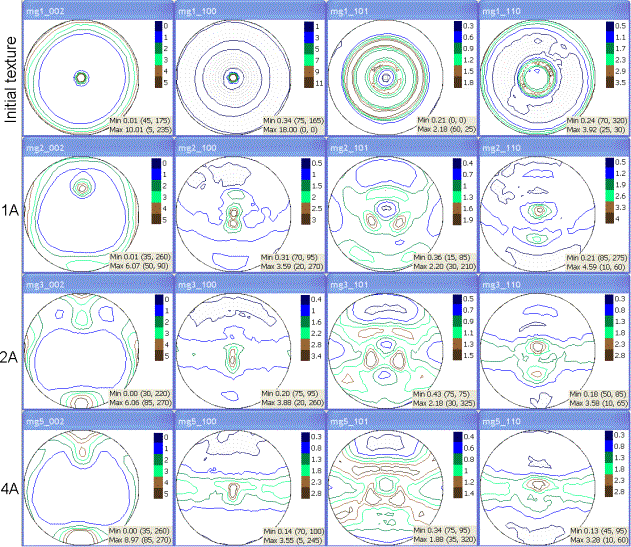
Fig. 2. The experimental pole figures for the input sample and the samples in
the route A of ECAP. All samples are from alloy MA2-1. The extrusion direction
(ED) is in the center for all PFs. The position of the sample coordinate system
(extrusion direction, transverse direction, normal direction) is the same for
all samples.
This corresponds to the first step
of ECAP procedure for the route Bc
in our case. Also the PFs in the third row (Fig.4) describe the next step of
the ECAP procedure, i.e. PFs after four passes in the route Bc . Here
two passes are carried out in route C and two passes in route Bc, i.e.
with rotation after second and third passes about longitudinal axis of the
sample by 90º clockwise.
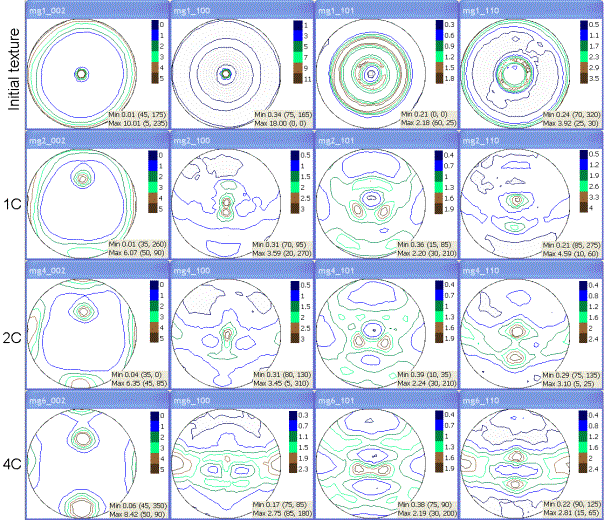
Fig. 3. The
experimental pole figures for the input sample and the samples in the route C
of ECAP. All samples are from alloy MA2-1. The extrusion direction (ED) is in
the center for all PFs.
The initial texture
(for input sample) is characterized by two strong axial components (basal and
prismatic). The intensity of the basal component is about 10 mrd, and the
intensity of the prismatic component is about 18 mrd. The pole density is given
in the units of random distribution. It should be underlined that for common magnesium
(AZ31, AZ61, MA2-1) alloys samples after extrusion only one prismatic texture
component is typical. The reason for the second component is backpressure
combining with extrusion. After the first pass we observe the moving of the
basal component (the intensity maximum) on the angle about 45° respectively to
extrusion direction. After the second pass in the route A this component moved
on the angle about 90° respectively to extrusion direction. After the fourth
pass in the route A the intensity of this component increased from the 6.06mrd
(after the second pass) up to 8.97 mrd.
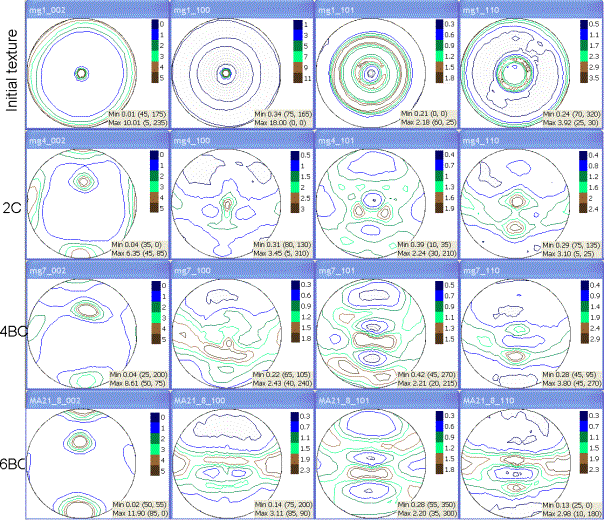
Fig. 4. The experimental pole figures for the input sample and the samples in
the route Bc of ECAP. All samples are from alloy MA2-1. The
extrusion direction (ED) is in the center for the PFs.
The moving of the
texture components during the route C is rather close to one in the route A.
The difference is velocity of intensity redistribution. So during the route C
the maximum of basal texture component on the angle about 45° respectively to extrusion
direction is more stable than in the route A. It presents on the PFs for the
samples after second and fourth passes as well in the route C. The maximum of
this texture component increased from
6.35mrd after the second pass up to 8.42mrd after the fourth pass in the route
C. As for the route Bc we
also observe the same component moving after the fourth pass. The maximum of
this component increased from 8.61mrd
after the fourth pass up to 11.9 mrd after the sixth pass.
The ECAP drastically
changes the initial axial texture characterized by sharp basal and prismatic components
by splitting them into several more scattered orientations. New texture consist
of the basal component inclined to the extrusion direction on 45-55˚ with
high degree of scattering and prismatic component. The degree of the
orientation scattering depends on the ECAP regime and route. The ECAP route Bc after four passes results
in the strongest scattering of the texture maximum. Such texture type favors for low temperature ductility of
magnesium alloys.
Samples were produced by V.N.
Serebryany within the frame of the Russian State
contract № 02.513.11.3340.
Summary
The plastic anisotropy can be rationalized in terms of
the strong crystallographic texture induced by the ECAP. The ECAP as a kind of severe plastic
deformation results in the essential texture changing in magnesium alloy MA2-1.
The quantitative study of texture influence on the plastic properties of these
alloys after different ECAP routes and annealing can be done by using
orientation distribution function. This analysis will allow finding the optimal
deformation regimes provided increasing of low temperature ductility.
References
1. K.Xia, J.T. Wang, X.Wu, G.Chen,
M.Gurvan, Mater.Sci.Eng. A 410-411, 324-327
(2005)
2. Z.Horita, T.Fujinami and T.G.
Langdon, Mater.Sci.Eng., A318, 34 (2001)
3. R.Z.Valiev, R.K. Islamgaliev and
I.V. Alexandrov, Prog. Mater. Sci., 45,
103 (2000)
4. Suwas S., Gottstein G., Kumar R., Mater. Sci. Eng. A, 1-14 (2007)
5. H.J. Bunge, Texture Analysis in Material Science, Butterworths,
London (1982)
6. H.J. Bunge., Textures and Microstructures, 10, 265
(1989)
7. Nikolayev D.I., Lychagina T.A., Nikishin A.V., Yudin
V.V., Solid State Phenomena, 105, 77 (2005)
8. T.A. Lychagina, D.I. Nikolayev, Crystallography reports, 52 (5), 774 (2007)