The approach of
teaching English language
Ismailova Feruza Valikhonovna
Резюме
Это статья
рассмотривается методы обучения английского языка и его виды, и дает
обяснения каждому из них.
Түйіндеме
Бұл мақала
ағылшын тілін оқыту әдістерін және оның бір неше
түрлерін қарастырады, оларға әр қайсысына
түсінік береді.
Every
few years, new foreign language teaching methods arrive on the scene. New
textbooks appear far more frequently. They are usually proclaimed to be more
effective than those that have gone before, and, in many cases, these methods
or textbooks are promoted or even prescribed for immediate use. New methods and
textbooks may reflect current developments in applied linguistic theory or
recent pedagogical trends.
Foreign
language teaching methods and approaches have been controversial and changed
over times in accordance with state needs and social-economic development. A
teaching method comprises the principles and methods used for instruction.
Commonly used teaching methods may include class participation, demonstration,
recitation, memorization, or combinations of these. The choice of teaching
method or methods to be used depends largely on the information or skill that
is being taught, and it may also be influenced by the aptitude and enthusiasm
of the students. A teaching method comprises the principles and methods used
for instruction.
There are several
methods of teaching English to students who are learning the language for the
first time, each with their own unique pros and cons. Depending on the
teaching situation, setting, and resources available, any one of these English
teaching methods could be right for you and your students.
In this guide, we’ll go over the basics of each method and determine what
kind of English language student it would work best on. If you or someone you
know are trying to learn English for the first time, or improve a current
English speaking skill level.
1. Grammatical Approach
A focus on grammar rules is one of the most popular English teaching
methods in traditional academic settings, perhaps due to the focus on grammar in
native language courses. Teaching English as a second language, according to
this approach, should not stray from the model.
This approach can only work if the instructor speaks the first language of
the students in addition to English, because much of it is based on the
teacher’s ability to translate. English grammar rules should be taught
conceptually in the student’s native language, with examples provided in simple
English sentences that the teacher can translate back to the native tongue so
that a solid parallel can be drawn. These grammar rules should be strictly
enforced, and students should be allowed to practice proper structure and
syntax through the use of examples and quizzes.
Also important to this method is vocabulary, as students need a large
knowledge bank of English words in order to interpret and form their own
English grammar examples. Grammar and vocabulary quizzes fuel this approach,
and should be at the forefront of instruction. The English language is examined
in terms of grammar rules.
In this method,
students strictly follow the textbook and translate sentences word for word in
order to memorize abstract grammatical rules and exceptions and long bilingual
vocabulary lists:
- The teacher translates
from the foreign language into the mother tongue and the students from their
mother tongue into the foreign language.
- Grammar points are
presented contextually in the textbook and explained by the teacher.
- The only exercised
skill was reading but only in the context of translation.
Disadvantages
of the grammar-translation method
Because of these
limited objectives, language professionals found more disadvantages in this method than
advantages.
Who is this best for?
This approach is best for students who natively speak a language with a
dramatically different set of grammar rules from English. The instructor must
have a strong grasp of the English language themselves, and the grammar rules
of their classroom’s native tongue, meaning it’s best if all students are
coming at English from the same first language.
2. Aural Approach
The aural English teaching method focuses on the most natural way to learn
a language, which is by hearing it. Children who are raised to speak English
learn it first by hearing it from their parents and others around them, long
before they ever learn how to read or write. The aural approach is similar,
meaning it’s strictly audio-based and should not focus on the reading or
writing until long after the students can grasp the language on a speaking
level.
The actual method involves dialogue. In the beginning, the students will
mostly be spoken to. The teacher might use visual cues such as objects to give
the students something to associate the words they’re hearing with. Then, they
will be instructed to speak the words themselves, coming to grasp vocabulary
and basic grammar through hearing and speaking, rather than advanced
instruction or writing. Teachers should not write the words they’re saying, and
let the bulk of the instruction exist in dialogue.
For note taking purposes, students should be allowed to write words they’ve
learned phonetically, in their native language, if applicable.
Who is this best for?
The aural English teaching method is an approach best used for younger students,
as it most closely relates to the way they’ve been used to learning language.
It’s also great for students whose first language is of a writing system
dissimilar to English.
This way, the students can focus on learning the language in its purest,
aural form, rather than be distracted and possibly confused by learning the
written word as well. That segment of the instruction can come once the
students have a firm grasp on the spoken language. Proper pronunciation is a
huge part of this method.
3. English-Only Approach
The English only method is one of the most direct approaches to teaching
the language. For this method, neither the teacher nor the student should speak
their native tongue at all during instruction. All instruction should be done
in English only.
Vocabulary should be taught first, as it is the easiest to grasp because it
can be demonstrated with a visual aid. As the student builds vocabulary, the
instructor can begin introducing abstract words and elements of the language,
but without explaining or focusing on the actual grammatical structure. The
complexities of the language will be learned inherently, with the student
picking up on its patterns through practice and application only.
At the end of each class period, there can be an optional question and
answer session where students are allowed to ask the teacher about that day’s
lesson. Here, clarifications may be made and confusion may be cleared up, but
again, this is entirely optional. Sometimes, the best way to learn the language
through this method is to just tough it out and let it come naturally.
Who is this best for?
This method works best for situations where the instructor does not speak
the native language of the students they’re instructing. (Of course, this would
make the optional question answer sessions an impossibility.) It is also an
ideal method for situations where there is a diverse set of students who don’t
share the same native language, all trying to learn English. This way, the
barriers and constraints brought in by an inability to communicate natively can
be dismissed, and a stronger focus on the language at hand can be made.
4. Translative Approach
The translative approach is a bit like the grammatical approach, only with
a broader focus on the English language’s structure in comparison to the native
language of the students. This approach must be taught by an instructor who
speaks the same language as their students, and all the students must also
share a fluency in the same language.
English will be taught as a subject like any other, with different elements
of the language such as vocabulary, grammar, syntax, speaking, reading, and
writing focused on every day. This method will make strong use of notecards,
where students can write English vocabulary and grammar concepts on one side,
and then translate the word or idea on the back in their native language.
Quizzes and exams should be given, first asking questions in the native
language of the students, and eventually moving into English-only in the later
duration of the course. Lecturing will be the primary method of instruction
during the class, with student questions allowed and encouraged.
Who is this best for?
This method is best for students learning the English language because of
an academic interest in it as a language, and not just an interest or need to
know how to speak it. Speaking, reading, and writing the language will be given
equal priority, and grammar rules and concepts will not be avoided for a more
“natural” approach. It will be taught academically, as any other subject, and
is best for students who are interested in this kind of rigorous approach.
5. Immersive Approach
The immersive approach is one of the best ways to learn the language for
older students who are able to travel for their education. Someone who wants to
learn English doesn’t even need to be enrolled in an English language course to
use this method – all they need are the resources involved in travel.
For students wanting to learn British English, a trip to the United Kingdom
is recommended. For students wanting to learn American English, a trip to the
United States is recommended. If the student wants an academic-heavy approach,
there are foreign exchange programs they can enroll in through colleges, or
other academic programs that allow prolonged travel.
Again, an academic program is not required for this method. Staying in a
new country and learning the language through pure immersion and necessity is
one of the best ways to learn it quickly. Students will be surrounded by media
in that language, and people who speak that language. It is a great way to
break off from the distractions of your native tongue, and learn how to think
in the English language as well as speak it.
Who is this best for?
Teachers and students who are able to travel and stay in another country
long enough to develop a strong grasp on the English language.
This module
provides a description of the basic principles and procedures of the most
recognized and commonly used approaches and methods for teaching a second or
foreign language. Each approach or method has an articulated theoretical
orientation and a collection of strategies and learning activities designed to
reach the specified goals and achieve the learning outcomes of the teaching and
learning processes.
Teaching through
problem solving is not always easy since many of us were taught by remembering
facts whether or not they were related to each other, whether or not we were
interested in the subject, and in some instances we were taught by rote. In
fact, many teachers may say that problem solving in their particular subject
area is not possible, not helpful, or only possible in limited parts of the
subject matter.
However, everything
that can be taught may be taught from a problem solving point of reference. The
rest of this article is dedicated to this idea.
Steps in the Problem Solving Process
1. Provide the basis for the solving of the
problem
The student is often stymied by the lack of
a basis from which to even begin the problem solving process.
List the possible presumptions to be
overcome in solving the problem.
Identify tools and references needed to
help in arriving at a solution.
Give basic knowledge needed to begin
searching for solutions.
Support off-the-wall suggestions which may
have some validity or
may lead to other possibilities which are
valid.
Breakdown the problem into manageable
component parts.
2. Discover the interest of the students.
Many students are not interested in a particular subject. It is the teacher's
challenge to illuminate the connection between the topic to be taught and the
students interests.
3. Enter the world of the student. See the
material to be learned from the student's viewpoint of what the student wants
to do, know, experience.
4. Allow the student to create a project of
personal interest which uses the material to be learned.
5. Multi-explanations or solutions. There
is always more than one explanation for a phenomenon (some have been proven
false long ago but were held to be true by the best minds of each preceding
age). Alternatively, there is more than one way to interpret what we know, or
more than one way to derive a solution. The differences should be brought up
and discussed and the students given the task of defending different positions
or of deriving the solution from different angles.
There are some problems for which students
know the strategy to solve as soon as they examine the problems. However, for particularly hard problems,
they do not know right-away how they can solve the problem. The progress on such problems often comes
from heuristics or 'rules of thumb' that are likely to be useful, but are not
guaranteed to solve problems. As a result, the progress on a problem takes the
form of multiple explorations or search of different ideas. Progress on a
typical problem would involve a student trying out a lot of different leads
using such heuristics. Work on the
problem solving may go through different phases such as trying to understand
the problem, working on a specific approach, getting stuck and trying to get
unstuck, critically examining solutions or communicating. The work may involve
going back and forth between these different phases of work. On this site, we
would now be providing a variety of different suggestions for attacking the
problem. Many of these are rules of thumb or heuristics. These heuristics can
be described in the form of condition, action form where conditions describe
problem situations in which these should be applied and actions describe what
should be done.
The teacher or the
textbook provides the topic, but the project writers themselves decide what
they write and how they present it. This learner-centred characteristic of
project work is vital, as we shall see when we turn now to consider the merits
of project work. It is not always easy to introduce a new methodology, so we
need to be sure that the effort is worthwhile. Students do not feel that
English is a chore, but it is a means of communication and enjoyment. They can
experiment with the language as something real, not as something that only
appears in books. Project work captures better than any other activity the
three principal elements of a communicative approach.
These
are:
a) a concern for motivation, that is, how
the learners relate to the task.
b) a concern for relevance, that is, how
the learners relate to the language.
c) a concern for educational values, that
is, how the language curriculum relates to the general educational development
of the learner.
|
Type
of student work |
Benefits |
Challenges |
When
it is suitable |
Connections
to theory |
|
Individual |
Students
work at their own pace, they are confident about what they know and what they
need to send more time on, they can use their preferred learning styles and
strategies |
Students
don’t get the benefit of learning from and working with their peers |
Giving
it, Getting it, final tasks/assign-ment |
Deductive
Learning, Learning Styles & Strategies, Gardner’s Multiple Intelligences,
Vygotsky’s Zone of Proximal Development |
|
Pair |
Students
have the chance to work with and learn from their peers; struggling students
can learn from more capable peers; it is especially useful for students who
prefer interpersonal learning settings |
If
students are not matched up well (i.e. low students together, high students
together, a higher student with a low student but they don’t work well
together) pair work won’t be useful; the ability of the students to work in
this way needs to be taken into consideration |
Giving
it and Getting it activities, Inductive learning activities |
Gardner’s
Multiple Intelligences, Vygotsky’s Zone of Proximal Development, Inductive
Learning |
|
Group |
Group
work provides more opportunity for practice, an increased variety of
activities is possible, increased student creativity, the Zone of Proximal
Development increases |
As
with pair work, the groups must be carefully selected to ensure students can
work productively; not all students are able to work to their full potential
in this situation; assessment of student progress can be challenging |
Giving
it and Getting it activities |
Gardner’s
Multiple Intelligences, Vygotsky’s Zone of Proximal Development, Assessment
for/of learning |
During the investigation of project method
in teaching we founded types of project method.
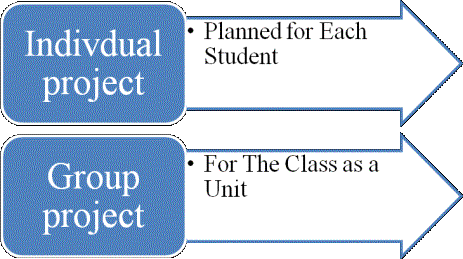
I guess it is very
effective to use at school in the process of the lesson.
On
the basis of the literary sources studied we can come to the following
conclusions that project work has advantages like the increased motivation when
learners become personally involved in the project, all four skills, writing,
listening, and speaking, are integrated; autonomous learning is promoted as
learners become more responsible for their own learning. The disadvantages of
project work are the noise which is made during the class, also projects are
time-consuming and the students use their mother tongue too much, the weaker
students are lost and not able to cope with the task and the assessment of
projects is very difficult.
However, every type of project can be held
without any difficulties and so with every advantage possible. A student who starts
studying methods will be puzzled by the variety of “methods” he or she may come
across in books and journals and, of course there good grounds for this. At
different periods, depending on the aims of teaching and learning a foreign
language, new methods sprang up. In each case the method received a certain
name; sometimes its name denoted logical categories, for example the
synthetic method, analytic method the
deductive method, the inductive method, sometimes the method was named after
the aspect of the language upon which attention was focused as in the cases of
the grammar method, the lexical method, the phonetic method. A third set of
methods received their names from the skill which was the main object of
teaching. Among these are the translation methods, the oral method. Sometimes
the method got its name from the psychology of language learning: in this,
category the following names occur: the intuitive method, the conscious method,
the direct method, the project method. Finally the method was sometimes named
after its inventor.
References
1. Anitchkov I., SaakyantsV. Methods of teaching English. Moscow, 1966.-
248p.
2. Harner Jeremy. The practice of English language teaching. L. - New York,
1991.-296p.
3. Potter Mike. International issues. Teacher's book. L., 1991.- 125p.
4. Rogova G. Methods of teaching English. Leningrad, 1975.- 312p.
5. Бугаев Н.И. Обучение –
это общение.// Народное образование Якутии- 1992 №2 с.37-49
6. Загвязинский В.И.
Методология и методика дидактических исследований.- М: Педагогика, 1982