“Teach pupils to speak dialogue speech in
primary school”
Asankhodjayeva I.F., Ismailova F.V.
Түйіндеме
Бұл мақала
оқушыларды ағылшын тілінде диологтық сөйлеуге
үйретуді қысқаша қарастырады .
Language education may take place as a general school
subject or in a specialized language
school. There are many ways of teaching
languages. Some have fallen into relative obscurity and others are widely used;
still others have a small following, but offer useful insights.
While sometimes
confused, the terms “Dialogue” is hierarchical concepts.
Dialogue is a
special kind of discourse that enables people with different perspectives and
worldviews to work together to:
-Dispel mistrust
and create a climate of good faith
-Break
through negative stereotypes
-Shift
the focus from transactions to relationships, creating community
-Make
participants more sympathetic to one another even when they disagree
-Prepare
the ground for negotiation or decision making on emotion-laden issues
-Expand
the number of people committed to decisions on challenging issues
To explain dialogue
we contrast it with debate, a more common form of discourse. Both are essential
in decision-making, but they have different purposes. Debate is about winning;
dialogue is about learning.
Dialogic
teaching is not just any talk. It is as distinct from the question-answer and
listen-tell routines of traditional teaching as it is from the casual
conversation of informal discussion. Thus:
Dialogic teaching is not the
speaking and listening component of the teaching of national curriculum English
under another name.
• It attends as closely to the
teacher’s talk as to the pupil’s.
• It is a comprehensive approach to
talk in teaching and learning across the whole curriculum.
• It is grounded in research on the
relationship between language, learning, thinking and understanding, and in
observational evidence on what makes for truly effective teaching.
Dialogic teaching certainly aims to
improve pupil’s powers of communication, but it aims to do much more than that.
Dialogic teaching is not a single
set method of teaching.
• Dialogic teaching is an approach
and a professional outlook rather than a specific method. It requires us to
rethink not just the techniques we use but also the classroom relationships we
foster, the balance of power between teachers and taught and the way we
conceive of knowledge.
• Dialogic teaching, like all good
teaching, is grounded in evidence and principles.
• And like all good teaching it
draws on a broad repertoire of strategies and techniques.
• The teacher draws on this
repertoire in response to different educational purposes and contexts, the
needs of different pupils, and the diverse character what is to be taught and
learned.
A
dialogue consists of a series of lead-response units. The significant feature
of a lead-response unit is that the response part may, and usually does, serve
in its own turn as a fresh inducement leading to further verbal exchanges, i. e., lead ► response ► inducement ► response. A response unit is a unit of speech between two pauses. It may
consist of more than one sentence. But the most characteristic feature of a
dialogue is that the lead-response units are closely connected and dependent on
each other. The lead is relatively free, while the response depends on the
first and does not exist without it.
— Where is the book?
— There, on the shelf.
In
teaching dialogue we should use pattern dialogues as they involve all features
which characterize this form of speech.
There
are three stages in learning a dialogue: (1) receptive; (2) reproductive; (3) constructive (creative).
1. Pupils "receive" the dialogue
by ear first. They listen to the dialogue recorded or reproduced by the
teacher. The teacher helps pupils in comprehension of the dialogue using a
picture or pictures to illustrate its contents. They listen to the dialogue a
second time and then read it silently for better understanding, paying
attention to the intonation. They may listen to the dialogue and read it again,
if necessary.
2. Pupils enact the pattern dialogue. We may
distinguish three kinds of reproduction:
Immediate.
Pupils reproduce the dialogue in imitation of the speaker or the teacher while
listening to it or just after they have heard it. The teacher checks the
pupils' pronunciation and intonation in particular. The pupils are asked to
learn the dialogue by heart for homework.
Delayed.
After pupils have learned the dialogue at home, they enact the pattern dialogue
in persons. Before calling on pupils it is recommended that they should listen
to the pattern dialogue recorded again to remind them of how it
"sounds".
Modified.
Pupils enact the dialogue with some modifications in its contents. They change
some elements in it. The more elements (main words and phrases) they change in
the pattern the better they assimilate the structure of the dialogue:
— Will you help me, sonny?
— What shall I do, Mother?
— Will you bring me a pail of water?
— Certainly I will.
The
use of pictures may be helpful. Besides pupils use their own experience while
selecting the words for substitutions.
The
work should not be done mechanically. Pupils should speak on the situation. As
a result of this work pupils master the structure of the pattern dialogue (not
only the contents), i. e., they can use it as a model for making up dialogues
of their own, that is why pattern dialogues should be carefully selected.
The
first two stages aim at storing up patterns in pupils' memory for expressing
themselves in different situations, of course within the topics and linguistic
material the syllabus sets for each form.
3.
Pupils make up dialogues of their own. They are given a picture or a verbal
situation to talk about. This is possible provided pupils have a stock of
patterns, a certain number of phrases for starting a conversation, joining in,
etc. They should use those lead-response units they have learned in connection
with the situation suggested for a conversation.
At
the third stage the choice of stimuli is of great importance, as very often
pupils cannot think what to say, though they know how to say this or that.
Therefore audio-visual aids should be extensively utilized.
Rule
for the teacher: In teaching dialogue use pattern dialogues; make sure that
your pupils go through the three stages from receptive through reproductive to
creative, supply them with the subject to talk about.
In
teaching speaking the problem is what form of speech to begin with, and what
should be the relationship between monologue and dialogue. This problem may be
solved in different ways. Some methodologists give preference to dialogic
speech in teaching beginners, and they suggest that pupils learn first how to
ask and answer questions which is mostly characteristic of a dialogue, and how
to make up a short dialogue following a model. Pupils are taught how to make
statements, how to combine several sentences into one utterance in connection
with an object or a situation offered. As to the relationship between monologue
and dialogue, it should vary from stage to stage in teaching speaking in
schools. In the junior stage (5—6 forms) dialogic speech, the time which allows
the teacher to introduce new material and consolidate it in conversation, must
prevail. In the intermediate stage (7—8 forms) dialogue and monologue must be
on an equal footing.
In
the senior stage (9—10 forms) monologic speech must prevail since pupils take part
in discussion and, therefore, express their thoughts in connection with a
problem or retell a text read or heard. To sum it up both forms of speech
(monologue and dialogue) should be developed side by side with preference for
the one which is more important for pupils' progress in learning a foreign
language at a certain stage.
Practical Ideas Language learning &
Language acquisition
• L1 is acquired and L2 is learned.
This is because we understand that the first
language is acquired through experience while the second language usually comes
with formal teaching.
• We The order of acquisition
… Present the language orally; the child
listens
… Then ask the children to reproduce the
language orally; the child speaks
… Then present language in the written form;
the child reads
… Finally ask then to reproduce this language
in a written form; the child writes
Pupils
should be acquainted with some peculiarities of the spoken language, otherwise
they will not understand it when hearing and their own speech will be
artificial. This mainly concerns dialogues. Linguistic peculiarities of
dialogue are as follows:
The
use of incomplete sentences (ellipses) in responses:
— How many books have you?
— One.
— Do you go to school on Sunday?
— No, - I don't.
— Who has done it?
— Nick has.
It
does not mean, of course, we should not teach pupils complete forms of
response. But their use should be justified.
— Have you seen the film?
— Yes, I have seen this film, and I am sorry
I've wasted two hours.
— Did you like the book?
— Yes, I liked it very much.
There
is a great variety of dialogue structures. Here are the principal four:
1.
Question — response.
— Hello. What's your name?
— Ann. What's yours?
— My name is Williams
2.
Question — question.
— Will you help me, sonny?
— What shall I do, mother?
— Will you polish the floor today?
— Is it my turn?
— Yes, it is. Your brother did it last time.
— Oh, all right, then.
3.
Statement — statement.
— I'd like to know when he is going to come
and see us.
—
That's
difficult to say. He is always promising but never comes.
—
It's
because he is very busy.
—
That's
right. He works hard.
4. Statement — question.
—
I'm
going to the theatre tonight.
—
Where
did you get tickets?
—
My
friend got them somewhere.
—
How
did he do it?
—
I
don't know.
In school teaching only one structure of dialogue is
usually used, i.e.,
question — response. More than that, pupils' dialogues are artificial and they
lack, as a rule, all the peculiarities mentioned above.
Reasonable to give the flowchart of the dialogue
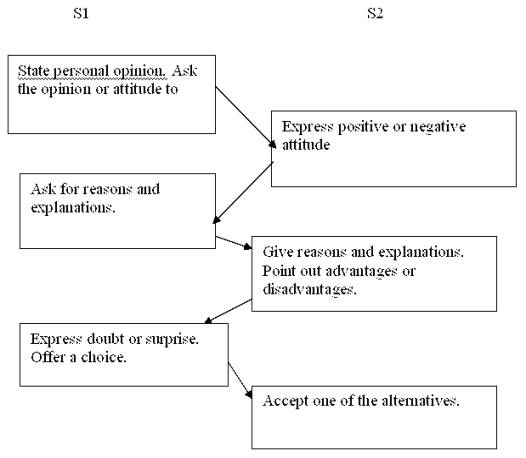
In teaching dialogue in schools it is necessary to take into account
these peculiarities and give pupils pattern dialogues to show what real
dialogues look like.
In
conclusion I would like to say that, dialogic teaching is an approach and a
professional outlook rather than a specific method. It requires us to rethink
not just the techniques we use but also the classroom relationships we foster,
the balance of power between teachers and taught and the way we conceive of
knowledge. Dialogic teaching is an approach and a professional outlook rather
than a specific method. It requires us to rethink not just the techniques we
use but also the classroom relationships we foster, the balance of power
between teachers and taught and the way we conceive of knowledge.
Bibliography
1.
Chastain, Kenneth. The Development of Modern Language
Skills: Theory to Practice. Philadelphia: Center for Curriculum
Development,1971.
2.
Rippa, S. Alexander 1971. Education in a Free Society,
2nd. Edition. New York: David McKay Company, 1971.
3.
Richards, Jack C.; Rodgers, Theodore S. (2001).
Approaches and Methods in Language Teaching (2nd ed.). Cambridge, New York: Cambridge University
Press.
4.
Rivers, Wilga M. Teaching Foreign Language Skills, 2nd
Edition. Chicago: University of Chicago Press, 1981.