Psychology and Sociology / 14.
Personnel management
Postgraduate student Ivanova A.А.
Russian
Presidential Academy of National Economy and Public Administration (Orel
Branch), Russia
Formation of a control system of corporate social responsibility of a
commercial bank in the Russian Federation: the human resource aspect
Corporate social
responsibility has a special place in the banking sector. Due to the increasing
crisis of banking systems around the world, the consequences of which have
spread to the global financial space, many banks have realized the need to
create a control system that can not only maintain the effectiveness of the
functioning of the banking system in the short term, but also to ensure its
effective development in the long term.
To do this, you must actively
put into practice the activities of banks principles of corporate governance
and corporate social responsibility that will systematize processes regulating
banking activity, regulate interaction with stakeholders to ensure effective IT
support management decision-making, improve information transparency of the
results of banking activities, to restore confidence in the banking system, to
ensure the implementation of the development strategy of the banking system.[1]
Social responsibility of a
commercial bank - is responsible for the bank's social results from management
decisions and banking through transparent and ethical behavior that contributes
to sustainable development (balanced social - economic development and
environmental protection, including health and well-being of society as a
whole, and clients, shareholders and staff in particular); takes into account
the expectations of stakeholders (partners, customers, employees); comply with
the applicable legislation and consistent with international norms of behavior
and international financial reporting standards; fully integrated into the
activities of the bank, is constantly used in internal and external relations,
aimed at increasing the efficiency of banking operations and quality control;
conducive to improving the reputation and image of the bank, building corporate
identity, enhance corporate culture and promotes social responsibility
institute of banking.
Accordingly, corporate
governance - a system and process relationships, as well as a set of
principles, rules and procedures of interaction between the owners
(shareholders), the board of directors, management and other stakeholders
inside and in the external environment of the company.
Thus, CSR is becoming a de
facto part of the corporate governance threading entire internal system of
management and external communications of the organization. And among the main
tools of social responsibility in corporate governance can be identified, at
least the following:
• Mission and Values, Code of
Ethics.
• The company's strategy,
including the goal of sustainable development (economic, environmental and
social).
• The concept of non-financial
risk management and stakeholder engagement.
• Activities on CSR and
sustainable development.
• Social (Sustainable
Development) reporting.
• Communication (PR, Internet
and Intranet, multi-sectoral partnerships).
Typically, the world's leading
companies create with their boards of directors, special committees on CSR,
sustainable development and risk management. Often these issues are also
committees for personnel and social policy.[2]
Formation of a control system
of corporate social responsibility in a commercial bank due to a number of
stimulating factors, among which the activity of civil society, increased
competitiveness, access to financing in the international market, risk, legal
requirements and the requirements of their parent banks (investors).[3]
In order to justify the
presence of CSR commercial banks select the subject and object of the system.
The subject of social
responsibility Commercial Bank acts directly the bank itself, performing
different roles: member of civil society, a service provider, employer,
investor, investment object, party competition, the participant social development.
The object of social
responsibility Commercial Bank has a complex structure, which can include
stakeholders and the objects of their interest:
1) the business structure
(employees of client companies, partners, investors, lenders, customers, competitors,
business community);
2) public authorities;
3) community (local community,
various social groups, community organizations, NGOs);
4) environment.
Based on the above, the
control system of social responsibility of a commercial bank in the general form
can be represented (figure 1):
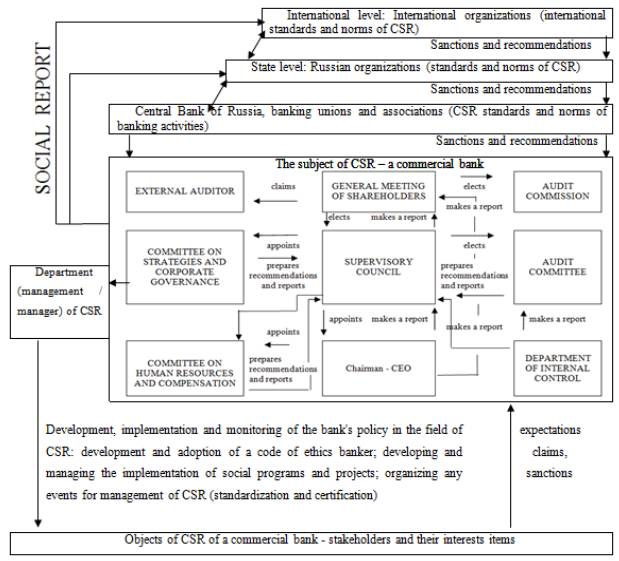
Figure 1 - The management
system of social responsibility Commercial Bank
As we can see, the system of
CSR in a commercial bank - a system based on constant interaction with the
bank's stakeholders.
Unfortunately, the problem of
formation of a control system of corporate social responsibility in the banking
sector has not yet become a subject of serious and in-depth study on the part
of researchers and professionals.
The effective functioning of
the banking system in Russia prevents the current state of the labor market. On
the market today there is practically no offer of free labor resources
necessary for many specialties, non-traditional planned economy (stock deal,
trust and leasing operations, audit, and so on), and the offer of ordinary
performers with an average level of training far exceeds the demand for them.
On the other hand, only in the stage of formation are structures that provide
the participants of the market a wide range of additional services - specialized
consulting firms, centers of professional selection and training, employment
services target.[4]
Rightly assume that the
support of CSR in the company are all its staff, without exception - from the
accountant to the director. But there are people who are engaged in the
activity of the company in this direction professionally. Despite the fact that
every year a growing number of educational institutions, introducing into the
curricula of social responsibility, the majority of staff in charge of charity
and philanthropy companies are "immigrants" from other disciplines,
such as marketing or human resource management.
The indisputable fact is that
the development and strengthening of CSR practices at Russian enterprises will
enhance the role of management in the activity of the modern economic entity.
Modern conditions of the economy became the basis for the establishment and
implementation of enterprise manager for CSR.
CSR Manager - is a specialist
who uses a creative approach to process management, and provides motivational
impact on workers. Currently, there is a shortage of facilities professionals
such as CSR Manager. In this context, issues relating to the role of manager of
CSR in the activities of a modern company is very relevant and timely.[5]
However, it is still
"difficult to talk about adequate perception of CSR manager. Necessary to
expand the range of public companies who build their activities according to
international standards, understanding the need for a professional approach and
focus on the implementation of CSR principles of structural divisions of the
company, embedding CSR in corporate governance on the part of senior
management. Then we can talk about real demand from the business community on
CSR manager". [6]
Despite the fact that every
year a growing number of educational institutions, introducing into the
curricula of social responsibility, the majority of staff in charge of charity
and philanthropy companies are "immigrants" from other disciplines,
such as marketing or human resource management. Experts believe that the ideal
applicant for this position must be visionary and be able to think
strategically, properly prioritize and formulate plans to communicate freely
with different categories of employees and target groups, motivate staff to
participate in social activities carried out by the company.[7]
Today, many banks have not
only strives to organize implement its social responsibility, but also commit
to engage its individual specialists. However, the "ready"
professionals in this field in the Russian market there is little, so the
responsible thing is trusted by professionals from other areas.
Russia is only beginning to
explore the experience of Western countries in the training of corporate social
responsibility. Despite the absence of this specialty in the registry, an
increasing number of universities and business schools, paying attention to CSR
and sustainable development. Among the leaders in this area can be named
MIRBIS, GSOM, Financial University under the Government of the Russian
Federation, HSE, MGIMO, Moscow State University, State University of
Management, European University at St. Petersburg, Moscow School of Management
Skolkovo.
General labor supply in the
banking sector is limited mainly by two segments: the market of graduates of
specialized educational institutions to meet the needs of employers in the
natural renewal of their personnel; market temporarily available workforce in
the face of professionally trained and have some experience in practice of bank
employees, including not only a relatively small direct unemployed as part of
the staff of other banks are not satisfied with their current position and
ready to change jobs.
Thus, the characteristic
features of the element of the labor market infrastructure are the obligatory
presence of vocational training at any level; consequent understanding of their
high social status and the corresponding requirements for the employer; full
understanding not only of purely professional functions, but also the specifics
of banking, consequently, additional obligations in relation to the employer;
conscious awareness of the need for ongoing professional development as the
only guarantee of a successful career.
Authoritative American
organizations FootprintTalent and WAP Sustainability, which specialize in CSR,
conducted a large-scale study to identify the ideal image of a specialist in
social responsibility. To this end, 254 were interviewed Director General of
the HR-departments and other top managers of leading companies.
The most important knowledge
that identified respondents are familiar with the methods of improving the
production process, such as LEAN and Six-Sigma, a basic understanding of
business development and sales process, skills and ability financial reports to
budget expenses, basic knowledge of environmental protection and public health.
Boston College Center for
Corporate Citizenship (BCCC) also identified a number of key knowledge and
skills, which should have a specialist in social responsibility. They were
treated: the ability to implement corporate citizenship, taking into account
social and business interests to get the value for both the company and
society, skills in building mutually beneficial and trusting relationships with
internal and external stakeholders, the ability to communicate within the
company and outside it, the ability to implement strategy through the
development of executive initiatives knowledge to establish and monitor the
implementation of short-term and long-term goals and performance indicators.
What else should be able to
'social' manager? To influence others, 59.1% of respondents believe, to
motivate others (39.8%), writing texts (38.9%), to manage the processes and the
time (32.5%).
What is really an expert on
corporate social responsibility? A detailed portrait of the manager creates all
the same BCCC. Thus, the majority of experts in CSR (93%) - came from other
industries, mainly from communications: 24.2% for the "native" is the
industry PR, to 22.6% - corporate communications, to 23.9% - Marketing.[8]
Thus, CSR Manager at a
commercial bank must have the above characteristics, which should be combined
with the personal characteristics of the banking professional staff members,
namely, as a rule, economic education, a high level of theoretical and
practical knowledge of banking, banking information technologies, sustainable
positive attitude towards profession and loyalty to the bank's corporate
culture.[9]
Thus, the formation of
corporate social responsibility implies that banks that accept the principles
of social responsibility, undertake to implement mechanisms of social
responsibility in their internal procedures and rules, and the management of
corporate social responsibility in a commercial bank is a complex multifaceted
process and requires the highest level of professionalism of bank employees.
At the same time, the
financial market in general, and mainly in the retail banking sector acute
shortage of qualified personnel, especially middle managers, which creates
additional obstacles to CSR management of commercial banks.
This problem takes time to
"growing" of specialists in CSR-oriented specificity of banking
activities, as well as on the establishment of the institute of CSR in Russia.
References:
1.
Corporate social responsibility in the banking sector. International
business magazine "Sustainable Business» http://csrjournal.com/korporativnaya-socialnaya-otvetstvennost-v-bankovskoj-sfere.
2.
Social responsibility in corporate governance. Portal "Business and
Society. CSR.
"http://www.b-soc.ru/theory-and-practice/materials/material/research/32
3.
The international environmental and social standards in
ensuring the social responsibility of financial institutions / L.P. Gulyaeva, J.S.
Tkachenko // Labour and Social Affairs. - 2010. - №10. p. 145.
4.
E. Balakireva. Problems of recruitment to a commercial bank //
"Personnel. Human Resource Management », N 9, September 2006.
5.
Ochnev M., A. Kazeeva, E. Batrakova. The role of the manager of
corporate social responsibility in the activities of a modern company. The
magazine "Kontentus." №1. - 2014. http://kontentus.ru/
6.
How to become a professional in the field of CSR. Portal
"Business and Society.CSR."http://www.b-soc.ru/theory-and-practice/materials/material/corpsocotv/85.
7.
Manager of CSR: What is it? Business e-journal in the field of CSR and
sustainable development "Sustainable Business»
http://csrjournal.com/3680-menedzher-po-kso-kakoy-on.html.
8.
Manager of CSR: What is it? Business e-journal in the field of CSR and
sustainable development "Sustainable Business» http://csrjournal.com/3680-menedzher-po-kso-kakoy-on.html.
9.
Social portrait of the banker. AA Ravens // Proceedings of the
Saratov University. 2013. 8. T. Ser. Sociology. Politics, vol. 1. p. 54.